Nigeria’s Minister of Women Affairs and Social Development, Hajiya Imaan Sulaiman-Ibrahim, has called on Member States of the Organisation of Islamic Cooperation (OIC) to reposition digital inclusion as a strategic driver of women’s economic empowerment.
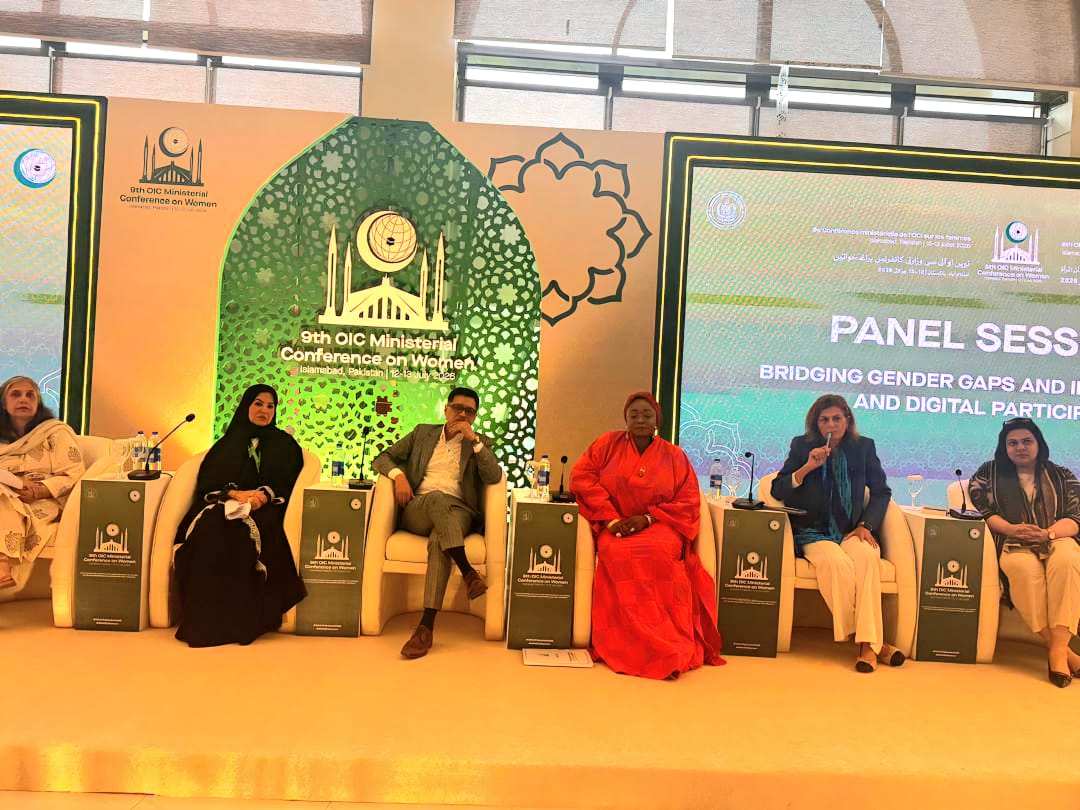
Championing the call during a high-level panel discussion on “Bridging Gender Gaps in Technology and Digital Participation” at the 9th OIC Ministerial Conference on Women in Islamabad, Pakistan, the Minister advocated that technology must translate into measurable gains in income, enterprise, financial inclusion and opportunity.
Speaking on the panel alongside the Minister of Social Welfare and Labour of Syria, Ms. Hind Qabawat; Executive Director (WDO), Counselor Sarah Al Shoura; Country Representative of UN Women, Mr. Jamshed M. Kazi; and Head of Business Management and Social Sciences, The Millennium Universal College, Dr. Sarina Zainab Shirazi; the Minister Setting out Nigeria’s policy direction said digital inclusion must extend beyond access to technology and become an instrument for sustainable economic advancement.
“Nigeria’s experience has shown that digital inclusion delivers the greatest impact when it is deliberately connected to women’s economic empowerment. For us, digital inclusion goes beyond access to a mobile phone, an application, or a training programme. It is about enabling a woman to convert technology into income, opportunity, safety, and influence.”
She stated that Nigeria’s approach is anchored on the Women’s Economic Empowerment Policy and the National Gender Digital Inclusion Strategy 2024–2027, which aim to bridge the gender digital divide by equipping women with practical digital skills while strengthening access to finance, markets, enterprise support, trusted information and a safe digital environment.
Highlighting implementation under the Renewed Hope Agenda of President Bola Ahmed Tinubu, the minister said:
“Under the Renewed Hope Agenda of His Excellency, President Bola Ahmed Tinubu, GCFR, we are translating these commitments into action through the Renewed Hope Social Impact Interventions–774, a national framework reaching all 774 Local Government Areas. A key component is RH Digital Harmony, through which digital inclusion is embedded across our interventions for women, children, and families, rather than being treated as a stand-alone technology project.”
The Minister emphasised that digital inclusion should be embedded within national women’s economic empowerment and development policies to ensure clear ownership, sustainable financing and accountability.
She urged OIC Member States to establish end-to-end pathways linking digital access and skills with finance, markets, employment and enterprise growth, stressing that progress should be measured by improvements in women’s incomes and opportunities rather than the number of people trained.
Calling for stronger regional collaboration, Minister Sulaiman-Ibrahim recommended greater knowledge exchange, shared standards, digital safety, public-private investment and scalable models across the OIC.
She also proposed an OIC Women’s Digital Economic Empowerment Compact to support measurable national targets that connect affordable digital access and practical skills with finance, markets, employment, enterprise development and leadership.
Reaffirming Nigeria’s commitment, she declared: “Nigeria’s goal is clear: to increase the number of women who can use technology to build sustainable businesses, access finance, reach markets, protect themselves and influence decisions. For us, digital inclusion is how women convert technology into income, opportunity, safety and influence.”
The 9th OIC Ministerial Conference on Women, themed “Socio-Economic and Political Empowerment of Women in the OIC Countries: Challenges and Way Forward”, is convened by the Government of the Islamic Republic of Pakistan through its Ministry of Human Rights, is ongoing in Islamabad, Pakistan.