


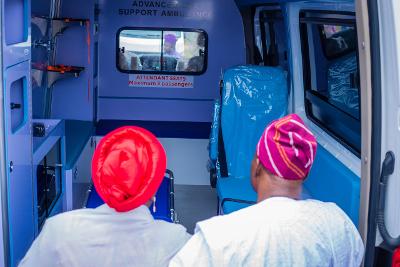
The Nigerian Government has deployed 13 ambulances to selected health facilities in Ogun State under the National Emergency Medical Services and Ambulance System (NEMSAS).
This would help in strengthening emergency response and reduce preventable deaths.
The Minister of State for Health and Social Welfare, Dr Iziaq Salako, disclosed this in Abeokuta, during the flag-off and distribution of Advanced Trauma Life Support (ATLS) and tricycle ambulances to health facilities in the state
Salako said the deployment comprised three Advanced Life Support (ALS) ambulances, one Basic Life Support (BLS) ambulance and nine tricycle ambulances.
READ ALSO:NDDC Donates Medical Equipment to Health Centre in Rivers
He explained that the vehicles were targeted at federal and state tertiary institutions, as well as selected high-volume and remote secondary and primary healthcare facilities.

The Minister said the intervention was part of a broader national acquisition of 145 tricycle ambulances, six boats, 15 BLS and 79 ALS ambulances, alongside laptops, printers and communication devices to strengthen emergency medical services nationwide.
According to him, the initiative reflects President Bola Tinubu’s commitment to improving emergency transport infrastructure, communication systems and state-level capacity under the Renewed Hope Agenda.
Salako said timely emergency care remained critical to preventing avoidable deaths and disabilities.
He noted that survival often depended on how quickly and effectively patients received appropriate care.
“Every day, precious lives are lost not because illnesses or injuries are beyond treatment, but because emergency care is delayed, fragmented, inaccessible, or entirely unavailable,” he said.
Salako also highlighted the impact of NEMSAS under the Maternal Mortality Reduction Innovation Initiative.
The Minister said the programme had provided more than 48,000 women with free emergency obstetric care and over 4,000 women with free caesarean sections in NHIA-empanelled facilities.
He said the intervention had contributed to a 17 per cent reduction in maternal deaths and a 12 per cent reduction in newborn deaths across 172 high-burden local government areas.
The Minister explained that the government was moving beyond ambulance provision to establish a coordinated emergency-care system connecting transportation, trained personnel, communication systems, referral pathways and definitive hospital treatment.
He, however, warned beneficiary institutions against misusing the ambulances, stressing that their effectiveness would be determined by their performance during emergencies rather than their presence at ceremonies.
Salako directed the beneficiary facilities to properly maintain the vehicles, deploy them according to emergency needs, use them exclusively for medical emergencies, provide trained personnel and ensure effective monitoring and accountability.
“Let me emphasise that these ambulances are not hearses for moving corpses or for going to the market to purchase goods, including drugs and other hospital consumables,” he said.
Maintenence Funding
He urged the Ogun State Government and beneficiary facilities to provide complementary operational and maintenance funding to ensure the sustainability of emergency medical services.
Salako further disclosed that the Nigerian Government was working with the legislative arm to address the fragmented regulatory framework governing first responders and emergency management in the country.
The Minister also raised concerns over alleged unprofessional practices, dereliction of duty and illegal collection of levies at the Federal Medical Centre (FMC), Abeokuta.
He said his office had received several complaints and encountered media reports alleging misconduct by some officials of the centre, stating that the complaints would receive “comprehensive attention.”
“Anybody found culpable will be sanctioned in accordance with the civil service rule in order to ensure that we sustain the confidence of the public in Federal Medical Centre, Abeokuta,” he said.
Salako urged health authorities, emergency responders and other stakeholders to work together to build an emergency medical system that is accessible, coordinated, equitable, resilient and sustainable
He said the ultimate goal was to ensure that emergency services reached Nigerians in time, strengthened public confidence and saved lives when every second counted.

, as part of efforts to strengthen emergency response and reduce preventable deaths.)