


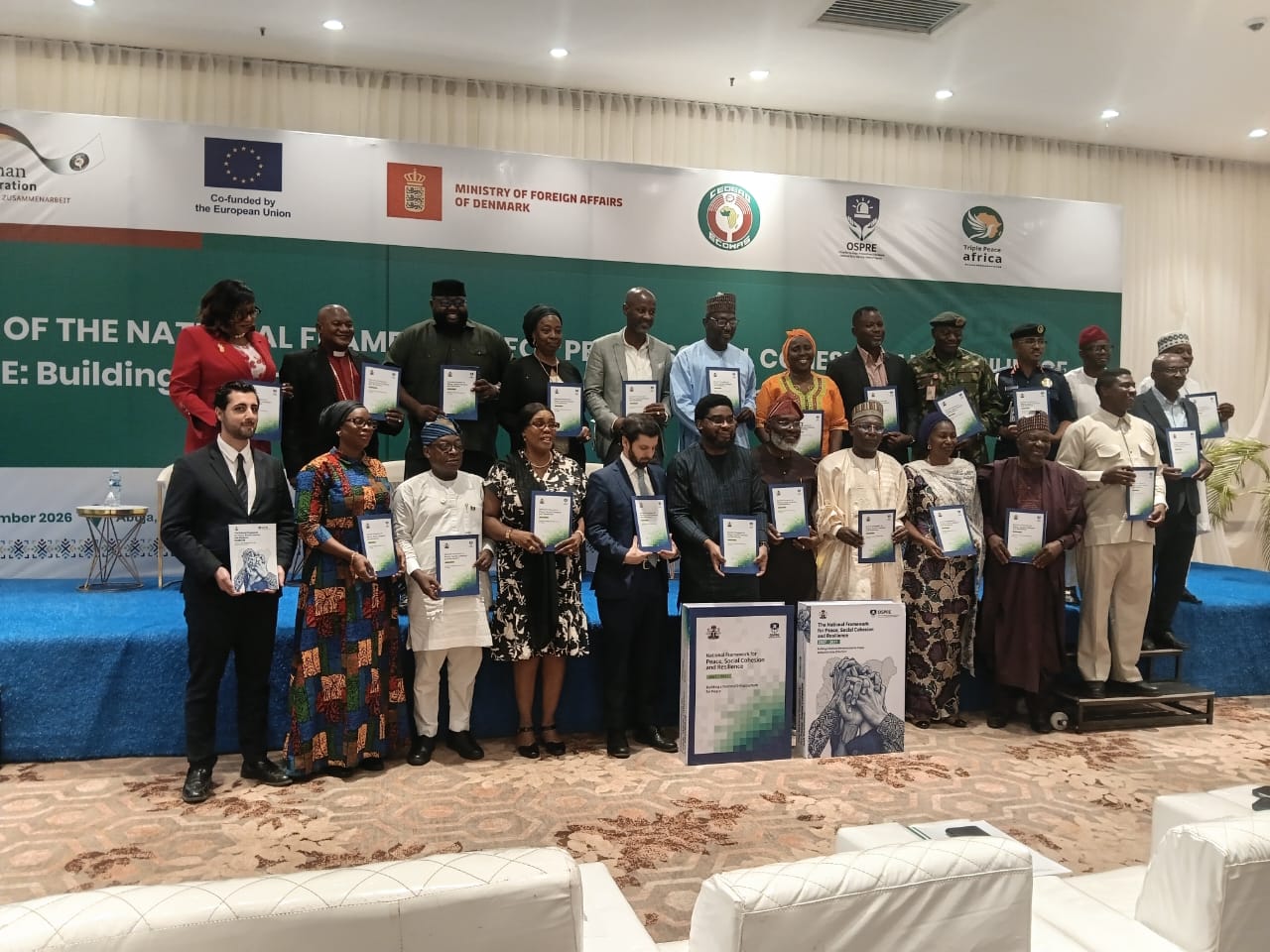
The Nigerian Government, through the Office of Strategic Preparedness and Resilience (OSPRE), in collaboration with Triple Peace Africa, has formally launched the National Framework for Peace, Social Cohesion and Resilience.
The development marks a significant milestone in efforts to strengthen Nigeria’s national infrastructure for peace and establish a coherent, collaborative approach to conflict prevention.
Developed through an extensive process of nationwide consultations, expert dialogues, technical workshops and stakeholder engagements spanning more than a year, the Framework represents a shared national doctrine and a consensus-based approach to addressing Nigeria’s increasingly complex peace and security challenges.
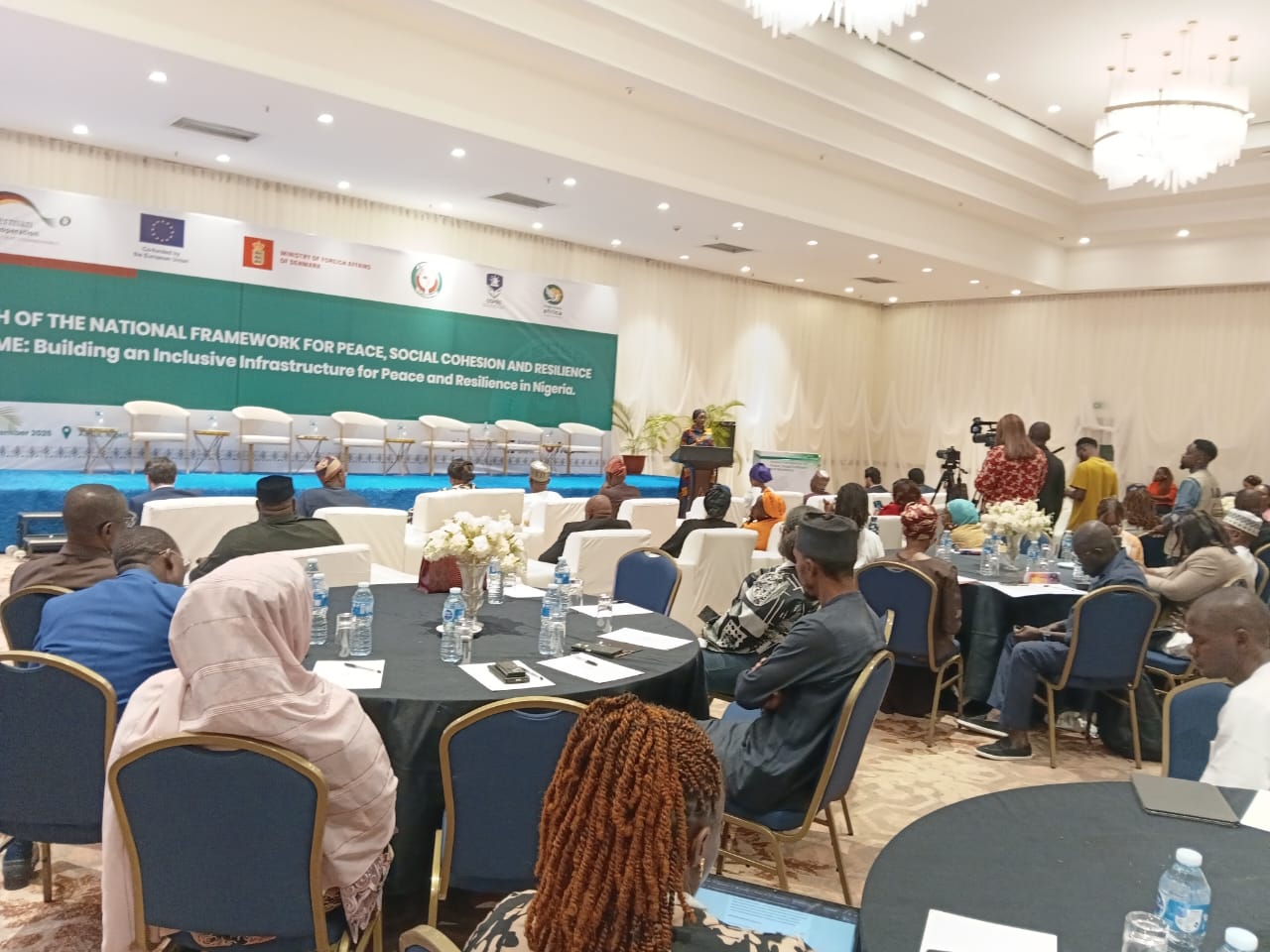
The development of the National Framework for Peace, Social Cohesion and Resilience was supported by the European Union (EU) and the Deutsche Gesellschaft für Internationale Zusammenarbeit (GIZ), whose technical and financial assistance facilitated the nationwide consultations, stakeholder dialogues and collaborative processes that informed its formulation.
The five-year framework, which will run from 2027 to 2031, is expected to provide a common strategic direction for conflict prevention, peacebuilding, social cohesion and national resilience, bringing together government institutions, civil society organisations and community stakeholders.
Speaking on the initiative, the Director-General of the Office for Strategic Preparedness and Resilience (OSPRE), Mr. Chris Ngwodo, said the framework was developed through extensive consultations involving federal ministries, departments and agencies, state governments, peace commissions, civil society organisations and other relevant stakeholders.

Mr. Ngwodo described the document as a shared national doctrine intended to harmonise peacebuilding activities and establish a common approach to addressing conflict and insecurity across the country.
He explained that the framework was informed by significant changes in Nigeria’s peace and security environment since the adoption of the 2012 National Peace Policy, including the emergence of new institutions, evolving conflict dynamics and the growing impact of climate change.
According to him, stakeholders had concluded that developing an entirely new framework was more appropriate than simply revising the existing policy, given the scale of changes in the country’s security landscape, saying, the new framework reflects a broader understanding of peacebuilding as a collective responsibility that cannot be left to a single government institution or level of administration.
“What has emerged from this process is a genuinely consensual document, one that has emerged through rigorous, painstaking consultation and dialogue across federal, state and local levels, as well as community and civil society organisations,” he said.
Mr. Ngwodo identified the strong emphasis on local participation and implementation as one of the major differences between the new framework and its predecessor, disclosing that implementation would begin at state level, with OSPRE working directly with state peace commissions and other relevant institutions to translate the framework’s objectives into practical action.
Mr. Ngwodo said the institutions involved in the development process were the National Boundary Commission, National Human Rights Commission, National Orientation Agency, Federal Ministry of Justice and the Nigeria Security and Civil Defence Corps.
The OSPRE chief said the participation of these institutions demonstrated the widespread nature of peacebuilding responsibilities, which extend across government agencies, civil society groups and community-based organisations.
“There is peacebuilding happening at federal level, at state level, at local level and at community level, driven by civil society. All of these are legitimate activities that have to be accommodated,” he said.
The development process was anchored by Dr. Paul Nyulaku, Executive Director of Triple Peace Africa, with stakeholders contributing to consultations and the formulation of the framework over more than a year.
Dr, Nyulaku said the framework was expected to strengthen institutional coordination, improve collaboration among peacebuilding actors and promote a more integrated response to the root causes of conflict, saying its implementation will also seek to build a shared understanding of national peace and security priorities while encouraging collective responsibility for creating a more peaceful, cohesive and resilient society.
The Director General of Boundary Commission, Mr. Adamu Adaji, who was represented by Dr. Farouk Tarfa said the framework would strengthen the commission’s efforts to promote effective boundary governance and cooperation among neighbouring communities.

He explained that the commission was responsible for defining Nigeria’s international boundaries, as well as boundaries between states, local government areas and communities, working in collaboration with the relevant state and local government authorities.
According to him, the framework would raise awareness about the importance of boundary definition and governance, while promoting inclusivity by ensuring that affected communities are involved in the process.
Dr. Tarfa noted that boundary-related issues had significant implications for national security and economic development, adding that the initiative would strengthen the commission’s work by bringing all relevant stakeholders on board.
Similarly, the Director-General of the Plateau State Peacebuilding Agency, Ms. Julie Sanda, said the national framework was developed through consultations involving stakeholders at federal, state and local government levels, as well as civil society organisations.
She expressed optimism that its implementation would not pose significant challenges, given the broad participation in its development.
She said Plateau State already had established structures that could be engaged to review the document and secure commitments from relevant stakeholders towards its implementation.
Ms. Sanda urged states to mobilise their respective stakeholders, raise awareness about the framework and ensure that organisations understood their clearly defined roles and responsibilities.
She said Plateau State already had established structures that could be engaged to review the document and secure commitments from relevant stakeholders towards its implementation.
Also speaking, a peace, security and governance specialist, Mr. Bayo Ishola Shupo, stressed the need to ensure that the framework benefited grassroots communities rather than remaining an initiative driven largely by elites.
Mr. Shupo identified community-based organisations (CBOs) as critical to its successful implementation, noting that despite their limited visibility and capacity, they maintained direct relationships and trust with local communities.

