

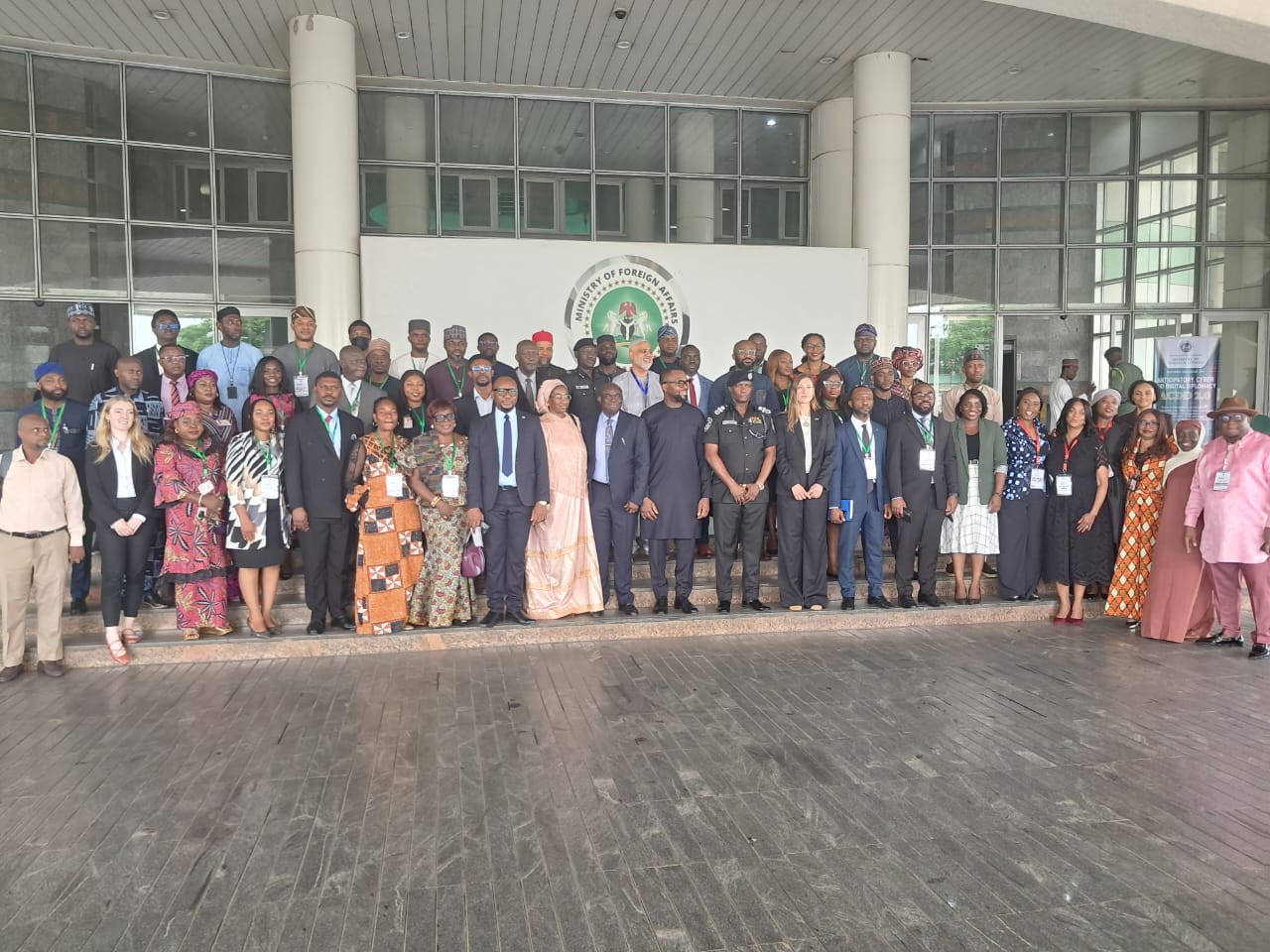
Nigeria has reaffirmed its commitment to strengthening cyber and digital diplomacy as emerging technologies continue to reshape global governance, security and international relations.
The commitment was made at the second edition of the Anticipatory Cyber and Digital Diplomacy Workshop organised by the Ministry of Foreign Affairs with support from the British High Commission.
Opening the seminar, the Minister of State for Foreign Affairs, Ambassador Sola Enikanolaiye, said the future of diplomacy would increasingly be shaped by information and communication technology and the ability of nations to adapt to evolving global dynamics.
READ ALSO: Nigeria’s External Reserves Hit 17-Year High at $52.5bn
Speaking on the theme, “From Awareness to Activation: Operationalising AI, Cyber and Digital Statecraft for Nigeria’s Foreign Policy,” the minister said the workshop builds on the success of the maiden edition, which led to the establishment of the Ministry’s Artificial Intelligence and Cyber Diplomacy Unit.
He said the unit would coordinate Nigeria’s engagement on emerging technologies and strengthen the country’s participation in global digital governance.
Mr. Enikanolaiye urged participants to focus on practical outcomes, stressing that “anticipatory diplomacy requires a shift from reactive approaches to proactive engagement.”
He noted that by embracing AI, cyber capabilities and digital statecraft, Nigeria would strengthen its diplomatic reach, enhance strategic communication and better advance its national interest.
Chairman of the African Union Cyber Security Experts Group, Abdul-Hakim Ajijola, said the workshop was designed to help Nigeria prepare for future technological developments rather than react to them.
“We are looking at artificial intelligence, quantum computing and drones. The questions Nigeria must ask are: how do we prepare, how do we take advantage of these technologies, and more importantly, how do we mitigate the risks they may bring?” he asked.
Ajijola noted that cyber diplomacy has become essential because conflicts increasingly begin in cyberspace before escalating physically, while digital diplomacy enables Nigeria to project its interests globally through digital platforms.
He disclosed that this year’s workshop builds on last year’s awareness campaign by focusing on implementation.
Minister of Communications, Innovation and Digital Economy, Dr. Bosun Tijani, described the workshop as timely, noting that digital capability is becoming a key measure of national influence.
He said Nigeria is already a digital leader in West Africa, with communications satellites, the region’s largest concentration of submarine internet cables and its position as a regional data hub.
“We’re a powerful nation in the digital space. Large technology companies have an interest in how we organise ourselves, while neighbouring countries also benefit from our investments in digital infrastructure,” the minister said.
Dr. Tijani also highlighted the Federal Government’s efforts to strengthen cyber security through a Ministerial Advisory Council on Cyber Security, the National AI Strategy, the newly approved National AI Trust and the Three Million Technical Talent (3MTT) programme, which he said has already trained nearly 300,000 young Nigerians.
Speaking on the sidelines of the event, Vice Chair of the African Union Cyber Security Experts Group and Professor of Law and Technology, Professor Nnenna Ifeanyi-Ajufo, said technology has transformed diplomacy beyond geographical borders, making it imperative for Nigeria to develop stronger institutional capacity in cyber governance.
“We mustn’t wait for crises and threats to come to our doors. We should anticipate them and develop policies that help Nigeria speak with the right voice when these issues arise,” she said.
Professor Ajayi urged African countries to harmonise their cyber security laws under frameworks such as the African Union’s Malabo Convention while safeguarding human rights online.
She stressed that governments must balance national security with freedom of expression, warning that cyber security measures should not be used to suppress press freedom or other fundamental rights.

