



Nigeria and the United Kingdom have reaffirmed their commitment to strengthening cooperation against misinformation, fake news and the growing challenges posed by artificial intelligence (AI) to credible electoral processes ahead of Nigeria’s 2027 general elections.
The Minister of Information and National Orientation, Mohammed Idris, disclosed this during a courtesy visit by the British High Commissioner to Nigeria, Peter Vowles, to his office in Abuja, where both officials discussed information management, public communication and the impact of emerging technologies on democratic processes.
Idris described the visit as a continuation of the longstanding relationship between Nigeria and the United Kingdom, noting that the engagement provided an opportunity to exchange ideas on the role of information in safeguarding the country’s electoral process.
READ ALSO: Information Minister Advocates Digital Innovation for Crisis Management

“The British High Commissioner’s visit, approximately eight weeks after assuming office in Nigeria, is an opportunity to understand the country’s information management efforts and explore ways of addressing shared challenges,” the minister said.
He identified misinformation, fake news and the misuse of artificial intelligence as major threats confronting Nigeria, particularly as the country prepares for future elections.
“The proliferation of fake news and misinformation has become a major concern for the government because of their potential to undermine public confidence in the electoral process. As he has told you, we have this issue of AI now, misinformation and fake news that threaten our electoral process. I think it is one of the biggest challenges we have as Nigerians now, the threat of fake news and misinformation and how that can be an obstacle to a credible election,” Idris stressed.
The minister said the Nigerian Government was working with international partners, including the United Kingdom, to address the challenge and ensure that information dissemination did not undermine peaceful and credible elections.
“We are working hard in conjunction with them, as we do with other countries and with other partners, to make sure that we have a smooth process for the electoral process,” he said.
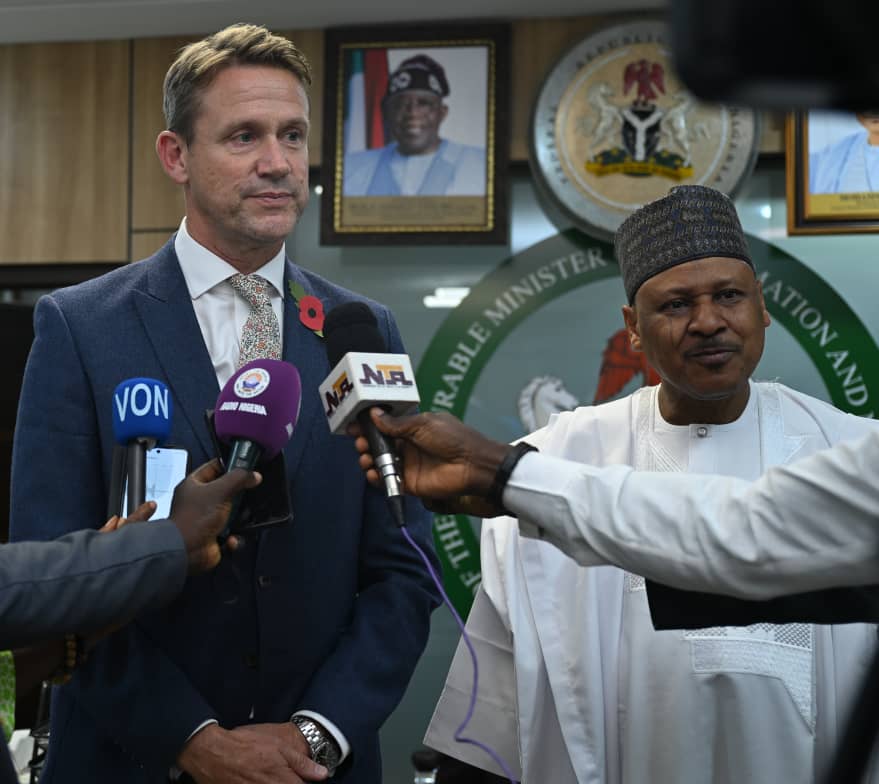
Speaking earlier, the British High Commissioner, Peter Vowles, described the visit as an opportunity to deepen relations between both countries and identify new areas of cooperation.
Vowles, who had been in Nigeria for approximately eight weeks, explained that the engagement was aimed at familiarising himself with the country’s information landscape and understanding the challenges both nations faced in communicating effectively with their citizens.
“It is a great opportunity to pay a courtesy call on the Honourable Minister of Information. As you know, I am the new British High Commissioner. I have been in Nigeria for probably about eight weeks, so this is a courtesy call to talk about the UK-Nigeria partnership, the relationship between the two countries and what we might do in the future,” he said.
He noted that the meeting also provided an opportunity to discuss the responsibilities of the Ministry of Information and National Orientation, particularly in addressing public communication challenges in an increasingly complex information environment.
“But, of course, given the Minister of Information’s brief, it is also a chance to talk about the information landscape in Nigeria and some of the challenges we ourselves face in the UK and Nigeria faces, and how we can work together to improve the way we do information and communicate with our citizens. So, a great courtesy call,” Vowles explained.
On Nigeria’s electoral process, the British envoy acknowledged the country’s sovereignty, describing the discussions on elections as an opportunity to understand how the Nigerian Government communicated with its citizens.
“Obviously, the elections in Nigeria are sovereign issues for Nigeria. So, we had a conversation about the electoral landscape, about how the Honourable Minister and the government of Nigeria communicate and how it tells a story to Nigerian citizens. That was for me just to learn, as I am learning about Nigeria, similarly to how we would do in the United Kingdom,” he said.

The High Commissioner further identified misinformation, particularly in the age of artificial intelligence, as a shared challenge requiring stronger international collaboration.
He explained that both countries faced difficulties in identifying and addressing false information, especially as technological advancements made it increasingly difficult to distinguish authentic content from fabricated narratives.
Vowles said the experiences of both countries could create opportunities for exchanging ideas and developing common approaches to tackling the problem.
“Well, often, we talked about some of the challenges both our countries face. Sometimes, one of the challenges is misinformation, and particularly how challenging that is in a world with AI, and how we can challenge AI or fake news stories.
“It is something that we ourselves face in the United Kingdom, and I understand is also something faced in Nigeria. So, that is the kind of area, the kind of thing we might be able to work more together on: shared challenges and how we have shared approaches to tackling these challenges,” he added.
The meeting highlighted the importance of sustained Nigeria-UK cooperation in promoting responsible information management, strengthening public communication and addressing the misuse of artificial intelligence and digital platforms to spread misinformation and undermine public trust in democratic institutions.

