


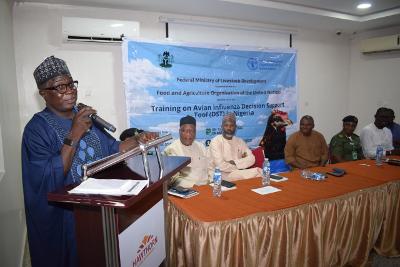
The Nigerian Government, in collaboration with the Food and Agriculture Organisation of the United Nations (FAO) and other stakeholders in the poultry value chain, has intensified efforts to prevent and contain Avian Influenza through the deployment of an Avian Influenza Decision Support Tool (AI-DST).
The initiative, being implemented under the Animal Mobility Intelligence Framework, ELEVATE, is designed to strengthen disease prediction, early warning, surveillance and preparedness across the country.
The Chief Veterinary Officer of Nigeria (CVON), Dr Samuel Anzaku, disclosed this on Monday, November 9, 2026, in Abuja, during the National Workshop and Training on the Avian Influenza Decision Support Tool.
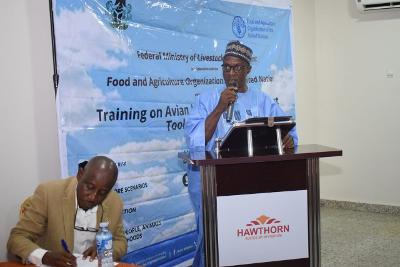
Anzaku explained that the tool integrates animal mobility indicators, community-based reporting, migratory bird flyways, market hotspots and risk scenarios to predict potential disease outbreaks, monitor their possible spread and assess their economic implications.
He disclosed that Kano and Lagos States had been selected as pilot locations for the initiative because of their high exposure to the disease.
According to the Chief Veterinary Officer, the deployment represents a shift from reactive disease control to proactive surveillance and prevention, enabling authorities to identify potential outbreak locations and take preventive measures before the disease emerges.
READ ALSO: Nigerian Government, FAO Intensify Avian Influenza Control
Anzaku, however, emphasised that the effectiveness of the predictive system would depend largely on the quality, consistency and timely submission of field data by relevant stakeholders.
He expressed concern over inconsistent reporting of bird mortality across states, warning that such gaps could undermine the accuracy of disease risk assessments.
The CVON consequently called for stronger collaboration among veterinary authorities, wildlife researchers, ecologists and ornithologists to improve monitoring of disease transmission at the wildlife-livestock interface.
He described the initiative as a practical demonstration of the One Health approach, noting that the tool would provide a comprehensive assessment of disease transmission risks involving poultry, live bird markets, wildlife and humans.
Anzaku further explained that identifying high-risk locations would require coordinated interventions beyond veterinary services, including environmental surveillance, improved market hygiene, effective public risk communication and human health monitoring.
He also urged stakeholders to embrace evidence-based findings from the risk assessments, stressing that appropriate interventions must be implemented wherever live bird markets were identified as potential centres of disease transmission.
While commending FAO for its technical support and investment through the ELEVATE project, TCP/NIR/4101, Anzaku called for the development of a Nigeria-specific decision support system that reflects the country’s ecological and epidemiological realities.
He identified an updated Avian Influenza Early Warning and Action Roadmap, clearly defined risk triggers, a validated map of the wild and domestic animal interface, and a proposal for a second phase of the project as key expected outcomes of the workshop.
Providing an overview of the disease burden, Anzaku disclosed that Nigeria recorded 1,096 outbreaks of highly pathogenic avian influenza between 2015 and 2023, with approximately 6.9 million birds exposed to the disease and more than 5.7 million birds culled.
Earlier, the FAO Country Team Lead for Livestock in Nigeria, Dr Otto Vianney, described the AI-DST as a newly developed predictive tool being introduced in Nigeria as a pilot initiative, with prospects for wider deployment across other countries in the region.
He noted that the initiative represented Nigeria’s first effort to deploy a predictive system capable of identifying potential Avian Influenza hotspots before outbreaks occurred, allowing authorities to implement timely preventive measures.
Vianney explained that the tool uses scientific data and risk analysis to identify areas susceptible to disease emergence and guide targeted interventions.
He stressed that, in the absence of vaccination against Avian Influenza, strengthening biosecurity measures ahead of anticipated outbreaks remained critical to containing the disease.
According to him, preventive biosecurity interventions should preferably commence about three months before anticipated outbreaks.
In her presentation on the ELEVATE project, the Senior Disease Ecology and Risk Modelling Expert and Project Coordinator at FAO Headquarters, Rome, Claudia Pittiglio, identified three major pillars of the initiative: wild bird mobility and the wildlife-livestock interface, market and trade mobility, and scenario analysis.
Pittiglio further explained that data analysis and phylogenetic studies had indicated possible multiple introductions of the H5N8 strain from different wetlands where wild birds interact with domestic ducks, highlighting the importance of monitoring migratory pathways and wildlife-domestic animal interactions.
In a goodwill message, the Executive Director and Chief Executive Officer of the National Veterinary Research Institute (NVRI), Vom, Plateau State, Dr Dashe Yakubu, acknowledged FAO’s sustained support for disease diagnosis and surveillance in Nigeria, particularly in addressing Avian Influenza and other transboundary animal diseases.
He called for stronger and sustained collaboration between the Institute and FAO to enhance the country’s capacity for disease prevention, early detection, diagnosis and control.
Other goodwill messages were delivered by representatives of the Ministries of Agriculture and Food Security, Environment, and Health and Social Welfare, as well as the Nigeria Centre for Disease Control (NCDC), Nigeria Agricultural Quarantine Service (NAQS), National Park Service (NPS) and the Director of Veterinary Services, Taraba State, among other stakeholders.
The stakeholders reaffirmed their commitment to strengthening inter-agency collaboration through the One Health approach to improve disease surveillance, enhance early warning systems, strengthen preparedness and contain the spread of Avian Influenza in Nigeria.
The four-day workshop brought together approximately 44 participants drawn from relevant government institutions, research organisations, the private sector and other stakeholders across the poultry value chain.
The initiative is expected to strengthen Nigeria’s disease intelligence and preparedness systems, protect poultry production and livelihoods, safeguard public health and support the Nigerian Government’s efforts to build a more resilient and productive livestock sector.

