
The Nigerian Minister of Finance and Coordinating Minister of the Economy, Taiwo Oyedele, has proposed the establishment of a specialised Commercial Dispute Resolution Tribunal.
This proposal is aimed at fast-tracking the resolution of business disputes.
Oyedele said this was needed as faster justice delivery is critical to attracting long-term investment and deepening Nigeria’s capital market.
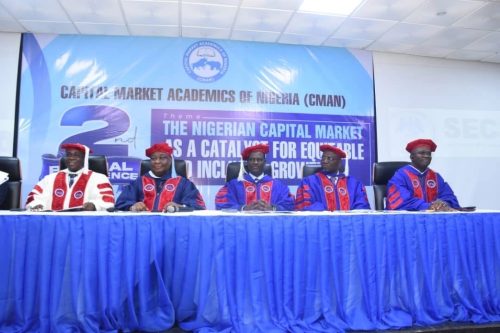
The minister made the proposal in his inaugural lecture as a Fellow of the Capital Market Academics of Nigeria (CMAN) during the association’s Second Biennial Conference in Abuja.
He said delays in resolving commercial disputes remained one of the biggest obstacles to investment, noting that cases currently take an average of 15 years to progress through the High Court, the Court of Appeal and the Supreme Court.
According to him, such prolonged litigation creates uncertainty, discourages investors and significantly increases the cost of doing business in Nigeria.

To address the challenge, the minister proposed a dedicated Commercial Dispute Resolution Tribunal staffed by judges and arbitrators with specialised expertise in commercial, financial and capital market matters.
Oyedele said the proposed tribunal should operate with digital case management systems and mandatory timelines to ensure swift resolution of disputes involving businesses, suppliers, joint venture partners and other commercial entities.
The minister explained that the proposed tribunal would also complement existing investment protection mechanisms by providing a more efficient avenue for resolving commercial disagreements that often delay investments and weaken investor confidence.

Borrowing for more development
Beyond judicial reforms, the minister further urged Nigerians to reconsider their long-held perception of public borrowing, insisting that debt should be judged by what it finances rather than by its size.
Oyedele argued that borrowing was not inherently harmful and should instead be viewed as a financial tool capable of supporting economic growth when channelled into productive investments.
“The relevant question is never simply how much debt there is. It is always debt for what, at what cost, against what return and repayable on what terms,” he said.
He criticised the tendency among analysts and commentators to condemn every instance of government borrowing without examining whether the funds are being invested in projects capable of generating sustainable economic returns.
According to him, governments and businesses that borrow to finance productive assets yielding returns above the cost of capital are making rational financial decisions, reaffirming that refusing to borrow under such conditions could amount to foregoing valuable development opportunities.
Wooing Investors
The minister also challenged the mindset of many Nigerian entrepreneurs who resist bringing in external investors in order to retain full ownership of their businesses.
He stated that owning 100 per cent of a small enterprise often creates less value than holding a substantial stake in a much larger and well-capitalised company.
Outlining what he described as the “seven laws of capital attraction”, Oyedele emphasised that investors are primarily attracted by trust, policy consistency, strong institutions and the rule of law rather than generous tax incentives.
“Capital hates uncertainty more than taxation,” he said, attributing investor hesitation to policy reversals, regulatory inconsistencies, foreign exchange uncertainty and weak contract enforcement,” he stated.
According to him, investors commit long-term capital to countries with credible institutions rather than to individual political leaders.
He identified an independent judiciary, a credible central bank and an efficient public bureaucracy as critical pillars for attracting sustainable investment.
The minister also urged government officials, professionals and the media to improve communication around economic reforms, stating that Nigeria often pays for what he described as a “perception premium” because positive policy changes are poorly communicated to investors.
Overall, he maintained that attracting long-term capital requires not only sound economic policies but also stronger institutions, policy consistency, efficient justice delivery and a shift in public attitudes towards debt and private investment.