
Mazino Dickson, Abuja
Organizer’s of the 2026 National Private Security Conference (NPSC) say security reforms and the creation of state police are welcome developments
To this end, they have unveiled plans for what they describe as a transformative national platform aimed at strengthening collaboration between government institutions, private security operators, technology innovators, and other stakeholders in Nigeria’s security sector.
The conference, scheduled for June 13, 2026, at the NAF Conference Centre, Abuja, will focus on the theme: “Building a Modern Security Ecosystem: Integrating Private Sector Capacity into Nigeria’s National Security Architecture.”
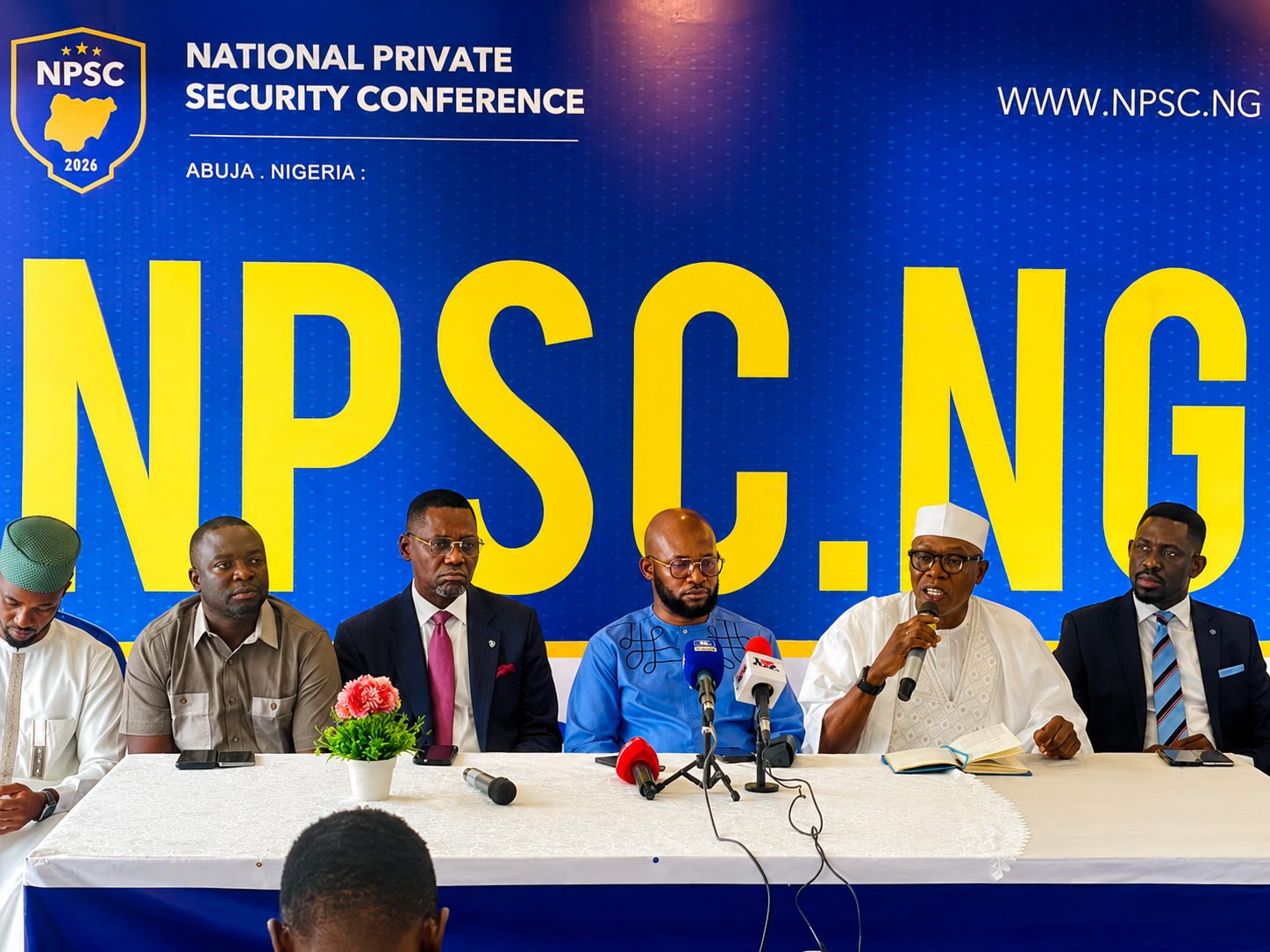
Speaking during the conference’s World Press Conference in Abuja, Convener Charles Awuzie said Nigeria’s evolving security landscape requires innovative thinking, stronger partnerships, and a coordinated approach to safeguarding lives, communities, and critical national assets.
Awuzie explained that the conference is designed as an independent and non-partisan platform that will foster dialogue, policy engagement, innovation, investment, and stakeholder collaboration across Nigeria’s broader security ecosystem.
According to him, the initiative is not intended to replace existing security institutions, regulatory agencies, or professional associations, but rather to complement ongoing efforts aimed at enhancing national security outcomes.
“The National Private Security Conference is a strategic forum designed to bring together those who share a common objective — a safer, stronger and more secure Nigeria,” he said.
Advancing Security Innovation
Awuzie noted that discussions at the conference will cover critical areas including security policy, intelligence integration, defence manufacturing, surveillance systems, artificial intelligence, security financing, cybersecurity, and emerging technologies shaping modern security operations worldwide.

He observed that contemporary security challenges increasingly require collaboration among governments, private sector operators, researchers, technology developers, investors, and local communities.
“The question before us is not whether collaboration is necessary. The question is how we can collaborate more effectively, more responsibly, and more strategically,” he stated.
Addressing ongoing national conversations on security reforms, Awuzie expressed support for discussions surrounding the establishment of state police and other initiatives capable of strengthening Nigeria’s security architecture.
According to him, the country must remain open to practical and lawful solutions that can improve security delivery and responsiveness at all levels of government.
“Let all possible avenues needed for addressing our national security be used. We must be willing to explore every lawful and effective option that can contribute to protecting lives, communities, and national assets,” he said.
Intelligence, Technology Key To Security Success
Co-convener and national security expert, Larry Pepple, stressed the importance of combining intelligence-driven operations with advanced technology to effectively combat insecurity across the country.
Pepple, who played a significant role in the Federal Government’s Amnesty Programme for repentant Niger Delta agitators, said community participation remains critical in intelligence gathering, crime prevention, and the disruption of criminal and terrorist activities.
He disclosed that several former Niger Delta agitators are already contributing positively within the private security sector and called for stronger legal and regulatory frameworks to maximise their expertise and effectiveness.
“Already, some key Niger Delta agitators are now playing key roles within the private security scene, but there is the need to streamline and strengthen the laws to make private security participation more effective,” he said.
Pepple further argued that technology-driven security operations would significantly improve the capacity of security agencies to neutralise threats while reducing risks to hostages and innocent civilians.
“If our security system is more tech-driven, it will be easier to take out criminals and terrorists without hurting hostages or kidnapped victims.”
He added that former agitators who have embraced peace possess valuable operational knowledge and local intelligence that can contribute meaningfully to national security efforts.
“For instance, the former Niger Delta agitators that are now involved in private security, they have already acquired arms-related knowledge, now having repented to become good citizens, they are more intelligent and resourceful, which is a major win for Nigeria’s national security architecture,” he opined.
Stakeholders To Shape Future Security Architecture
Chief Executive Officer of Barricade Executive Protection Limited, Ademola Adetuberu, said the conference is expected to attract senior government officials, military leaders, lawmakers, private security practitioners, investors, international experts, development partners, and technology innovators.
He described the conference as a significant shift in how security challenges are approached and managed, emphasizing the need for stronger collaboration between public and private actors.
Similarly, security research expert with the Tukur Buratai Research Center, Mohammed Abubakar, said the conference would focus on generating practical solutions capable of influencing policy development, strengthening industry growth, attracting investment, and improving security outcomes across Nigeria.
Abubakar noted that Nigeria possesses substantial institutional capacity, technical expertise, and human resources that can be better harnessed through enhanced coordination and stakeholder engagement.
Background
The National Private Security Conference 2026 is expected to be chaired by Nigeria’s Minister of Defence, General Christopher Gwabin Musa, and will bring together policymakers, military leaders, private security operators, technology innovators, investors, researchers, and development partners to deliberate on the future of Nigeria’s security architecture.
Organisers say the conference aims to deepen public-private partnerships, promote community-based security solutions, encourage investment in the security sector, and advance reforms capable of enhancing national safety, resilience, and sustainable development.
The conference is expected to culminate in a communiqué containing strategic recommendations for government, industry stakeholders, security institutions, and development partners on strengthening Nigeria’s security ecosystem and improving coordination among critical actors.


 2026 have unveiled plans to strengthen Nigeria's security architecture through public-private collaboration, technology, intelligence integration, and security reforms, including discussions on state police.)