
The Commandant of the Nigeria Security and Civil Defence Corps (NSCDC), Federal Capital Territory Command, Dr Olushola Odumosu, has urged public relations professionals to verify information before publication.
He warned that misinformation can trigger panic, endanger lives and undermine public confidence in security institutions.
Odumosu gave the charge in a presentation titled “Responsible Communication in a Security-Sensitive World: Practical Protocols, Verification Tools, and Trust Framework for PR Professionals” delivered at the October Monthly meeting of the FCT chapter of the Nigerian Institute of Public Relations.
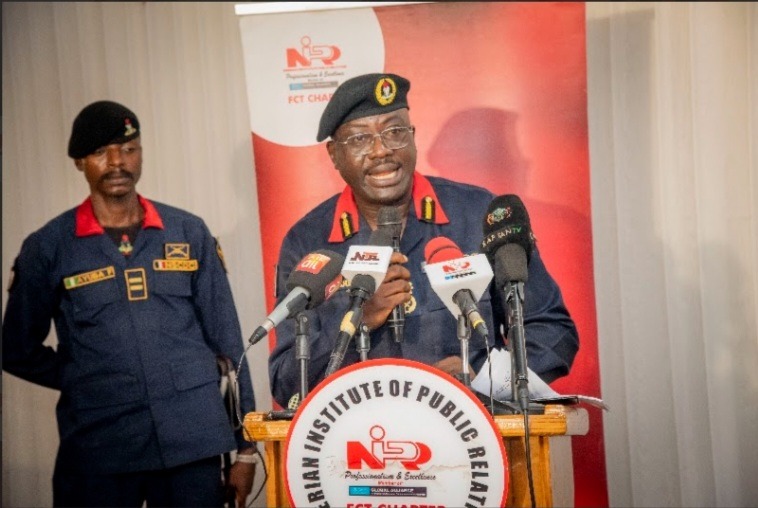
He said the speed of digital communication had made it possible for misleading reports to spread widely before institutions could establish the facts.
“We live in an age, where information travels faster than institutions can sometimes verify,” he said.
The commandant noted that photographs taken in one location could be misrepresented as incidents elsewhere, while old videos and unconfirmed casualty figures could circulate as breaking news, potentially exposing communities to danger and compromising security operations.
Responsible Communication
Odumosu said responsible communication which entails accurate, timely and transparent dissemination of information must take into cognisance the obligation to protect human dignity, national security, institutional integrity and public trust.
“Responsible communication is saying the right thing to the right people at the right time through the right channel based on verified facts,” he said.
He identified accuracy, truthfulness, timeliness, confidentiality, fairness and accountability as fundamental principles, urging practitioners to authenticate sources, distinguish confirmed facts from assumptions and correct errors promptly.
READ ALSO: NSCDC Urges Personnel to Uphold Neutrality Ahead of Elections
Using a hypothetical terrorist attack example, Odumosu cautioned against announcing unverified casualty figures or reporting an invasion before confirmation, explaining that such claims could provoke panic, misdirect residents and interfere with security operations.
He advocated measured public updates that acknowledge reports under investigation, provide appropriate safety guidance and commit to further information when facts are established.
Verification Tools
The NSCDC commandant urged public relations practitioners to employ digital verification tools, including Google Lens and TinEye for reverse-image searches, and InVID and WeVerify for examining online videos.
He also warned that artificial intelligence could generate convincing but fabricated images, audio recordings, videos and official-looking documents, making independent verification essential before publication.
Odumosu cautioned that silence during emergencies could create an information vacuum for rumours, stressing that institutions must communicate promptly without recklessly disclosing sensitive operational information.
He called for authorised communication channels, consistent institutional messaging and stronger coordination among security agencies, emergency-management organisations and health authorities through designated liaison officers.
Odumosu further urged practitioners to subject sensitive information to five tests: whether it was true, necessary, appropriate, clear and defensible.
“Trust is not secured by the volume of information we release, but by the reliability of the information we provide and the integrity within which we provide it,” he said.
He stressed that responsible communication must extend beyond institutional image management to support public safety, accountable governance and national cohesion.
“Let us verify before we amplify. Protect without concealing wrongdoing, inform without causing avoidable harm, and correct without delay,” he urged.