The Oyo State Government has commenced preparation of the 2027–2029 Medium-Term Expenditure Framework (MTEF) and trained top Civil Service leadership cadres on talent management and mentoring as part of efforts to strengthen governance, fiscal planning and institutional capacity.
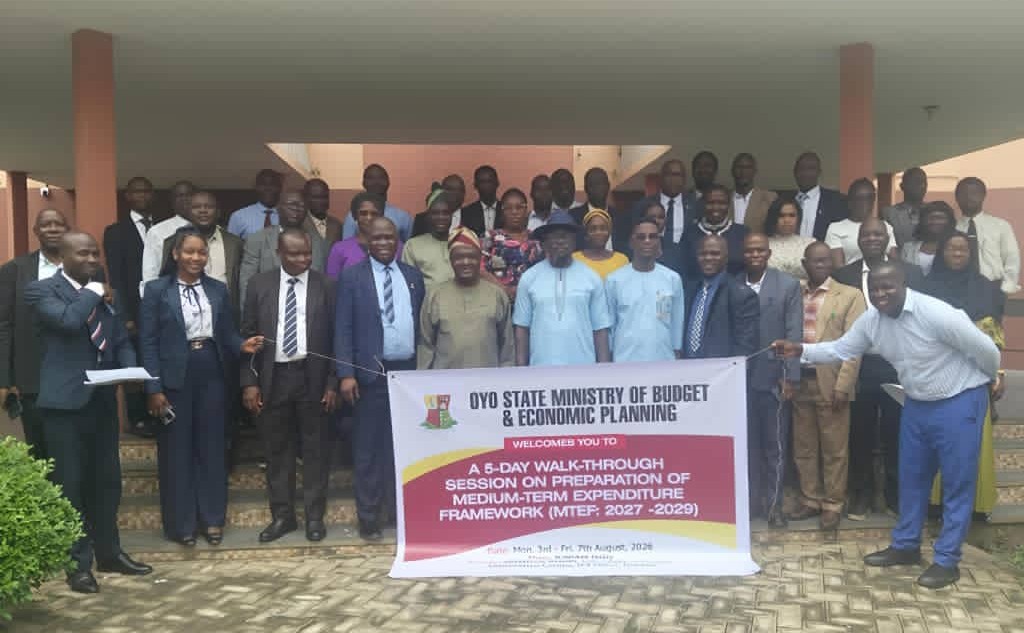
The Ministry of Budget and Economic Planning organised a five-day walk-through session on the preparation of the 2027–2029 MTEF, bringing together 60 participants from Ministries, Departments and Agencies (MDAs) responsible for planning, budgeting and finance.
The workshop, held at the University of Ibadan Conference Centre, aimed to build a common understanding of the MTEF process and equip participants with the technical knowledge required to prepare a realistic, credible and implementable medium-term budget framework.
READ ALSO: Oyo Assembly Moves to Strengthen School Security
Executive Assistant to Governor Seyi Makinde on Finance, Budget and Economic Planning, Ghafar Bello, who represented the Commissioner for Budget and Economic Planning, Ayobami Ojo, described the exercise as another milestone in institutionalising transparent, prudent and result-oriented budgeting in the state.
Bello said the MTEF remained a critical instrument for aligning government spending with policy priorities, available resources and the State Development Plan, noting that a credible framework provides the foundation for realistic annual budgets capable of delivering measurable development outcomes.
He explained that the workshop would deepen participants’ knowledge of revenue forecasting, expenditure planning, programme-based budgeting and fiscal sustainability, while ensuring that MDAs align their plans with the Roadmap for Sustainable Development (Omituntun 2.0) and Agenda 2040.
Bello urged participants to embrace transparency, accountability and realistic costing throughout the budget preparation process, adding that the technical session would produce realistic revenue projections, programme-based budgets, strengthened monitoring frameworks and draft expenditure ceilings for the 2027 budget.
The Lead Consultant, Dr Ayuba Onifade, urged participants to provide accurate and reliable data, stressing that the quality of the MTEF would depend on the credibility of information supplied.
In a related development, the state government trained 100 top leadership cadres across Ministries, Departments and Agencies on talent management and mentoring as part of ongoing efforts to transform the Civil and Public Service.
The two-day executive workshop, organised by the Ministry of Establishments and Training in collaboration with the American Open University, was held at the university’s Ashi-Bodija campus in Ibadan.
The training, themed “Talent Management and Mentoring as Panacea for Sustainable Institutional Development,” was designed to strengthen talent management, mentorship and succession planning within the Civil Service.
Represented by the Permanent Secretary, Career Management Services, Office of the Head of Service, Sunday Olagoke, the Head of Service, Mrs Adenike Fasina, said effective talent management was essential for sustainable institutional development.
She noted that strong succession planning guarantees continuity, prevents panic recruitment and addresses staff attrition within the service.
Commissioner for Investment, Trade, Cooperatives and Industry, Professor Saliu Adelabu, said the training would equip senior officers with the leadership and soft skills required to improve efficiency, mentor subordinates and enhance service delivery.
“We need to begin to identify talents within the service and deliberately develop them. More than 100,000 civil and public servants depend on the leadership of fewer than 150 senior officers. Talent development and mentorship must therefore become a priority,” Adelabu said.
Permanent Secretary, Ministry of Establishments and Training, Hameed Bello, described the workshop as a challenge to participants’ leadership capabilities and urged them to maximise the opportunity.
Participants commended the initiative, saying it would strengthen succession planning and support the state’s vision of becoming the fastest-growing economy in Nigeria.