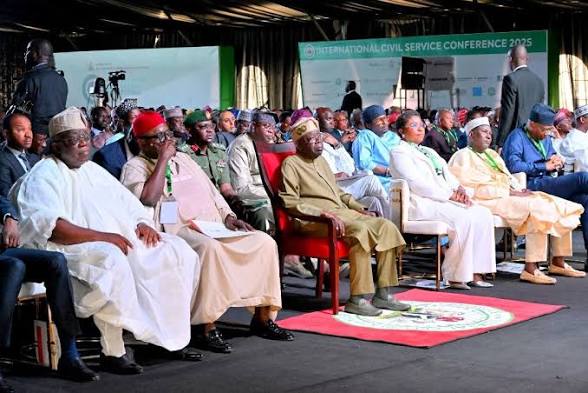
The Nigerian President, Bola Tinubu, has described the Civil Service as the engine room of national transformation.
President Tinubu stated this when he declared open the 2025 International Civil Service Week in Abuja, Nigeria.
Represented by the Secretary to the Government of the Federation, George Akuma, the President said that no policy, however sound, can succeed without a capable, disciplined and high-performing Civil Service to implement it.
READ ALSO: NITDA Advocates Use of AI for National Transformation
”The Nigerian Public Service has moved beyond plans and policy declarations. It has tested its systems against global economic pressures, domestic service demands and the urgent expectations of citizens. The results we see today speak to the resilience, commitment and adaptability of our workforce,” he stated.
He said bureaucracy must no longer be seen as a bottleneck but must serve as a bridge to efficiency, investment, innovation and inclusive growth.
According to him, with 38 Ministries and Extra-Ministerial Departments operating on a secure, paperless and end-to-end electronic workflow system, it is a clear message that Nigeria is building a public service that enables progress.
“This digital leap is being reinforced by the Personnel Audit and Skills Gap Analysis, which I authorised during the last Conference and which is now nearing completion. We are no longer relying on assumptions about our capacity; we are measuring it.
“We are identifying gaps, strengthening competencies and ensuring that the right people are placed in the right gaps, strengthening competencies and ensuring that the right people are placed in the right roles, equipped with the digital skills and professional discipline required for 21st-century governance,” he said.
President Bola Tinubu said under the Renewed Hope Agenda of his Administration, the government works for every Nigerian.
The Head of the Civil Service of the Federation, Mrs Didi Esther Walson Jack, said the service is deepening conversation on responsible artificial intelligence in governance.
“Our position is clear: AI must expand human capacity, not replace human judgement. It must serve citizens, especially the most vulnerable, not simply those already well-served,” she noted
She said that the architecture of the International Civil Service Week, 2026, is structured across eight stages – Aspire, Innovate, Activate, Accelerate, Accomplish, Rejuvenate, Transform, and Impact – as a deliberate progression, noting that they reflect the journey that genuine reform takes, from vision, through implementation, to making gains last and delivering lasting results.
“The three roundtables will tackle the future of work in the public sector, partnerships and collaboration as well as financing reform under fiscal pressure. These are not designed for comfortable consensus. They are designed to generate the useful friction that produces insight.”
“The Deal Room is our most consequential innovation this year. Stakeholders will not merely discuss partnerships; they will formalise them, with Legal Officers on hand, to support the signing of Memoranda of understanding.”
The 2026 Conference has in attendance sixteen nations; the United States, the United Kingdom, Switzerland, Singapore, Indonesia, Colombia, Ghana, The Gambia, Zambia, Algeria, Zimbabwe, Sudan, Iran, Ethiopia and the DR Congo.
The theme of this year’s conference is “Reforms, Resilience and Results”.