Nigerian President Bola Ahmed Tinubu has urged civil society organisations nationwide to take the frontline in safeguarding the credibility of the 2027 general elections, while directing the establishment of a quarterly government-civil society policy dialogue.
The President stated this at the 2026 Nigeria First National Civil Society Organisations Summit at the Bola Ahmed Tinubu International Conference Centre, Abuja.
President Tinubu pledged to protect Nigeria’s CSOs, while urging them to remain the “vanguard of democracy” through voter education, election monitoring and advocacy for reforms, as they work with the Independent National Electoral Commission, security agencies, judiciary and media to strengthen the electoral process.
Represented by the Secretary to the Government of the Federation, Senator George Akume, Tinubu said he had directed the SGF to establish a Quarterly Government-Civil Society Policy Dialogue Forum through which evidence-based advocacy and grassroots perspectives would feed into government policy design, implementation and evaluation.
READ ALSO: INEC Begins Online Media Accreditation For General Elections
The President also announced plans to widen opportunities for civil society participation in public finance transparency, budget tracking and monitoring of humanitarian interventions, while strengthening CSOs as partners in the localisation of the Sustainable Development Goals.
President Tinubu said the government would collaborate with the United Nations system, development partners and the private sector to provide civil society organisations with technical and financial support aligned with national priorities, including poverty reduction, youth and wome’s empowerment, health, education, climate resilience and peacebuilding.
The Nigerian leader informed the summit that the country was entering a new phase after what he described as three difficult years of economic reforms undertaken by his administration.
He said the reforms introduced from 2023 to stabilise the economy and dismantle what the administration considered unsustainable policy arrangements had caused difficulties for both citizens and government, but maintained that progress was becoming evident.
“Four years down the line, we wish to modestly assure Nigerians that Nigeria is moving from reform to prosperity,” the President said.
He said the next phase of the Renewed Hope Agenda would focus on rebuilding public trust, strengthening institutional accountability and ensuring that economic growth translates into social inclusion and improvements in citizens’ lives.
President Tinubu described civil society as the “conscience of the nation” and strategic co-creators of national development, recalling the role of civic groups in Nigeria’s return to democratic rule and their interventions in human rights, anti-corruption, social justice and poverty eradication.
He said the government alone could not deliver the prosperity agenda and cited Nigeria’s involvement in the Extractive Industries Transparency Initiative and Open Government Partnership as examples of collaboration between government and civil society.
The President also reaffirmed what he described as his administration’s commitment to freedom of expression, association, peaceful assembly and press freedom, while urging civil society organisations to develop a code of conduct that would reinforce ethical standards and accountability within the sector.
“Let your legitimacy be matched by credibility and your advocacy by credible patriotism,” Tinubu said.
He restated food security, poverty eradication through jobs and enterprise, improved governance and human capital development as four areas around which government and civil society should build stronger cooperation.
The President urged the groups to sustain their engagement with the government while retaining the independence required to hold public institutions accountable.
Minister of Budget and Planning Senator Isah Bagudu, in his remarks, said the government is willing to partner and dialogue with non-governmental organisations and civil society organisations because of their ability to interrogate and provide context to issues.
He urged the CSOs to partner with the government, as they are working to bring out potentials in each of the 8,809 wards recently mapped out across the country.
He said the mappings were about understanding what is everywhere and how to support the hard-working men and women to quickly restore the ecosystems in each of the wards and even build them as centres of prosperity.
“This cannot be done by the men alone. This requires a total society approach, where civil society organisations will understand the results, and take on the results, interrogate, adopt the wards, and guide us in how we can make life better in those wards.
“What is one of the biggest potentials for our country is that today there are millions of hard-working men and women who need support to quadruple their output,” he said.
The National Convener of the National Civil Society Organisation Summit, 2026 and the Director-General of the Civil Society Organisations on Community Advancement and Humanitarian Empowerment Initiative, CSCHEI, Ambassador Kunle Yusuff, said CSOs possess extensive grassroots information that could help the government identify emerging problems and design more responsive interventions.
Yusuff said CSCHEI was working with about 3,700 accredited civil society and community-based organisations across 485 areas, describing the network as a potential bridge between communities and government. According to him, the network provided access to community-level data and early-warning information that could support national planning and interventions.
“For too long, policy has been formulated for people without people,” he said, adding that the summit was proposing a sustainable partnership compact through which the government, civil society and the private sector could work jointly on national priorities rather than operating from positions of suspicion.
Yusuff said the proposed framework would provide a mechanism for monitoring government policies, budgets and electoral promises, while ensuring that information generated from communities reached relevant authorities.
“We are not here to complain. We are here to make a positive contribution that will make Nigeria a better place to live,” Yusuff added, noting that civil society leaders had previously submitted nine recommendations to the Presidency, with three already receiving government attention.
Yusuff, in the same vein, urged the private sector to align its corporate social responsibility programmes with national development priorities. He said civil society could provide community-level data and early warnings, and the government could provide policy direction and implementation, while the private sector could contribute resources and technical expertise.
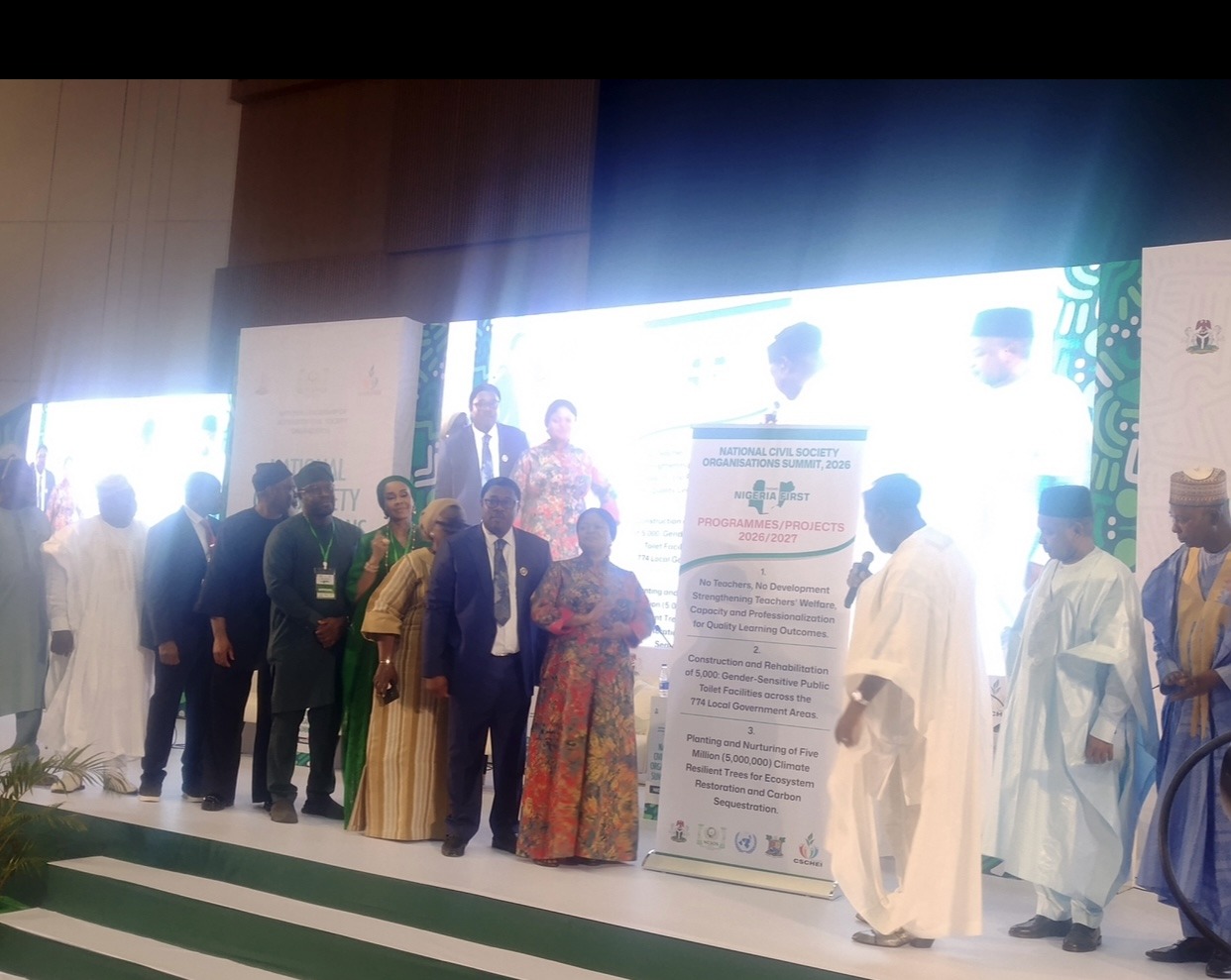
The Summit witnessed panel and technical sessions that dealt with politics, governance, elections, artificial intelligence, food security, and others, as well as the unveiling of the Nigeria First programme/projects 2026/2027