



President Bola Ahmed Tinubu says his administration will leverage renewed international confidence in Nigeria’s economy to create jobs, stimulate economic growth and improve the living standards of citizens.
The President said this would be done through increased foreign investment, access to long-term financing and accelerated infrastructure development.
In an article personally authored by the President, titled: “From Reforms to Delivery: Our Infrastructure Investment and Growth Strategy,” the Nigerian Leader stated that the international financial community had acknowledged the progress achieved through his administration’s economic reforms.
He noted that renewed investor interest, positive assessments by international credit rating agencies and improved access to global capital markets reflected growing confidence in Nigeria’s economic policies and strengthened financial credibility.
“The international financial community has delivered a clear and unprecedented convergence of positive signals on Nigeria. All three major credit rating agencies (S&P, Fitch and Moody’s) have taken positive rating actions, with S&P upgrading Nigeria’s sovereign rating and Fitch and Moody’s raising their outlooks to Positive, ” he said.
The President explained that the renewed confidence was also reflected in Nigeria’s improved standing among international financial institutions, including its restoration to Frontier Market status by FTSE Russell and removal from the Financial Action Task Force (FATF) grey list.
He said: “FTSE Russell has restored Nigeria to Frontier Market status, reopening its visibility to global institutional investors, while the FATF has removed Nigeria from its grey list, recognising progress in financial transparency and compliance. Nigeria’s successful Eurobond issuance, attracting strong international demand, further demonstrates renewed investor appetite for Nigerian sovereign risk.”
President Tinubu further outlined the specific credit assessments, noting that Fitch rated Nigeria B with a Positive outlook as of October 9, 2026, Moody’s assigned a B3 rating with a Positive outlook, while S&P upgraded the country’s sovereign rating to B with a Stable outlook on May 15, 2026.
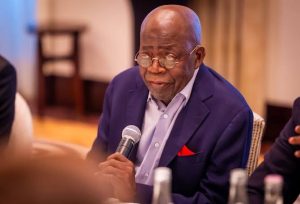
President Tinubu described these developments as independent assessments of Nigeria’s improving economic fundamentals rather than political endorsements.
He said: “Nigeria’s exit from the FATF Grey List in October 2025 and the EU list in January 2026 further supports improved financial transparency and compliance. These are not political endorsements; they are independent assessments by global rating agencies, index providers, regulators and investors, recognising stronger external reserves, improved macroeconomic management and greater financial credibility.”
President Tinubu noted that the improvements would expand Nigeria’s access to international capital, encourage greater investor participation and create opportunities for more competitive borrowing costs and longer repayment periods.
The Nigerian Leader noted that the international financial community increasingly regards Nigeria as a major infrastructure investment destination, with growing interest in financing roads, railways, electricity, water, agriculture, transportation and social infrastructure.
“The message from international investors, global banks and development institutions is unequivocal: Nigeria has undertaken the reforms; now is the time to invest, build and deliver at scale,” he stated.
He highlighted that the Nigerian Government must take advantage of the improved investment climate by translating international confidence into completed infrastructure projects and measurable economic benefits.
The President said: “Nigeria must seize this window of opportunity. The greatest risk is no longer simply the cost of borrowing, but the economic cost of failing to invest. Every year of delayed infrastructure means lost growth, higher logistics costs, missed investment and jobs that are never created. The international financial community is ready to support credible, bankable projects.”
President Tinubu further explained that the administration was restructuring Nigeria’s borrowing strategy by shifting from short-term financing towards longer-term debt instruments that correspond with the lifespan of major infrastructure investments.
He said international investors were willing to commit capital to Nigeria for periods extending beyond ten and fifteen years, reflecting confidence in the country’s long-term economic prospects.
The President disclosed that the Monetary Policy Rate was reduced by 350 basis points on September 22, 2026, from 26.5 per cent to 23 per cent, although lending rates remained above 30 per cent, reinforcing the need for more competitive long-term financing.
On the administration’s fiscal priorities, President Tinubu identified food affordability and energy price stability, budget harmonisation and fiscal discipline, completion of high-impact infrastructure projects, regulatory efficiency, and targeted household support and human development as key areas of intervention.
He maintained that the administration’s economic reforms were designed not merely to stabilise the economy but to establish the foundation for sustainable growth and long-term prosperity.
“At this point, it must be clearly stated that we did not undertake difficult reforms merely to stabilise the economy. We undertook them to unlock Nigeria’s economic potential and build lasting prosperity.”
The President further defended the administration’s borrowing strategy, explaining that public debt must increasingly be directed towards productive investments capable of generating lasting economic value.
“We are moving from borrowing to bridge fiscal gaps to borrowing to build the productive capacity of our nation. The key question is not how much we borrow, but what we build, the value we create and the future we leave behind. Although loans must be repaid, the roads, ports, railways and economic opportunities they finance can serve generations, ” he said.
President Tinubu emphasised that Nigeria’s ambition to build a $1 trillion economy would require infrastructure capable of supporting sustained industrialisation, increased productivity, expanded trade and employment opportunities over several decades.
He said: “We cannot build a $1 trillion economy with infrastructure designed for an economy a fraction of that size. We are investing in infrastructure for the next 50 years, and our financing strategy must reflect that ambition.”
On the economic benefits of infrastructure development, the President said investments in highways, railways, ports and electricity would improve connectivity between markets, stimulate industrial activity and strengthen Nigeria’s competitiveness in international trade.
He said: “We are building more than highways. We are opening economic corridors, connecting markets, supporting industries and reshaping Nigeria’s economic geography. The value of a road extends beyond the completed construction to the farms, factories, businesses and communities it connects.”
He stressed that infrastructure development would generate employment during construction while creating longer-term opportunities for businesses, industries and communities.
President Tinubu further stressed that the success of the government’s investment programme would be determined by the completion of projects and their measurable contributions to economic growth and citizens’ welfare.
“Securing financing is only the beginning. The real achievement lies in completing projects, delivering value for money, and improving Nigerians’ lives. Every Naira borrowed must be justified by the economic value it creates, and we must measure every project by its results.”
He reaffirmed his administration’s commitment to delivering transformative infrastructure projects while maintaining responsible public financial management.
“Our ambition is not simply to announce a large infrastructure programme, but to deliver projects that transform Nigeria’s economy. We must pursue our development goals with urgency while maintaining the discipline required for responsible public financial management, ” The President explained .
On Nigeria’s $1 trillion economy ambition, President Tinubu maintained that the target could only be achieved through sustained investment, increased productivity, industrialisation and trade.
“A $1 trillion economy will not emerge through declarations alone. We must build it through investment, higher productivity, industrialisation and trade. Nigeria’s greatest asset is its economic potential, and we must provide the infrastructure to turn that potential into prosperity. We are not borrowing against our children’s future. We must invest responsibly to expand opportunities available to them.”he said.
The President reiterated that converting renewed international investor confidence into productive investment, completed infrastructure and tangible economic benefits would remain central to his administration’s development agenda.

