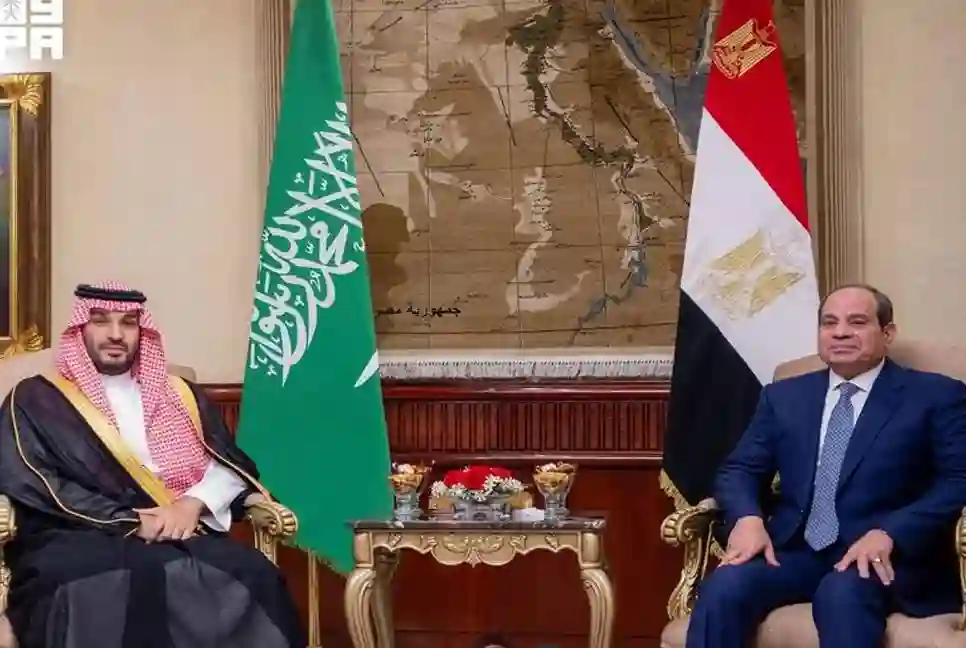
Saudi Crown Prince Mohammed bin Salman and Egyptian President Abdel Fattah al-Sisi have called for freedom and security of maritime navigation through the Red Sea and key regional waterways during talks in Cairo.
The two leaders discussed the security threat posed by Yemen’s Houthi movement and its control of areas around the Bab al-Mandab Strait, a key shipping route for Saudi oil exports and Egypt’s Suez Canal revenues.
The Egyptian presidency said the leaders called for “ensuring the freedom and security of maritime navigation” through the Strait of Hormuz and Bab al-Mandab, adding that Sisi affirmed Egypt’s support for measures taken by Saudi Arabia “to protect its security and stability.”
READ ALSO: Egypt, China Move To Strengthen Diplomatic Ties
The talks came as Saudi Arabia vowed to respond firmly to attacks by the Houthis, who have previously targeted shipping in the Red Sea.
The Bab al-Mandab, which links the Red Sea with the Gulf of Aden, is an important maritime route connecting the Indian Ocean with the Suez Canal and European markets.
The waterway has become increasingly important to Saudi oil exports after disruptions to shipping through the Strait of Hormuz during the Middle East conflict affected routes from the Gulf.
Since the Houthis declared a naval blockade on Saudi Arabia in July, the kingdom has relied more heavily on Egypt to export oil, chiefly through the Sumed pipeline.
Crude is transported from the Saudi Red Sea port of Yanbu to Egypt’s Ain Sokhna before being moved overland through the pipeline to the eastern Mediterranean at Sidi Kerir.
A recent drone attack, which Riyadh said was launched from Iraq, also forced the closure of the East-West pipeline that supplies Yanbu, contributing to a rise in global oil prices above 100 dollars per barrel.
Disruption to shipping through the Bab al-Mandab could also affect Egypt, which relies heavily on Suez Canal revenues as a source of foreign exchange.
Revenues from the waterway stood at 4.67 billion dollars in the 2025/2026 fiscal year, down from 8.8 billion dollars in 2022/2023.
Data analysed by AFP from the International Monetary Fund’s PortWatch platform also showed that average daily transits through the Suez Canal remained at little more than half their pre-Gaza war level.
Egyptian Foreign Minister Badr Abdelatty said last week that Cairo’s losses from the Suez Canal disruptions had reached 11 billion dollars.
According to Mirette Mabrouk of the Washington-based Middle East Institute, the Saudi Crown Prince would seek assurances from Egypt over its support for securing the Bab al-Mandab if necessary.
Mabrouk, however, said Cairo’s traditional preference for mediation meant it was unlikely to enter a military confrontation it considered avoidable or against its interests.
Africanews