Stakeholders on climate have called for stronger collaboration, responsible environmental practices and sustained public awareness to address the growing impacts of climate change in Nigeria.
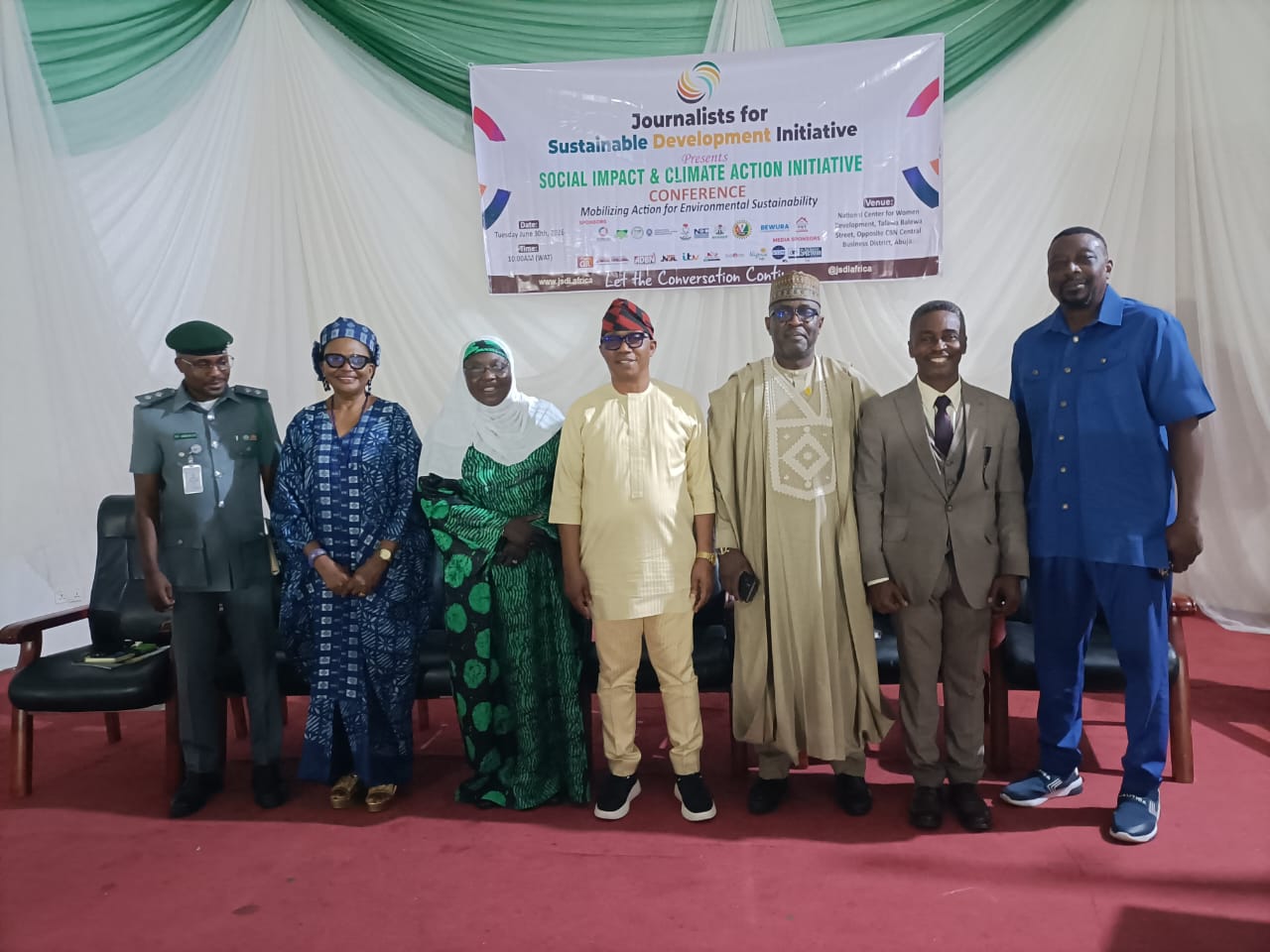
The call by climate experts, government officials, journalists and development partners was made in Abuja, Nigeria during the Social Impact Climate Action Initiative Conference 2026, organised by the Journalists for Sustainable Development Initiative (JSDI).
Speaking at the event, Executive Director of JSDI, Dr Parry Benson, said climate change is no longer a distant threat but a reality already affecting communities across Nigeria, making it imperative for citizens, institutions and governments to work together in protecting the environment.
He noted that while every individual generates waste in one form or another, the real challenge lies in how responsibly that waste is managed.
“Whether you are a truck driver, hotel owner, artisan, street hawker or industrialist, everyone has a responsibility to protect the environment. The actions we take today will determine the kind of world we leave behind for our children,” he said.
He described the conference as the beginning of a movement aimed at translating climate conversations into practical actions that will safeguard the environment for future generations.
According to him, JSDI was established to promote sustainable development through media advocacy, tree-planting campaigns and strategic partnerships with communities and like-minded organisations.
“The conference was convened to develop simple, practical and adaptable solutions that would encourage environmental preservation and promote sustainable living across the country,” he said.
Chairing the event on behalf of the Senior Special Assistant to the President on SDGs, Adejoke Orelope-Adefulire, Senior Technical Adviser, Dr. Bala Yunusa said the conference aligns with Nigeria’s commitment to achieving the 2030 Agenda for Sustainable Development.
He explained that the Sustainable Development Goals (SDGs) are built around economic growth, social inclusion and environmental sustainability, stressing that environmental protection remains central to achieving the global goals.
According to him, the government alone cannot deliver the SDGs, thereby making partnerships with civil society organisations, the media and the private sector indispensable.
“The journalists, as members of the Fourth Estate, have a critical role to play in advocacy, public sensitisation and building partnerships that will help accelerate the achievement of the Sustainable Development Goals,” he said.
The President of the Nigerian Institute of Public Relations, Dr Ike Neliaku, represented by Mrs Olubunmi Badejo, described climate change as one of the greatest threats facing humanity.
She urged journalists to leverage their platforms to educate the public, investigate environmental issues and champion solutions capable of reducing environmental degradation.
She also called on families to instil environmental consciousness in children by promoting proper waste disposal and discouraging indiscriminate littering, noting that behavioural change begins at home.
Assistant Superintendent of Customs and Liaison Officer, Nigeria Customs Broadcasting Network, Folusho Adeogun highlighted several climate-friendly initiatives introduced by the Customs Service, stressing that the agency has intensified awareness of the Federal Government’s Green Tax policy, introduced to promote environmental sustainability, reduce carbon emissions and encourage the adoption of cleaner vehicles.
“The policy forms part of broader fiscal reforms aimed at supporting Nigeria’s climate goals,” he said.
Adeogun added that electric vehicles, including electric motorcycles, currently enjoy zero import duty as part of government efforts to encourage cleaner transportation, while import duties on solar panels and other renewable energy technologies have also been reduced to make them more affordable for Nigerians. These incentives, he said, are intended to accelerate the country’s transition to cleaner energy and reduce dependence on fossil fuel-powered transportation.
Participants at the conference agreed that tackling climate change requires collective action from the government, media, businesses and ordinary citizens.
They urged Nigerians to adopt environmentally responsible lifestyles, dispose of waste properly, embrace renewable energy where possible and support initiatives that protect the ecosystem, stressing that safeguarding the environment is a shared responsibility that cannot be postponed.