
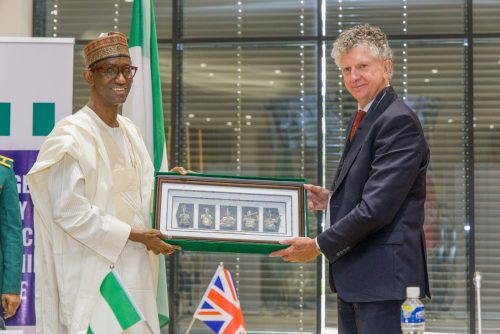
The United Kingdom and Nigeria have reaffirmed their commitment to strengthening bilateral cooperation on security and defence, especially in counterterrorism, cyber security, maritime security, defence capacity building, human rights, and the fight against fraud and illicit finance.
The commitment was contained in a joint communiqué issued at the end of the Fourth United Kingdom–Nigeria Security and Defence Partnership (SDP) Dialogue, held in Abuja, Nigeria.
The meeting, hosted by the Office of the National Security Adviser (ONSA), was co-chaired by Nigeria’s National Security Adviser, Nuhu Ribadu, and the United Kingdom’s National Security Adviser, Jonathan Powell. Senior officials from both governments participated in discussions covering regional and domestic security, hybrid threats, defence cooperation, counterterrorism, human rights, and financial crimes.
Both governments in the communique, agreed to deepen cooperation based on mutual accountability and delivery of commitments while working in a spirit of partnership.
“As part of the renewed defence cooperation, the United Kingdom reaffirmed its long-term support for Nigeria’s Armed Forces through military training, doctrine development, technical assistance, and enhanced capabilities to counter threats posed by improvised explosive devices (IEDs) and uncrewed aerial systems (UAS)”.
The two countries also pledged to strengthen maritime security in the Gulf of Guinea by aligning efforts to combat piracy, illicit maritime activities, and other transnational threats while exploring opportunities to expand defence trade relations.
On cyber security and hybrid threats, both governments agreed to establish a more structured framework for intelligence sharing and cooperation to combat cyber-attacks, foreign information manipulation, organised crime, and disinformation campaigns.
According to the communiqué, both countries committed to advancing a new structured framework for cooperation on countering hybrid threats in order to effectively counter mis/disinformation, cyber-attacks, transnational organised crime, and other hybrid threats, whilst upholding human rights and the rules-based international order.
“Counterterrorism remained a major focus of the dialogue, with both countries agreeing to strengthen intelligence sharing, multi-agency coordination, aviation security, forensic investigations, and crisis preparedness. The United Kingdom also pledged continued support for Nigeria’s National Counter Terrorism Centre and the expansion of the Multi-Agency Anti-Kidnap Fusion Cell across the country.
The communiqué noted that both countries: renewed their commitment to preventing violent extremism through non-kinetic approaches including Disarmament, Demobilisation and Reintegration (DDR) and implementing a comprehensive, whole-of-society approach to building sustainable peace.”
On human rights, both governments reaffirmed that civilian protection and accountability remain central to effective security operations.
“Nigeria and the United Kingdom reaffirmed the central role of human rights and non-kinetic approaches in achieving sustainable security outcomes. both sides agreed to deepen cooperation on civilian protection, conflict prevention, accountability, and the Women, Peace and Security agenda”.
The dialogue also addressed the growing threat of fraud and illicit financial flows. Both countries agreed to strengthen intelligence sharing, improve asset recovery processes, enhance oversight of virtual assets and cryptocurrencies, and coordinate law enforcement efforts against organised financial crime.
Regional security also featured prominently, with both governments expressing concern over the deteriorating security situation in the Sahel and reaffirming Nigeria’s leadership role in promoting peace and stability across West Africa through regional cooperation and multilateral engagement.
At the end of the meeting, both countries were tasked to implement the agreed action plans and review progress ahead of the fifth Security and Defence Partnership Dialogue, which will be hosted by the United Kingdom in 2027.
The communiqué was jointly endorsed by Nigeria’s National Security Adviser, Nuhu Ribadu, and the United Kingdom’s National Security Adviser, Jonathan Powell, underscoring both governments’ commitment to sustained engagement and practical implementation of agreed security priorities.

