The United Nations Children’s Fund (UNICEF) has urged northern Nigerian states to strengthen health, education and child protection services to end child marriage, warning that the practice threatens girls’ health, education and rights.
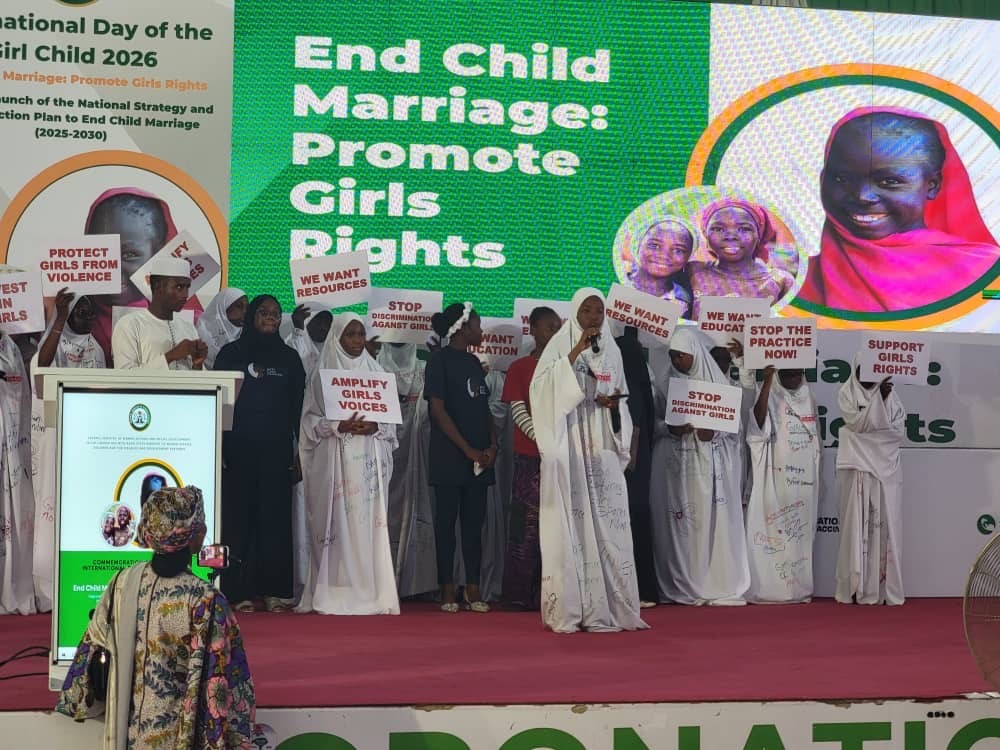
The Chief of UNICEF Field Office Kano, Mr Shafeeq Ur-Rehman, made the call on Tuesday at the 2026 International Day of the Girl Child and the launch of the National Strategy and Costed Action Plan for Ending Child Marriage (2025–2030), held at Coronation Hall, Government House, Kano.
Ur-Rehman explained that child marriage violates girls’ rights, disrupts their education and limits their opportunities, while exposing them to health risks associated with early pregnancy and inadequate access to essential health services.
READ ALSO: Oyo, UNICEF Partner to Boost Food, Nutrition Security
Citing the 2024 Nigeria Demographic and Health Survey (NDHS), he disclosed that about one in three young women nationwide were married before the age of 18, while the proportion was nearly one in two in the North-West and North-East.
He noted that child marriage prevalence stood at 74 per cent in Bauchi, 72 per cent in Jigawa, 69 per cent in Katsina and 39 per cent in Kano State, compared with the national average of 33.4 per cent.
According to the UNICEF official, addressing child marriage requires tackling poverty, gender inequality and harmful social norms, alongside strengthening healthcare, social protection and child protection services.
Ur-Rehman stressed the importance of keeping girls in school and ensuring that adolescents and their families could access appropriate healthcare and support services.
He also congratulated the Nigerian Government on launching the National Strategy and Costed Action Plan for Ending Child Marriage, covering 2025 to 2030, but emphasised that its success would depend on adequate funding and implementation.
“A costed plan must become a financed and implemented plan, reflected in state priorities, budgets, strong services and measurable results,” he said.
Ur-Rehman urged northern states to demonstrate sustained political commitment, increase domestic financing and strengthen health, education and protection systems to safeguard girls and improve their wellbeing.
He called for a future in which more girls complete school, no girl is married before the age of 18, and adolescent girls have greater opportunities to participate in decisions affecting their lives.
He reaffirmed UNICEF’s readiness to work with governments, development partners, civil society organisations and communities to ensure that every girl is protected, educated and empowered to fulfil her potential.