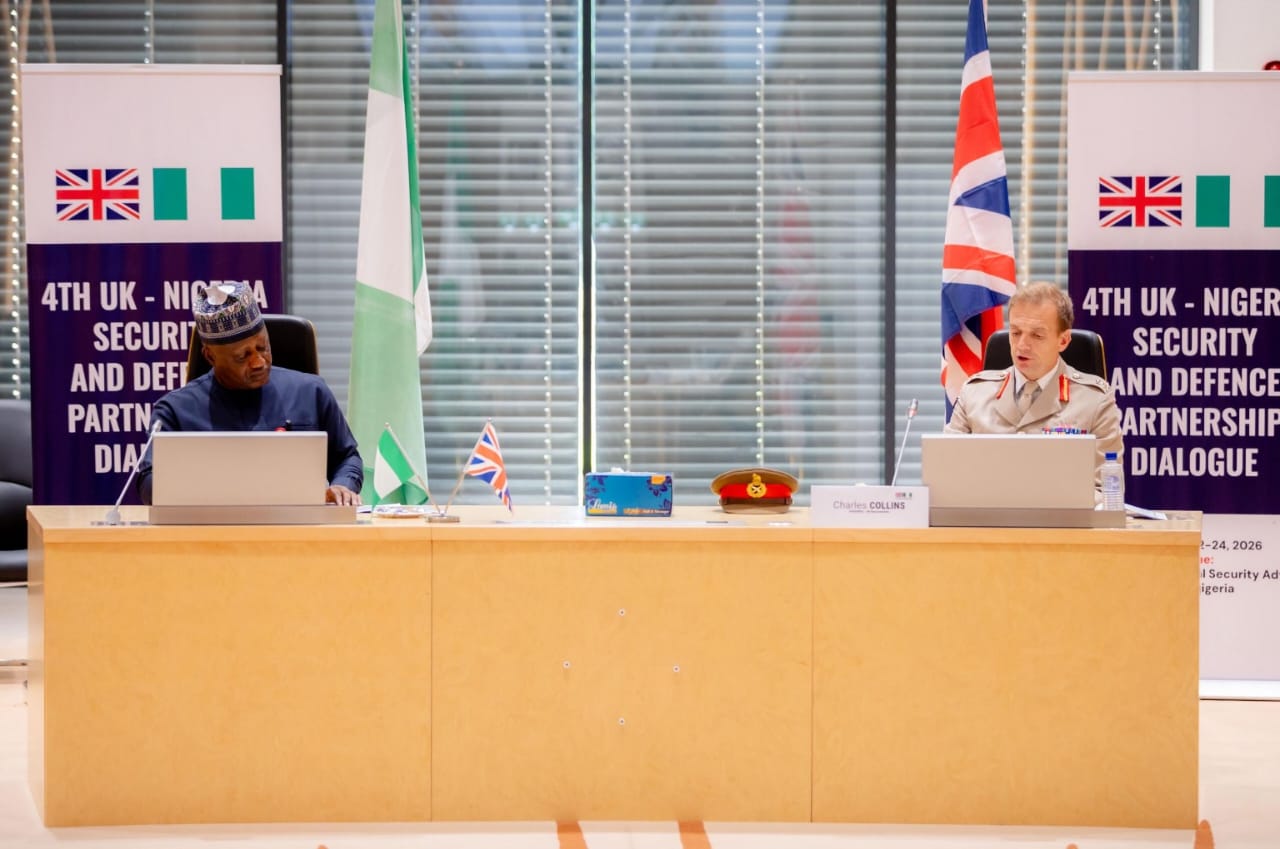
The Minister of Women Affairs and Social Development, Hajiya Imaan Sulaiman-Ibrahim, says the Security and Defence Partnership (SDP) remains a key pillar of bilateral cooperation, noting that women’s participation is essential to sustainable peace and security.
Presenting a progress report on the implementation of commitments of the Third UK–Nigeria Security and Defence Partnership Dialogue, with emphasis on strengthening the Women, Peace and Security agenda as a central pillar of national stability, the Minister reaffirmed Nigeria’s commitment to integrating gender perspectives into national and international security frameworks.
Addressing the Fourth UK–Nigeria Security and Defence Partnership Dialogue in Abuja, she stated that “it is now well established, in our national experience and in international practice, that the participation, protection and meaningful inclusion of women is not peripheral to security; it is central to it.”
She emphasised that the Federal Ministry of Women Affairs and Social Development
serves as the national coordinating institution for the implementation of United Nations Security Council Resolution 1325 and related frameworks, adding that commitments made under the Third SDP Dialogue are already yielding measurable progress.
According to her, Nigeria has developed and officially launched its Third National Action Plan on Women, Peace and Security, describing it as a major milestone in consolidating national efforts.
“The Plan was developed through a highly participatory, multi-sectoral process with the support of UN Women and the Government of Norway and was endorsed at the highest levels by His Excellency, President Bola Ahmed Tinubu; the leadership of the National Assembly; and the heads of our security agencies.” She said.
The Minister highlighted support from the United Kingdom’s Foreign, Commonwealth and Development Office through the Strengthening Peace and Resilience in Nigeria programme, which she said has enabled the domestication of the National Action Plan across seventeen states.
“SPRiNG demonstrates precisely the kind of institution-strengthening, non-kinetic partnership that the Security and Defence Partnership envisages, and it offers a tested model for extending the reach of the Plan.” She lauded.
Minister Sulaiman-Ibrahim further disclosed that security institutions, including the Armed Forces of Nigeria, the Nigeria Police Force, the Nigeria Security and Civil Defence Corps, and the Department of State Services, have adopted gender policies with monitoring frameworks, alongside the integration of gender training manuals into security curricula.
She noted that the ministry has also strengthened civilian peacebuilding structures, with “851 trained women mediators, with over 5,000 network members, actively engaged in peacebuilding across eight states.”
The Minister identified implementation challenges including inconsistent political will, limited funding, weak coordination and monitoring gaps, stressing that “The Third NAP has been deliberately designed to address these through gender-responsive financing, deeper legislative oversight, and strengthened coordination.”
She called for sustained international partnership, stating, “We invite the United Kingdom to help us build on the SPRiNG foundation to support the replication of this localisation model in additional states, to strengthen the National Secretariat and monitoring architecture that will sustain the plan, and to deepen technical cooperation on gender-responsive security sector reform.”
While thanking the United Kingdom, UN Women, the European Union, Norway and Germany, among others, for their steadfast support and Nigerian security institutions for their growing partnership, the minister reaffirmed Nigeria’s commitment to full implementation of its Women, Peace and Security agenda obligations under the Security and Defence Partnership framework.
“security is most durable when it is inclusive.” She emphasised