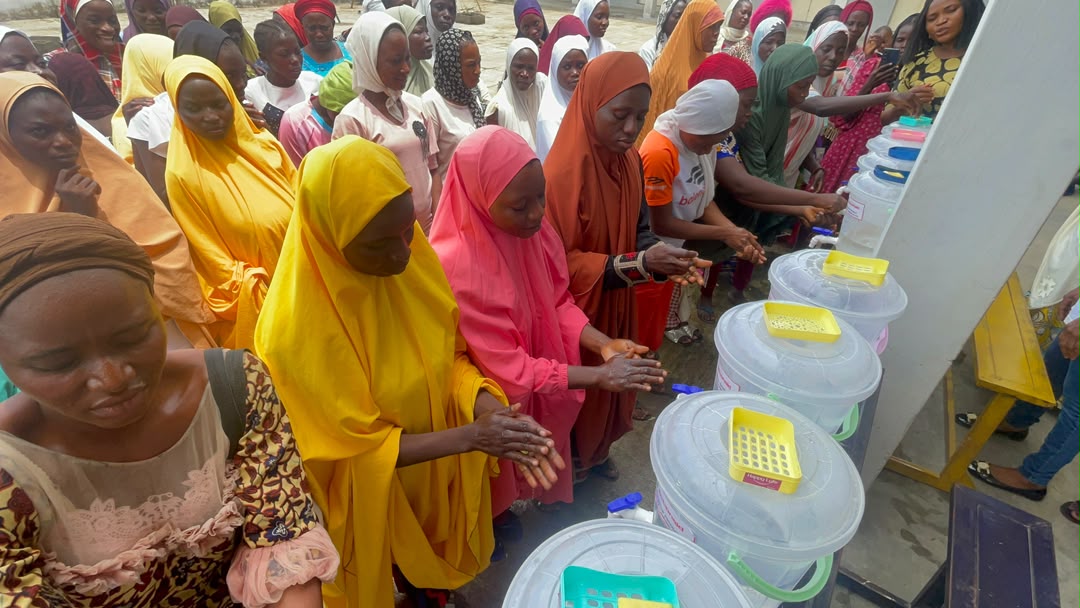
A women-led sanitation movement has commenced across 16 communities in Kundu Ward of Kwali Area Council, Federal Capital Territory, as part of renewed efforts to eliminate open defecation and improve hygiene practices at the grassroots level.
The intervention is being implemented under ThriveFlow, the women’s health, dignity and community resilience programme of the Resource Conservation Development Initiative International (RCDI).
It is supported by ActionAid Nigeria through the Renewed Women’s Voice and Leadership–Nigeria Project, funded by Global Affairs Canada, and implemented in collaboration with the FCT Rural Water Supply and Sanitation Agency (FCT RUWASSA).
The programme, titled “Supporting ODF Attainment in Kwali through Women-Led Community Mobilisation,” seeks to mobilise women as agents of change in promoting sanitation awareness, encouraging consistent toilet use and fostering healthier behaviours within households and communities.
The intervention comes at a critical time when government institutions and development partners are intensifying efforts to improve sanitation standards and accelerate the attainment of Open Defecation Free status across communities in the Federal Capital Territory.
Women have been deliberately placed at the centre of the campaign because of their significant role in household water management, sanitation, hygiene, childcare and menstrual hygiene.
Their regular engagement with families and other community members also positions them to influence behaviour and strengthen community ownership of sanitation initiatives.
Speaking during a training programme for women community champions in Kwali, RCDI Programme Officer, Ms. Mary-Jane Ukaegbu, said “the intervention was designed to empower women to take ownership of sanitation advocacy and drive positive behavioural change at the community level”.
According to her, women are uniquely positioned to influence hygiene practices within families and communities, making them strategic partners in efforts to end open defecation and improve public health outcomes.
She explained that the project focuses on supporting ODF attainment in Kundu Ward through women-led mobilisation, household sanitation education, menstrual hygiene awareness, community monitoring and increased local ownership of hygiene initiatives.
Ms. Ukaegbu said that engagement activities had commenced with women leaders and other stakeholders from the 16 participating communities.
She added that “80 women would be trained and organised into groups to conduct intensive house-to-house sensitisation and household follow-up activities across the ward.”
The trained women will serve as community sanitation champions, taking key messages directly to households and encouraging residents to use toilets consistently, wash their hands at critical times, maintain clean surroundings and abandon open defecation practices.
The intervention also incorporates menstrual hygiene education under RCDI’s ThriveFlow programme, recognising that safe menstrual hygiene is an important part of public health, dignity and women’s participation in community life.
Reusable sanitary pad kits are expected to be distributed to selected women and adolescent girls as part of efforts to improve access to safe menstrual hygiene products, reduce recurring costs and strengthen knowledge of proper use, care and maintenance.
Also speaking, the WASH Coordinator of Kwali Area Council, Mrs. Aminat Dada, commended RCDI, ActionAid Nigeria, FCT RUWASSA and other partners for supporting ongoing sanitation and hygiene improvement efforts within the Area Council.
She noted that the Area Council had implemented several community sensitisation activities aimed at encouraging households to construct and use toilets, saying that the women-led intervention would complement and strengthen the work already being carried out.
According to her, Kundu Ward is one of the ten wards in Kwali Area Council, and the involvement of women as sanitation champions will play an important role in advancing the council’s objective of attaining Open Defecation Free status.
Sanitation Knowledge
Mrs. Dada described the intervention as timely and expressed optimism that it would accelerate progress by strengthening women’s sanitation knowledge, leadership and capacity to influence household practices.
She urged traditional leaders, community representatives and residents to support the women champions, embrace improved sanitation practices and ensure that the gains achieved through the intervention are sustained.
One of the participants, Mrs. Ruth Abu, Women Leader of Sadaba Community, said the training provided valuable lessons on personal hygiene, environmental sanitation and disease prevention.
She explained that participants were educated on the importance of regular handwashing, maintaining clean surroundings and adopting healthy habits that can prevent diseases associated with poor sanitation.
Mrs. Abu pledged to take the knowledge gained back to her community and mobilise residents to adopt healthier sanitation and hygiene practices.
READ ALSO: Kwara Government Launches Anti-Open Defecation Campaign
The programme is being delivered as a one-month intensive intervention, with continued community follow-up, learning and progress documentation expected beyond the initial implementation period. A broader progress review may also be conducted around World Toilet Day on 19 November 2026.
Stakeholders believe the women-led approach will strengthen sanitation advocacy, improve household hygiene practices, enhance menstrual health and dignity, and contribute significantly to the attainment of Open Defecation Free status in Kundu Ward.