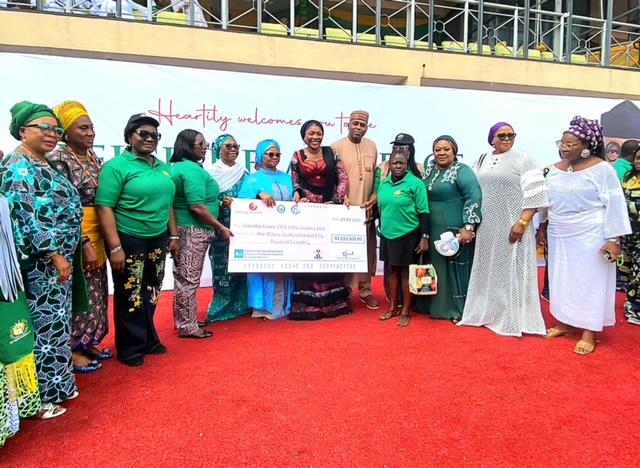
The Minister of Women Affairs and Social Development, Hajiya Imaan Sulaiman-Ibrahim, has flagged off the disbursement of the Community Investment Fund (CIF) to Affinity Groups in Ijebu-Ode, Ogun State.
The Minister said Women Affinity Groups in Ogun State have collectively saved N2.692 billion and disbursed N4.006 billion in loans among members.
She said the figures underscored the economic potential of organised women and the need for government to provide catalytic support to expand their enterprises.

“These figures tell an important story. They demonstrate that women at the grassroots are not waiting to be empowered; they are already organising, saving, investing and building enterprises with the resources available to them.”
READ ALSO: Ogun Launches Free Health Insurance Scheme For Pregnant Women
According to her, Ogun has established 5,394 Women Affinity Groups comprising 127,105 members across seven Local Government Areas and 3,489 communities.
Sulaiman-Ibrahim said the N6 billion Community Investment Fund would provide eligible groups with resources to expand businesses, strengthen enterprises, create employment, increase household incomes and stimulate local economies.
“This Fund will provide eligible Women Affinity Groups with resources to expand their businesses, strengthen their enterprises, create employment, increase household incomes and contribute to the growth of local economies.”

She said the intervention aligned with President Bola Ahmed Tinubu’s Renewed Hope Agenda and its emphasis on inclusive economic growth, social protection and women’s empowerment.
“Our objective is clear: women must not merely be beneficiaries of development; they must be active participants and drivers of Nigeria’s economic transformation.”
She also called for stronger linkages between Ogun women and opportunities under the Renewed Hope Social Impact Interventions–774, including PowerHer 774, WAVE, Digital Harmony, Happy Woman Platform, WRIC and WINGS.
To the beneficiaries, she said, “this opportunity belongs to you, but its impact must go beyond you.”
She urged them to grow their businesses, create jobs, increase savings and use their collective strength to open opportunities for other women.
Also speaking, Senior Social Development Specialist at the World Bank, Michael Ilesanmi, said the Fund would help women tackle collective challenges beyond the capacity of individual enterprises.
“Today is more than the launch of a community investment fund. It is about putting resources behind a simple but powerful idea: when women are organised, connected to finance, markets and institutions, and given the opportunity to invest collectively, they can transform not only their own households, but also their communities.”
He said women were “investors, entrepreneurs, producers, employers, consumers and community leaders.”
He said the Community Investment Fund would help address constraints such as inadequate processing facilities, storage, equipment, aggregation, transportation and market access, enabling women to make investments that create economic opportunities collectively.
The National Project Coordinator, Nigeria for Women Programme Scale-Up (NFWP-SU), Hajiya Hadiza Maina, says the Community Investment Fund (CIF) disbursement to Women Affinity Groups (WAGs) in Ogun State will strengthen women-owned enterprises, increase incomes and build more resilient livelihoods.
Commending the Ogun State Government, World Bank, Federal Ministry of Women Affairs and Social Development, State Project Coordinating Unit, FPCU, LPIUs, community leaders, facilitators and other development partners for their roles in advancing the programme, she urged beneficiary groups to manage the fund collectively and transparently, invest it productively, maintain accurate records and ensure that decisions reflected the collective interest.
She said the fund was expected to help women strengthen existing businesses, expand productive activities, add value to local products, access markets and improve household welfare.
Maina, however, said the ultimate measure of the initiative would be its impact beyond the disbursement itself. “As we flag off this disbursement, let us remember that the real success of CIF will not be measured by the amount disbursed today, but by what these resources produce tomorrow: stronger enterprises, increased incomes, jobs, improved household welfare and more resilient communities.”