The Minister of Works, Senator David Umahi, has directed contractors handling the ongoing Trans-Sahara Highway project to minimise the demolition of houses and other properties along the road alignment.
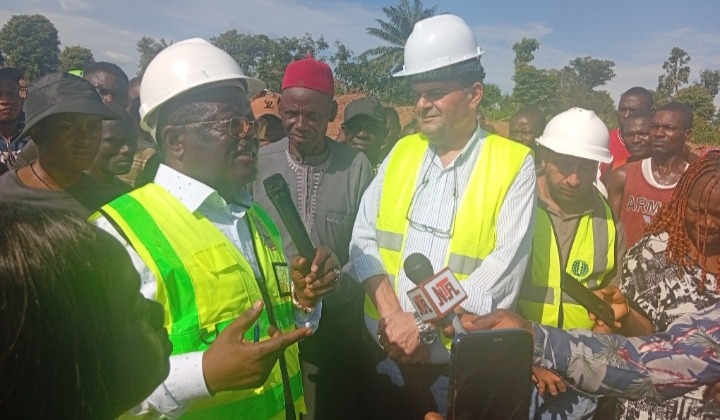
Umahi gave the directive during an inspection of the Federal Government’s Trans-Sahara Highway project at the weekend, assuring residents and other stakeholders that the government was committed to delivering the strategic road infrastructure while minimising its impact on host communities.
The minister explained that Section One of the Trans-Sahara Highway covered approximately 123 kilometres from the Ebonyi axis to the Ebonyi-Benue boundary, while Section Two extended about 173.4 kilometres through parts of Benue, Enugu and Kogi states to the Benue River and Nasarawa boundary.
According to him, the combined length of the two sections was approximately 300 kilometres and, at a design speed of 100 kilometres per hour, the completed highway would substantially reduce travel time and enhance connectivity across the affected regions.
He said the project would have far-reaching economic implications for the South-East, North-Central and South-South regions, particularly through the strengthening of agricultural supply chains, facilitation of trade and expansion of commercial activities.
Umahi further noted that improved road infrastructure along the corridor would contribute significantly to security by enhancing the movement of security personnel and improving connectivity between previously isolated communities.
The minister said that Section One, currently designed as a single carriageway, would subsequently have a second carriageway designed to integrate with other legacy infrastructure projects of the Tinubu administration.
READ ALSO: Kaduna Builds Ultra-Modern Public Transport Terminal
He said that an approximately 8.9-kilometre bypass around Afikpo and onward to the Timbershed area would be dualised as part of the broader intervention.
Expressing satisfaction with the commitment of the contractor handling Section Two, Umahi said the Federal Government remained committed to completing the project despite financial constraints arising from the volume of road infrastructure projects being executed across the country.
Speaking during the inspection, a Stakeholder of Ndiagu Ishieke Community Chief Idenyi Agbo, commended the Federal Government for the ongoing construction, describing the project as a demonstration of responsive governance and a major intervention capable of transforming the economic fortunes of communities along the corridor.
Eze Agbo particularly eulogised Umahi for applying his engineering expertise, administrative experience and sensitivity to the cultural heritage of host communities in the execution of the project.
The Project Manager of Section Two of the Trans-Sahara Highway, Rabih Munayer, said the contractor was implementing directives issued by the Minister of Works to minimise property damage and avoid unnecessary demolition along the road alignment.
Munayer said Section Two covered approximately 173.4 kilometres, subject to adjustments arising from the ongoing design review.
“This is Section Two of this major superhighway,” he said, explaining that the section traverses parts of Benue, Enugu and Kogi states before terminating at the Benue River and Nasarawa boundary.
He said the contractor would deploy additional pipes and temporary measures, particularly during the rainy season, to maintain trafficability and facilitate construction activities without unnecessarily disrupting communities.
The community stakeholders also declared their support for APC candidates “from top to bottom” in the 2027 elections, stressing that people would continue to identify with administrations whose policies and projects had tangible impacts on their lives.
The inspection underscored the Federal Government’s renewed focus on major road infrastructure as a catalyst for economic integration, with community leaders along the corridor expressing optimism that the completion of the Trans-Sahara Highway would significantly transform the socio-economic landscape of the affected areas