
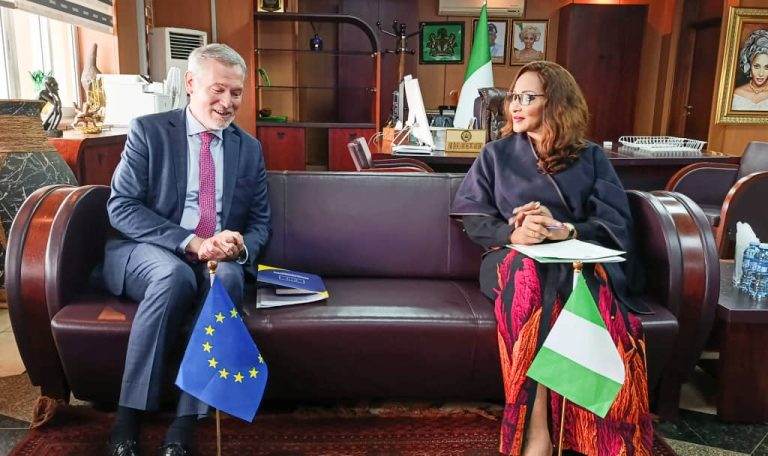
Nigeria and the European Union have reviewed ways to deepen bilateral cooperation in democracy, migration, security and sustainable development, with both sides reaffirming the importance of sustained diplomatic engagement.
The Minister of Foreign Affairs, Ambassador Bianca Odumegwu-Ojukwu, and the EU Ambassador to Nigeria and ECOWAS, Gautier Mignot, discussed these in a meeting at the Ministry of Foreign Affairs headquarters in Abuja.
According to a statement by the Ministry’s Spokesperson, Oluwafemi Adeniyi, the meeting focused on Nigeria’s forthcoming 2027 general elections, developments in West Africa, migration and mobility, security, multilateral cooperation, sustainable development and preparations for high-level Nigeria-EU engagements.
On democracy and elections, the two diplomats underscored the importance of “inclusive, peaceful, and credible electoral processes” in promoting democratic stability in West Africa.
READ ALSO: Reverse Migration: Vice Chancellors Call for AI-Ready Universities
Mignot briefed the Minister on the EU’s engagement with the Independent National Electoral Commission, INEC, and disclosed that the bloc would deploy an expert mission, rather than a conventional electoral observation mission, for Nigeria’s 2027 general elections.
He also said the EU would sustain its support to INEC, the media, civil society organisations, political parties and the National Assembly in strengthening electoral processes and democratic institutions.
The EU Ambassador stressed the importance of “electoral inclusivity, voter education and adequate preparations for elections,” including ensuring accessibility for persons with disabilities and strengthening public confidence in the electoral process.
Cooperation on Migration
On migration, both sides reviewed cooperation on migration management, combating human trafficking, legal migration pathways, returns and readmission.
Amb. Mignot said that technical work was progressing towards formalising a readmission agreement between Nigeria and the EU, building on existing informal arrangements between Nigeria and individual EU member states.
Both sides recognised the importance of cooperation on “regular migration pathways and arrangements that uphold human dignity,” agreeing to continue technical consultations towards advancing the Nigeria-EU migration partnership.
The meeting also examined Nigeria-EU cooperation under wider international initiatives, including freedom of navigation, the Global Green Bond Initiative and the Electrify Now initiative, particularly in the areas of clean energy, climate action and economic resilience.
On international affairs, Odumegwu-Ojukwu and Mignot exchanged views on the situation in Ukraine and its implications for food security and global commodity markets, as well as developments in the Middle East.
The two sides reaffirmed support for a two-state solution to the Israel-Palestine conflict and emphasised the importance of multilateralism and closer Africa-Europe cooperation in addressing shared global challenges.
They also highlighted the value of sustained engagement through international institutions for the advancement of “peace, security, development and a more equitable international system.”
People-to-People Exchanges
The EU Ambassador further highlighted people-to-people and cultural exchanges as important components of the Nigeria-EU partnership.
He cited EU-supported initiatives targeting young entrepreneurs in Nigeria’s North-West, the Lagos Biennial for Contemporary Arts, the Abuja Festival for Literature and Ideas, and an illustrated-books project for children across Nigeria’s 36 states.
Odumegwu-Ojukwu welcomed the EU’s continued engagement with Nigeria and stressed the importance of translating existing partnerships into “practical programmes and measurable outcomes” that support Nigeria’s development priorities.
She also underscored the value of sustained dialogue on security, migration, economic development, democratic governance and other areas of mutual interest.
The Minister and the EU Ambassador agreed on the importance of maintaining regular consultations, bolstering high-level exchanges and strengthening existing mechanisms for cooperation.
They further stressed the importance of “timely communication and follow-up through established diplomatic channels” to ensure effective implementation of agreed outcomes.
The engagement, Adeniyi said, reflected the “very broad nature of Nigeria-EU relations” and the shared objective of strengthening existing partnerships for the advancement of common aspirations.

