Political stakeholders and civil society organisations in Ebonyi State have called on the electorate to look beyond political manifestos and critically assess the competence and track records of political party candidates in the 2027 general election.
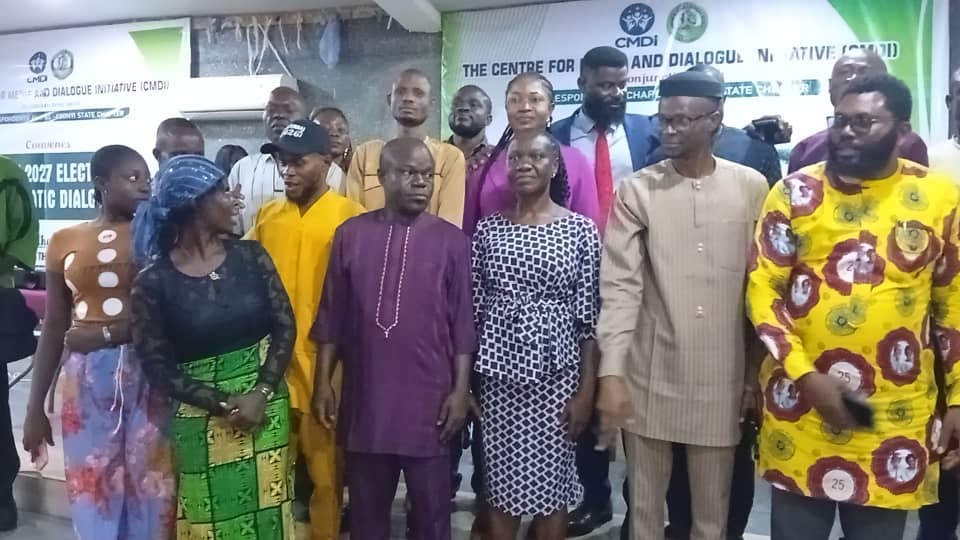
They made the call in Abakaliki, the Ebonyi State capital, during a democratic dialogue organised by the Centre for Media and Dialogue Initiative (CMDI) in collaboration with the Nigeria Union of Journalists (NUJ) Ebonyi State chapter.
The Programme Director of the Centre, Eze Chikodiri Igwe, said the essence of the dialogue was to provide a credible, respectful and non-partisan platform where candidates could explain their programmes while citizens, the media and other stakeholders interrogate their policy choices and capacity to deliver.
Igwe said democracy required more than campaign promises, stressing that voters must demand clear explanations on how proposed policies would be implemented, the resources required and the mechanisms for measuring performance and holding elected officials accountable.
“A manifesto tells us what a candidate promises. Democracy, however, requires us to go further and ask: What is the problem? What is the proposed solution? How will it be delivered? What resources will it require?
“What priorities will guide the choices? How will citizens measure performance? And what mechanisms will make leadership accountable to the people?” he said.
READ ALSO: INEC Briefs Stakeholders on 2027 Election Preparations
He explained that the objective of the initiative was not to endorse any candidate or political party, but to move electoral discourse “from political promises to public policy; from slogans to substance; from personalities to capacity; and from campaign rhetoric to measurable commitments.”
He added that the electorate had the right to ask questions, candidates had the responsibility to provide answers, while the media had a duty to interrogate claims and provide citizens with credible information to enable them to make informed choices.
He maintained that an election was not merely about choosing who would occupy an office, but about deciding who would be entrusted with the hopes, resources, security and future of the people.
In his remarks, the Chairman, Correspondents’ Chapel, Nigeria Union of Journalists ( NUJ), Ebonyi State, Comrade Uchenna Inya, said journalists had a responsibility to set the agenda for public discourse and ensure that the electorate was adequately informed about candidates and their programmes.
Inya said the media must interrogate candidates on what they intended to offer the people, how they planned to implement their policies, and what mechanisms would be deployed to address critical sectors such as agriculture, healthcare, security, and the economy.
He stressed that journalists were not partisan actors in the electoral process, but professional stakeholders whose responsibility was to report issues accurately and allow citizens to make informed choices.
He urged political actors and their supporters to eschew violence and allow the electorate to freely exercise their democratic rights.
Representing the Independent National Electoral Commission (INEC) at the event, Mrs. Esther Idam, described citizens as critical stakeholders in the electoral process and urged registered voters to collect their Permanent Voter Cards (PVCs) ahead of the elections.
Idam also cautioned voters and political actors against misinformation and fake news, urging citizens to verify information before sharing it on social media platforms.
She warned youths against allowing themselves to be used to perpetrate electoral violence, stressing that a peaceful environment was essential for credible participation.
According to her, voters should familiarise themselves with their designated polling units and comply with electoral guidelines rather than resort to confrontation when difficulties arise.
She further emphasised the need for political parties, candidates, agents and voters to understand the rules governing accreditation, voting and the collation process.
The INEC representative also reiterated the commission’s commitment to an inclusive electoral process, noting that women, youths and persons living with disabilities were important participants in the democratic process.
She assured that the commission would provide a level playing field for all candidates for the general election.
The dialogue attracted candidates and representatives of various political parties, including the Labour Party, ADC, PDP, NDC, ARM among others.