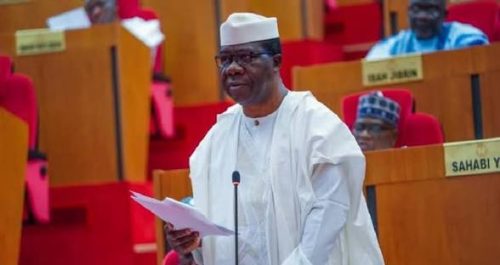
Senate Leader Opeyemi Bamidele says the establishment of state police in Nigeria has moved closer to reality following the approval of the State Police Constitution Alteration Bill, 2026, by at least 30 state Houses of Assembly.
Bamidele, who is also Vice Chairman of the Senate Committee on the Review of the 1999 Constitution, said the approvals had satisfied the constitutional requirement for the proposed amendment, marking a significant step towards restructuring the country’s security architecture.
He, however, noted that the National Assembly must complete the remaining legislative procedures, including collating reports from state assemblies and considering the required resolution before the next stage of the process.
The Senate Leader disclosed this on Thursday while delivering a lecture to participants of Senior Executive Course 48 at the National Institute for Policy and Strategic Studies (NIPSS), Kuru, Jos, Plateau State.
The lecture, titled: “Improving the Efficiency and Effectiveness of Governance through Proactive Lawmaking,” examined the role of legislation in strengthening public governance and advancing national development.
Bamidele said the National Assembly had set December 2026 as its target for completing the remaining legislative stages required to establish state police.
“We are pleased to inform our constituents across the federation that state police have moved from rhetoric to reality. We have already received formal reports from the State Houses of Assembly and, as of today, no fewer than 30 states have approved the State Police Constitution Alteration Bill, 2026,” he said.
According to him, Section 9(2) of the 1999 Constitution, as amended, requires the concurrence of at least two-thirds of the 36 state Houses of Assembly for a constitutional alteration.
He described the development as a historic milestone in Nigeria’s efforts to build a security system that is more responsive to local conditions and the needs of communities.
“What happens next is procedural, but critical. The National Assembly is now constitutionally obligated to consider the reports transmitted by the State Houses of Assembly, collate those reports, and pass a resolution by simple majority of members in both chambers. Once this resolution is passed, the Alteration Bill will be transmitted to the President and Commander-in-Chief for assent,” he said.
Bamidele added that the National Assembly intends to conclude the remaining stages, including consideration of the reports, passage of the resolution and transmission of the bill for presidential assent, on or before December 2026.
He said the proposed reform marked a major departure from more than 15 years of unsuccessful attempts to establish state police through the National Assembly.
According to him, the initiative reflects the 10th National Assembly’s commitment to making the protection of lives and property a central component of its legislative agenda.
He argued that decentralised policing would enable Nigeria to develop a system that understands local terrain, speaks local languages and responds more effectively to the security concerns of communities.
The Senate Leader, however, stressed that state police would not be designed to weaken the Federal Government or create state armies, but to strengthen Nigeria’s federal structure through community-based policing backed by constitutional safeguards, operational standards, oversight mechanisms and human rights protections.
He said the National Assembly, under the leadership of Senate President Godswill Akpabio, remained committed to delivering the reform.
“We will not falter until every Nigerian, whether in Kuru, in Iyin-Ekiti, in Gusau or in Yenagoa, can sleep with both eyes closed,” he said.
Legislative Achievements
Beyond the state police initiative, Bamidele said the performance of the 10th National Assembly should be assessed by the tangible impact of its legislative interventions on citizens rather than the number of bills passed into law.
He said the current Assembly had prioritised strategic, people-centred legislation intended to address critical national challenges and improve citizens’ welfare.
He said the impact of such legislation cut across national security, economic transformation, public financial management, electoral credibility, education, healthcare, technological innovation, environmental sustainability and intergovernmental relations.
The Senate Leader cautioned, however, that the passage of good laws alone was insufficient to guarantee effective governance.
He said legislation must be relevant to prevailing realities, supported by credible evidence, implementable, adequately funded and properly administered to produce the desired outcomes.
READ ALSO: Lawmaker Backs President Tinubu’s Re-Election Bid
NIPSS-NASS Collaboration
Bamidele also called for stronger institutional collaboration between NIPSS and the National Assembly to improve legislative foresight, policy development and governance outcomes.
He described NIPSS as strategically positioned to support the legislature, given its multidisciplinary approach and its ability to bring together experienced professionals from the public sector, military, private sector, academia and other strategic institutions.
“This multidisciplinary character makes NIPSS uniquely positioned to contribute to legislative foresight. I would, therefore, encourage stronger institutional collaboration between NIPSS and the National Assembly,” he said.
The lecture was attended by former and serving legislators among other dignitaries.