The Nigerian Army has intensified efforts to strengthen non-kinetic warfare capacity, leadership adaptability, and critical decision-making among tactical commanders as part of broader institutional reforms aimed at addressing Nigeria’s evolving security threats.
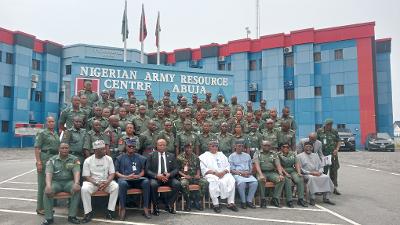
This operational direction formed the focus of discussions at the graduation ceremony of Leadership Skills Development Course 15/2026 held at the Nigerian Army Resource Centre (NARC) in Abuja, where Army leadership stressed that contemporary military operations now require a combination of combat capability, emotional intelligence, inter-agency coordination, and strategic thinking.
Representing the Chief of Army Staff, Waidi Shaibu, the Deputy Chief of Training (Army), Courses and Examinations, Major General Sunday Makolo, outlined the Army’s increasing emphasis on adaptive leadership and non-kinetic operational competencies within modern conflict environments.
READ ALSO: Nigeria Army Intensifies Offensive Against Terrorists in Zamfara
According to the Army’s evolving operational assessment, current security threats are increasingly complex, fiscally demanding, and multidimensional, requiring commanders capable of critical thinking, comprehensive planning, and decisive action across joint operational theatres.
Army leadership noted that the course aligns with the Chief of Army Staff’s transformation agenda focused on building a more professional, combat-ready, and adaptable force capable of operating effectively within joint and multi-agency environments.
The Army further disclosed that the programme was deliberately structured to sharpen leadership skills among tactical-level officers and soldiers through modules covering emotional intelligence, mentorship, conflict management, military justice systems, inter-agency collaboration, social media implications, and critical thinking.
According to the Army’s training doctrine presented at the event, future battlefield effectiveness will increasingly depend not only on kinetic operations but also on leadership judgment, communication skills, human rights awareness, and the psychological management of personnel under operational pressure.
Speaking during a post-event interaction, Major General Makolo explained that modern warfare now combines kinetic and non-kinetic dimensions, making leadership behaviour and decision-making central to operational outcomes.
Army training authorities noted that the programme was designed to deepen participants’ understanding of warfare beyond conventional combat operations by integrating leadership psychology, emotional intelligence, and strategic communication into tactical command responsibilities.
Earlier, the Director-General of the Nigerian Army Resource Centre, Major General James Myam, stressed that contemporary operational, administrative, and logistics challenges confronting tactical commanders require creativity, emotional intelligence, and innovative leadership approaches.
The Centre’s leadership maintained that the course was intended to bridge leadership gaps within operational formations while improving decision-making capacity among officers and soldiers operating in increasingly complex theatres.
Course coordinators disclosed that 61 participants drawn from formations and units across the Nigerian Army underwent intensive training during the two-week programme.
The curriculum, according to the course highlights, focused on adaptive leadership, mentorship, coaching, teamwork, military ethics, conflict management, inter-agency cooperation, and leadership responsibilities in peace and wartime operations.
Army authorities also confirmed that participants completed table-top exercises and leadership assessments aimed at evaluating their understanding of operational leadership principles and institutional responsibilities.
Participants at the event identified emotional intelligence, critical thinking, and ethical leadership as some of the major takeaways expected to improve field leadership, troop management, and operational coordination.
The graduation ceremony further reinforced the Nigerian Army’s ongoing institutional shift towards leadership-driven operational effectiveness as the service continues recalibrating its force structure against asymmetric threats, joint operational realities, and multidimensional security challenges confronting the country.