
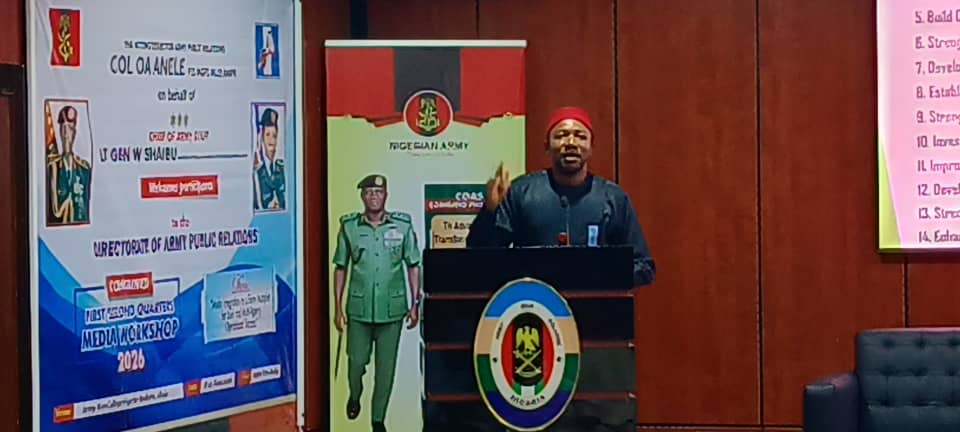
The Head of the Department of Mass Communication at Achievers University, Owo, Ondo State, Dr. Walter Duru has emphasised the importance of proactive strategic communication in military operations.
According to Dr Duru, effective communication planning is essential for building public trust, enhancing inter-agency cooperation, and achieving successful operational outcomes.
He made the remarks while presenting a paper titled “Media as a Force Multiplier: Leveraging Integrated Platforms to Enhance Public Trust, Inter-Agency Synergy, and Operational Outcome” during the Directorate of Army Public Relations Combined First and Second Quarters Media Workshop held at the Army War College, Abuja.
READ ALSO: Military Pension Board Warns Pensioners Against Fraudsters
He explained that strategic communication requires proactive planning, efforts, and tactics that enable organisations to remain in control of narratives while ensuring that stakeholders are fully engaged and committed to shared goals.
Planning Process
According to him, communication should no longer be treated as an afterthought in military and security operations but should be integrated into the planning process from the outset.
He noted that every security intervention should have a communication component that supports operational objectives.
Dr. Duru observed that modern warfare is no longer fought solely on the battlefield but also in the information space, where narratives and public perception play critical roles.
He described information as a strategic asset capable of influencing the success or failure of security operations.
The communication scholar warned against adopting a reactive approach to communication, where institutions only respond after negative reports emerge.
“Such an approach, leads to endless cycles of crisis management and places organizations on the defensive,” He said.
Dr Duru identified media as a major force multiplier that complements traditional military assets such as technology, intelligence, and logistics.
Institutional Credibility
According to him, effective use of media can strengthen operational effectiveness, boost troop morale, enhance institutional credibility, and secure public support.
Duru also stressed the growing influence of digital platforms, noting that every smartphone user has become a publisher in the digital age.
This development, he said presents both opportunities and challenges for security agencies seeking to manage information and combat misinformation.
He highlighted the benefits of integrated communication platforms, including real-time engagement, wider audience reach, rapid crisis response, public sensitisation, and improved collaboration between institutions and citizens.
He said that “communication strategies must be carefully tailored to specific situations, including decisions on when to respond to or ignore certain narratives.”
The lecturer warned that when institutions fail to communicate proactively, rumors, misinformation, and disinformation quickly fill the vacuum.
He noted that such situations, often lead to public anxiety, declining trust, and the dominance of false narratives over verified information.
Duru further identified fake news, deepfakes, manipulated visuals, online propaganda, and viral rumors as major information threats facing security operations.
He urged military and security communicators to continuously improve their skills and adapt to emerging communication trends, emphasising that proactive communication remains the most effective tool for countering misinformation and strengthening national security outcomes.
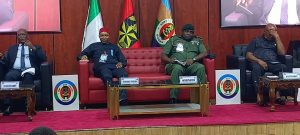
During the interactive session, the First Discussant and Chairman of the Centre for Crisis Communication, Major General Chris Olukolade (rtd), commended the presentation and urged participants to carefully reflect on the issues raised, particularly the concept of the media as a force multiplier in addressing Nigeria’s security challenges.
He noted that the paper aligned with current thinking on the critical role of communication in modern security operations.
Tacking insecurity
Olukolade observed that the force multiplier role of the media is consistent with the nation’s adoption of the all-of-society and all-of-government approaches to tackling insecurity.
According to him, achieving sustainable security outcomes requires the active participation of all stakeholders, with the media playing a vital role in fostering public understanding, cooperation, and support for security initiatives.
He further explained that the presentation was not directed solely at media practitioners but was particularly relevant to public relations and information officers who serve as the link between security institutions and the public.
He emphasised that beyond traditional force multipliers such as intelligence, technology, and combat capabilities, strategic communication has become an indispensable factor in operational success.
Also speaking, the Second Discussant, Professor Okey Ikechkwu, described the paper as well-researched, concise, and highly insightful.
He praised the presenter for highlighting the value of the media during and after conflicts, as well as the need to integrate communication into the planning and execution of operations rather than treating it as an afterthought.
Professor Ikechukwu further noted that communication departments are often underfunded despite their strategic importance.
He stressed the need for institutions to invest more resources in communication structures to enhance effectiveness and public engagement.
The session was moderated by the Acting Deputy Director, 6 Division Army Public Relations, Lieutenant-Colonel Danjuma Jonah Danjuma.

