

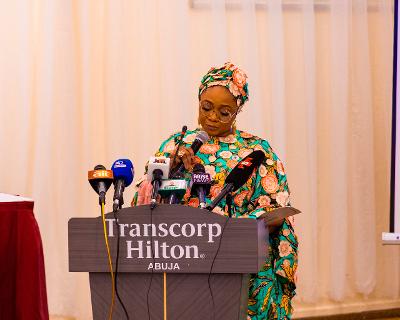
The Minister of Women Affairs and Social Development, Hajiya Imaan Sulaiman-Ibrahim, has tasked the Agrifood System Working Group (ASWG) to place women at the centre of Nigeria’s agricultural transformation, declaring that closing the gender productivity gap is essential to achieving food security and fulfilling the African Union’s CAADP Kampala Declaration commitments.
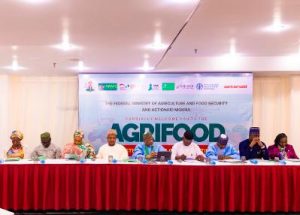
Speaking at the second Biannual High-Level Meeting of the ASWG, convened by the Federal Ministry of Agriculture and Food Security in Abuja, the minister structured her intervention around three imperatives: confronting the challenge, adopting measurable reforms, and deploying existing ministerial instruments.
“I come to this table not as an observer, and not to add a social footnote to an economic conversation. I come because the Ministry of Women Affairs and Social Development holds assets, programmes, and evidence that this Working Group needs to deliver its own mandate,” she said.
Drawing attention to the Kampala Declaration, which commits member states to halve the gender yield gap by 2035, Sulaiman-Ibrahim stressed, “Closing the gender gap in agriculture is not my request of this Working Group. It is this Working Group’s obligation under a Declaration Nigeria has already signed. My Ministry is here to help you deliver it.”
She juxtaposed those commitments with stark realities, noting that about 36 million Nigerians face food insecurity. At the same time, women remain disproportionately affected by hunger, malnutrition, limited land ownership, inadequate credit, weak extension services, climate shocks and unequal access to productive inputs.
“It is not a gap in effort. It is not a skill gap. It is a gap in inputs. We are not looking at underperforming farmers. We are looking at under-resourced ones. And that is a policy failure, which means it is a policy-fixable failure,” she declared.
To reverse the trend, the minister proposed adopting the gender yield gap as a formal ASWG performance indicator, institutionalising sex-disaggregated agricultural data, guaranteeing women greater access to farm inputs and extension services, applying the Affirmative Procurement Policy across agricultural value chains, and establishing a joint technical desk between the Ministries of Agriculture and Women Affairs.
She also highlighted the ministry’s implementation tools, including the Nigeria for Women Programme, which has organised over 560,000 women into more than 26,000 savings and enterprise groups, the Renewed Hope Social Impact Intervention 774, the Women Agro-Value Expansion initiative, the Affirmative Procurement Policy and the Nigeria Gender Profile and Roadmap to Equality 2030.
“We are gathered because roughly 35 million of our compatriots will not eat adequately this season. In that emergency, we cannot afford to leave any source of productivity untouched… Close that gap, and we do not merely advance equality. We raise national output, we reduce the import bill, we improve child nutrition,” the minister stated.
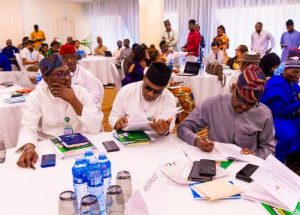
Inaugurated on April 15, 2025, the ASWG provides a unified coordination platform linking government institutions, researchers, farmers, financiers, development partners, private sector actors and civil society to strengthen Nigeria’s food security through coherent, evidence-based, gender-responsive action nationwide.

