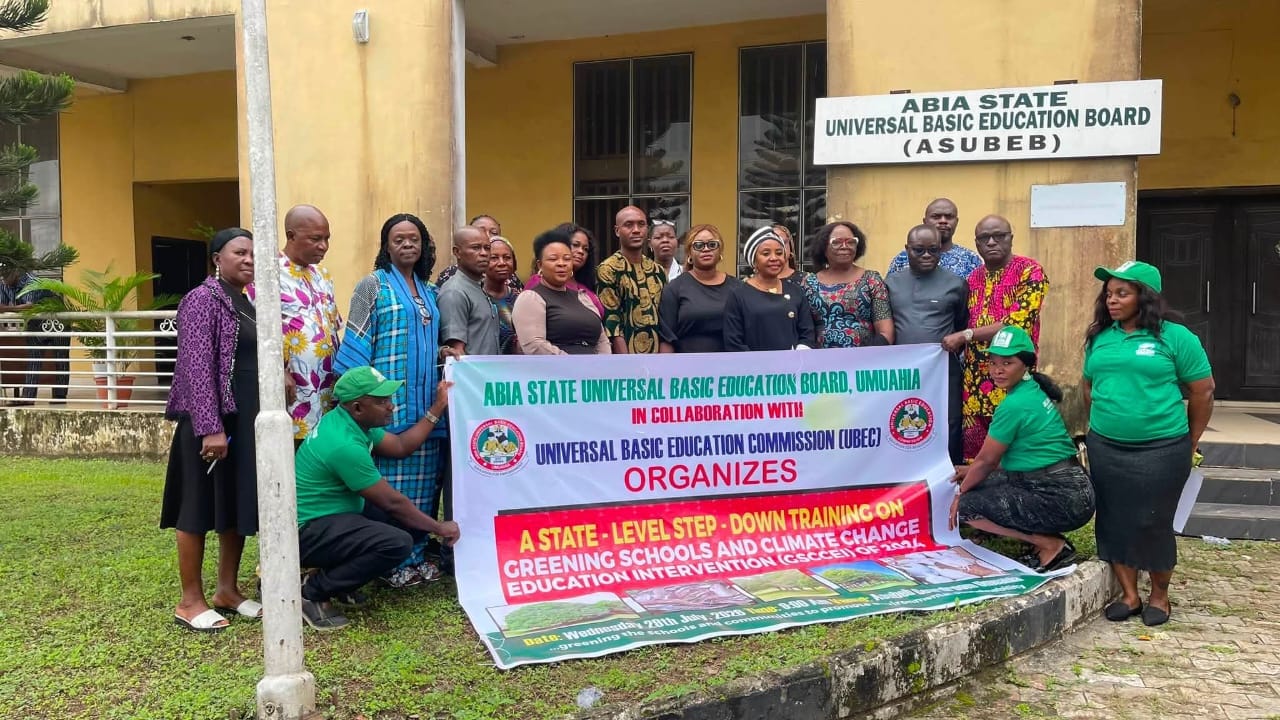
The Universal Basic Education Commission (UBEC), in partnership with the African Centre for Environment, Agriculture and Rural Development (ACEARD), has launched the state-level step-down training on the Greening Schools and Climate Change Education Intervention (GSCCEI) in Abia State to strengthen climate change education and environmental sustainability in Nigeria’s basic education system.
The programme brings together officials of State Universal Basic Education Boards (SUBEBs), Local Government Education Authority (LGEA) desk officers, school administrators, facilitators and other stakeholders to build institutional capacity and support effective implementation nationwide.
Chief Executive Officer of ACEARD, Mr Unyime Robinson, commended UBEC for its commitment to integrating climate change education into the country’s education system.
He described the GSCCEI as a transformative initiative that would position schools as centres of environmental stewardship, innovation and resilience.
Robinson said the intervention would equip learners with climate literacy, sustainability knowledge and practical green skills required to tackle present and future environmental challenges, describing it as a strategic investment in the nation’s youth and sustainable development.
Declaring the training open on behalf of the Executive Secretary of UBEC, Dr Aisha Garba, the Commission’s representative, Mr Madmere Victor, said the intervention forms part of the Federal Government’s education reform agenda aimed at preparing learners for a climate-resilient future.
He explained that the GSCCEI aligns with the National Education Sector Renewal Initiative (NESRI) and Nigeria’s commitments under the UNESCO Greening Education Partnership.
READ ALSO: NiMet, AKADEMIYA2063 Partner on AI, Climate Research
He added that UBEC has developed national implementation guidelines and a handbook, alongside a web-based monitoring and evaluation portal to enhance implementation, accountability and performance tracking.
He reaffirmed the Commission’s commitment to providing continuous technical support to states and the Federal Capital Territory in collaboration with ACEARD.
Robinson urged participants to become climate change champions in their schools and communities, stressing that their role would be vital to the programme’s successful grassroots implementation. He also reaffirmed ACEARD’s commitment to technical assistance, capacity building, monitoring and implementation support.
The Executive Chairman of the Abia State Universal Basic Education Board (ASUBEB), Mrs Lydia Ezihe Onuoha, welcomed participants and praised UBEC for extending the initiative to the state.
She noted that climate change poses significant challenges to education and national development and stressed the need to equip schools with the knowledge, skills and tools to respond effectively.
A major feature of the training was a presentation on Greening Education and the GSCCEI Implementation Guidelines, which provided participants with practical strategies for integrating climate change education, environmental sustainability, green skills and climate-resilient practices into school curricula and administration.
Participants were also introduced to the Climate and Green Champions Clubs Handbook, designed to guide the establishment and management of school-based clubs that promote environmental awareness, climate action, leadership and sustainable practices among learners.
Built around seven core pillars, the GSCCEI integrates climate change education, green skills development and sustainability practices into basic and secondary school curricula across the country. Stakeholders expressed confidence that the initiative would help build greener, more sustainable and climate-resilient schools for present and future generations.