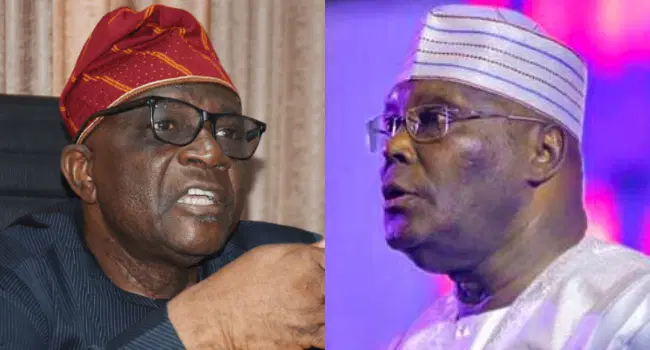
The Presidency says the Tinubu administration’s reforms have laid the foundation for sustainable economic growth and will continue to expand opportunities, strengthen institutions and improve the living standards of Nigerians.
Special Adviser to the President on Information and Strategy, Bayo Onanuga, stated this in response to former Vice President and presidential hopeful, Atiku Abubakar, who accused the administration of fiscal recklessness, questioned the removal of fuel subsidy, criticised its tax reforms, alleged a ₦7.98 trillion oil windfall and claimed that the country was drifting economically.
“There is no such windfall of N7.98 trillion. Any incremental revenue from higher oil prices is reflected in the monthly FAAC figures. While the average price for the first half of 2026 for Brent is around $90, compared to the $64.85 benchmark, average daily production fell short at about 1.6m bpd, compared to the forecast of 1.84m bpd. The production shortfall partly offset the price premium,” he added.
Onanuga said Atiku’s claims were based on outdated fiscal data and did not reflect progress since the implementation of the administration’s economic reforms.
“Politics thrives on disagreement. Democracy demands it. But disagreements must be rooted in facts, not frozen snapshots of history. When yesterday’s data are presented as today’s reality, the public deserves context.
ALSO READ: APC Debunks Atiku’s 2027 Campaign Funding Claim
“Former Vice President Atiku Abubakar has accused the administration of President Bola Ahmed Tinubu of fiscal recklessness, citing excess borrowing in the 2024 budget, questioning the removal of fuel subsidy, criticising tax reforms, concocting an oil windfall of N7.98 trillion, and suggesting that Nigeria is drifting economically.
“His concerns, though misplaced, deserve a response—not because criticisms should be silenced – but because Nigerians should have a fuller picture of where the country is today. Here are the real issues Atiku and his courtiers should apprise themselves of,” Onanuga added.
He said reforms should be assessed based on long-term outcomes rather than initial adjustment periods.
“The Nigerian economy that underwent painful adjustment in 2024 has evolved considerably,” Onanuga said.
The presidential aide said Nigeria’s economy had rebounded since the 2024 exchange-rate adjustment, noting that the country’s dollar-denominated Gross Domestic Product (GDP) rose from about $253 billion after the currency realignment to approximately $377 billion, while Naira GDP increased from about ₦314 trillion to around ₦530 trillion.
On public debt, Onanuga said Nigeria was not overborrowed, explaining that the country’s debt-to-GDP ratio remained at about 40 per cent, while the debt service-to-revenue ratio declined from nearly 100 per cent in December 2022 to below 60 per cent due to improved revenue generation and fiscal management.
“The unvarnished truth is that Nigeria’s revenue-to-GDP ratio is still ranked among the lowest globally, limiting the government’s ability to fund public services without borrowing.
“It is important to ask a broader question: What is Nigeria’s capacity to sustain her debt? For debt, in itself, is not the defining measure of fiscal health. What matters are the size of the economy; our revenue-generating capacity; debt servicing costs; the purposes for which funds are borrowed; and whether borrowed resources finance productive investments or recurrent consumption. Nigeria’s debts have been acquired for productive, long-term infrastructural and investment purposes – according to the law.”
“Nigeria’s debt-to-GDP ratio remains relatively modest (at barely 40%) compared with many peer economies and advanced countries (South Africa (85%), Egypt (80%), Ghana (60%), Kenya (75%), USA (130%), UK (110%), China (300% – unofficially), even though debt-service pressures have historically been significant.
“Still, the Tinubu Administration has seen a reduction in the debt service-to-revenue ratio, from a high of nearly 100% in December 2022 to less than 60% today,” the Presidential aide added.
Onanuga reiterated that the removal of fuel subsidy was a long-overdue reform that had increased revenues available to states and local governments, boosting investment in infrastructure, healthcare and education.
“The visible consequence of subsidy removal has been the sharp improvement in revenues accruing to states and local governments through the Federation Account,” he said.
On tax reforms, Onanuga dismissed claims that the administration was overtaxing Nigerians, saying the measures were designed to reduce the burden on low-income earners and small businesses while improving compliance among higher-income individuals and profitable enterprises.
“The objective of the tax reforms is not merely to increase collections but to create a broader, more equitable tax system,” Onanuga stated.
Onanuga also highlighted achievements in the health sector, including the revitalisation of more than 3,000 Primary Healthcare Centres, retraining of over 78,000 frontline health workers, provision of free caesarean sections for indigent mothers in more than 100 public health facilities and establishment of three cancer centres.
He cited progress in education, noting that over 11,000 projects had been executed through the Universal Basic Education Commission, while more than 1.64 million students accessed loans under the Nigerian Education Loan Fund (NELFUND), with over ₦303 billion disbursed through about 300 tertiary institutions.
The presidential aide also pointed to investments in roads, railways, power, airports, housing, gas projects and digital connectivity as evidence of efforts to drive economic growth.
Responding further to Atiku’s allegation of a ₦7.98 trillion oil windfall, Onanuga described the claim as flawed, explaining that government oil earnings depend on production volumes, costs, contractual obligations and crude oil sales arrangements, not crude prices alone.
He added that the Federal Government had introduced the ward-centric NG-CARES, HOPE and SOLID programmes valued at over $3 billion, alongside cash transfers to 15 million vulnerable households, to cushion the impact of the reforms and support healthcare, education and poverty reduction.