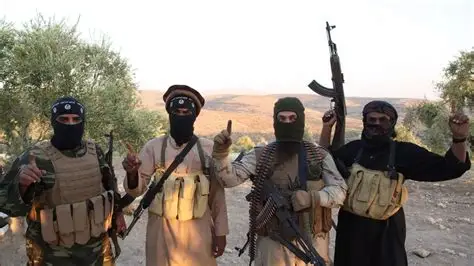
The United Nations (UN) Security Council members have called for greater international support for African countries confronting terrorism.
This follows a warning that the Islamic State terrorist group remains a major security threat in Africa, particularly across the Sahel, Lake Chad Basin and parts of Central Africa.
They made the call during a security council briefing on the activities of the Islamic State in Iraq and the Levant (ISIL), also known as Da’esh or Islamic State.
Somalia’s representative said efforts to combat ISIL should strengthen national ownership of counter-terrorism programmes, while Jocelyne Lukundula, Deputy Permanent Representative of the Democratic Republic of the Congo, called for increased support for Africa’s counter-terrorism efforts.
“Without constant vigilance and international cooperation, no region will be spared in the long-term,” she warned.
Liberia’s Permanent Representative to the UN, Lewis Brown, said sub-Saharan Africa now accounted for more than half of global terrorism fatalities.
Brown warned that terrorist organisations in the Sahel were no longer seeking merely to disrupt governments, adding “they seek to replace it”.
He also cautioned that extremist groups were expanding towards coastal West African countries.
“A threat that adapts faster than our response will inevitably expand to consume all of us,” Brown warned.
Brown called for stronger border intelligence, improved operational capacity and closer subregional security cooperation.
READ ALSO: Nigeria, US Deepen Military Cooperation Against Terrorism
Presenting the UN Secretary-General’s 23rd report on ISIL, Oguljeren Niyazberdiyeva, Chief of the Office of the Under-Secretary-General for Counter-Terrorism, said Africa continued to bear the burden of the group’s activities, identifying the Islamic State West Africa Province as the most active ISIL affiliate globally.
“In spite of international efforts, Da’esh continues to pose a serious threat to international peace and security,” Niyazberdiyeva said.
She said sustained counter-terrorism operations had disrupted ISIL’s senior leadership and weakened its ability to coordinate attacks centrally, but warned that the group had adapted by operating through decentralised networks driven by a shared extremist ideology.
“While sustained counter-terrorism operations have disrupted Da’esh’s senior leadership, the group has continued to adapt,” she said.
According to her, ISIL and its affiliates are exploiting artificial intelligence, encrypted communications, virtual assets, drones and other emerging technologies to recruit members, mobilise resources and coordinate attacks across borders.
She added that terrorist organisations continued to exploit weak governance, fragile security institutions, prolonged conflicts, poverty and political instability, calling for stronger international cooperation to prevent the group from regaining strength
Council members also raised concerns over foreign terrorist fighters, online radicalisation, organised crime and the rapid use of emerging technologies by terrorist groups, stressing that defeating terrorism would require coordinated military, political, economic and social responses tailored to affected communities.
NAN