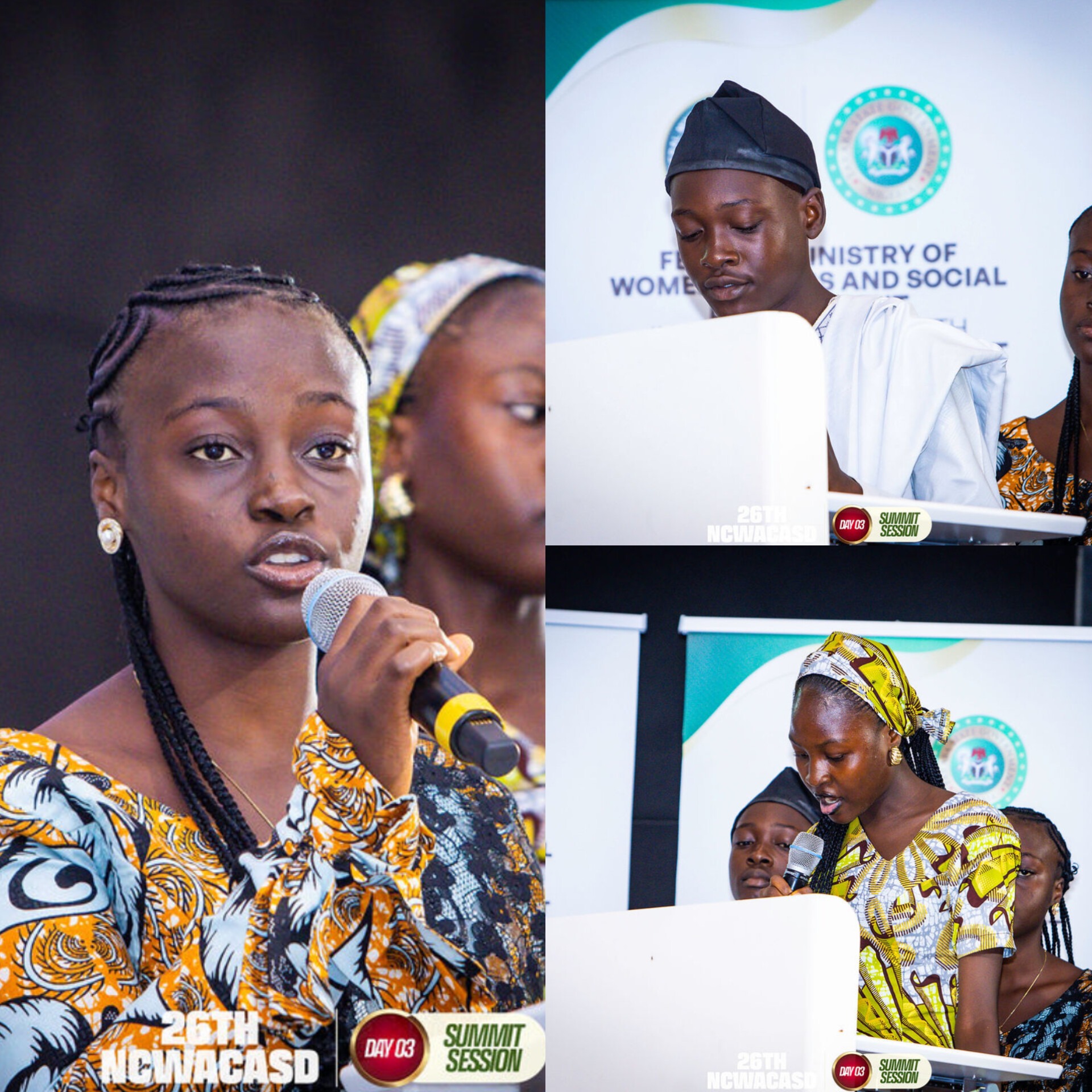
The Speaker of the Taraba Children’s Parliament, Queen Gbashi, has called for stronger and sustained government policies to safeguard the rights, welfare and future of Nigerian children under the Renewed Hope Agenda.
Gbashi, alongside the Deputy Speaker, Tyolanga Ephraim Aondosoo, and House Leader, Amila Dogo, made the call at the 26th National Council on Women Affairs, Child Advancement and Social Development, where they presented the children’s appreciation of government efforts to advance child survival, development, protection and participation.
They expressed appreciation to President Bola Ahmed Tinubu, Taraba State Governor, Dr Agbu Kefas, and the Minister of Women Affairs and Social Development, Imaan Sulaiman-Ibrahim, for their efforts to improve the rights, welfare and prospects of Nigerian children.
Speaking for children in Taraba and across Nigeria, Speaker Gbashi said children must be recognised as active stakeholders in national development rather than merely beneficiaries of government programmes.
“We are citizens and stakeholders in Nigeria’s development,” she said, urging the government to institutionalise children’s participation in policy formulation and implementation.
Gbashi particularly commended the Nigerian Government’s decision to review the Child Rights Act 2003, describing it as “a significant and commendable step towards strengthening the protection and promotion of children’s rights in Nigeria.”
The Speaker called for children’s voices to remain central to policies affecting their lives, stressing that participation should extend beyond commemorative occasions.
“We ask that our voices continue to be heard—not only on special occasions such as Children’s Day, but whenever policies, programmes and decisions affecting children are being developed and implemented,” she said.
Gbashi also applauded government interventions aimed at securing children’s right to survival, including investments in healthcare, immunisation, nutrition, maternal and child health, water and sanitation.
On child protection, she acknowledged efforts to strengthen national systems for preventing and responding to violence, abuse, exploitation, neglect and harmful practices.
Gbashi specifically recognised the Costed National Action Plan on Ending Violence Against Children (2024–2030), describing its implementation as critical to coordinated prevention, protection, survivor support, justice and stronger child-protection systems.
The Deputy Speaker, Tyolanga Ephraim Aondosoo, reinforced the Speaker’s policy call, urging the government to translate commitments into sustained interventions capable of reaching children, particularly those in vulnerable and marginalised communities.
Aondosoo advocated continued investment in “quality education, healthcare, nutrition, social protection, child protection, digital inclusion and meaningful child participation.”
He stressed that effective implementation remained essential to ensuring that government policies produce tangible improvements in children’s lives.
House Leader Amila Dogo also joined the call for sustained policy attention to children, presenting the children’s position as both an appreciation of government efforts and an appeal for deeper investment in their future.
The children urged the government to ensure that policies are inclusive, responsive and consistently implemented, particularly for children affected by poverty, exclusion, violence and limited access to essential services.
They further called for meaningful child participation to become a permanent feature of governance rather than an occasional engagement.
“We believe that when Nigeria invests in its children, Nigeria invests in its future,” the children declared.