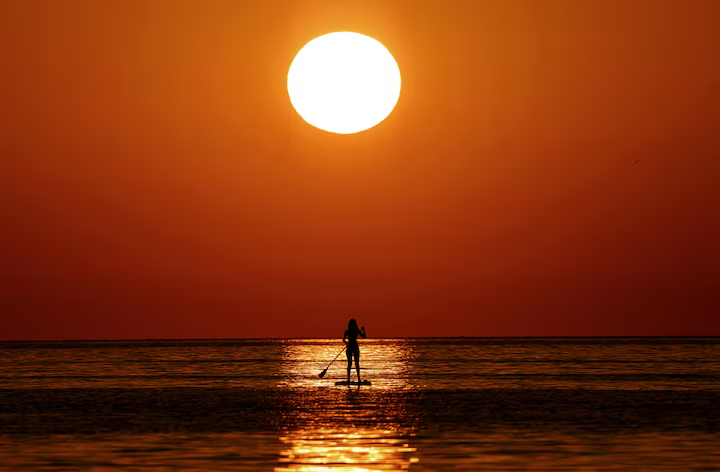
Human-caused climate change was the main factor behind record-breaking sea temperatures around Europe, scientists said on Wednesday, warning that the extreme heat could have severe consequences for marine ecosystems and coastal communities.
Europe’s seas have also been affected by the extreme heat experienced across the continent this summer. In July, the Mediterranean’s average temperature reached 27 degrees Celsius (81 degrees Fahrenheit), the highest recorded for the month, while an offshore buoy near Mallorca registered 33 C in early August.
According to an analysis by the World Weather Attribution (WWA), human-caused climate change has added about 2 C of warming to the Mediterranean and around 1.4 C to Western European seas. The group uses peer-reviewed methods to assess the role of global warming in extreme weather events.
“This has the potential to completely reshape ecosystems that coastal communities rely on for food and income, and drive damaging extreme weather on land too,” said Claire Bergin, a climate scientist at Ireland’s Maynooth University and co-author of the study.
READ ALSO: Europe’s Record Heatwaves Trigger Huge Economic Losses
The WWA analysis found that the peak sea temperatures recorded this year in the eastern and western Mediterranean, as well as along the Bay of Biscay and Iberian coast, would have been “virtually impossible” without human-caused climate change.
In the Celtic Sea, off Britain and Ireland, the most extreme temperatures recorded this year would occur only about once a century in a world without human-caused climate change, the analysis found.
Warmer seas can increase humidity and overnight temperatures in coastal areas while also providing more energy for intense storms later in the year.
Greenhouse gas emissions, largely from burning fossil fuels, have pushed global average temperatures to around 1.4 C above pre-industrial levels, according to the World Meteorological Organization. This warmer baseline allows the high-pressure systems responsible for heatwaves to produce more extreme temperatures.
Marine heat spikes can trigger mass die-offs of species such as corals, disrupt food supplies for birds and mammals and cause wider damage across marine food chains.
John Bruno, a marine ecologist at the University of North Carolina, said some species were moving northward in search of cooler waters, but not all would be able to adapt.
“We are rapidly approaching the absolute biological limits of adaptation for many species,” he said.
The WWA analysis found that marine heatwave conditions have affected about 90% of the Bay of Biscay and 80% of the western Mediterranean this year. Without global warming, the affected areas would have been closer to 40%.
Reuters