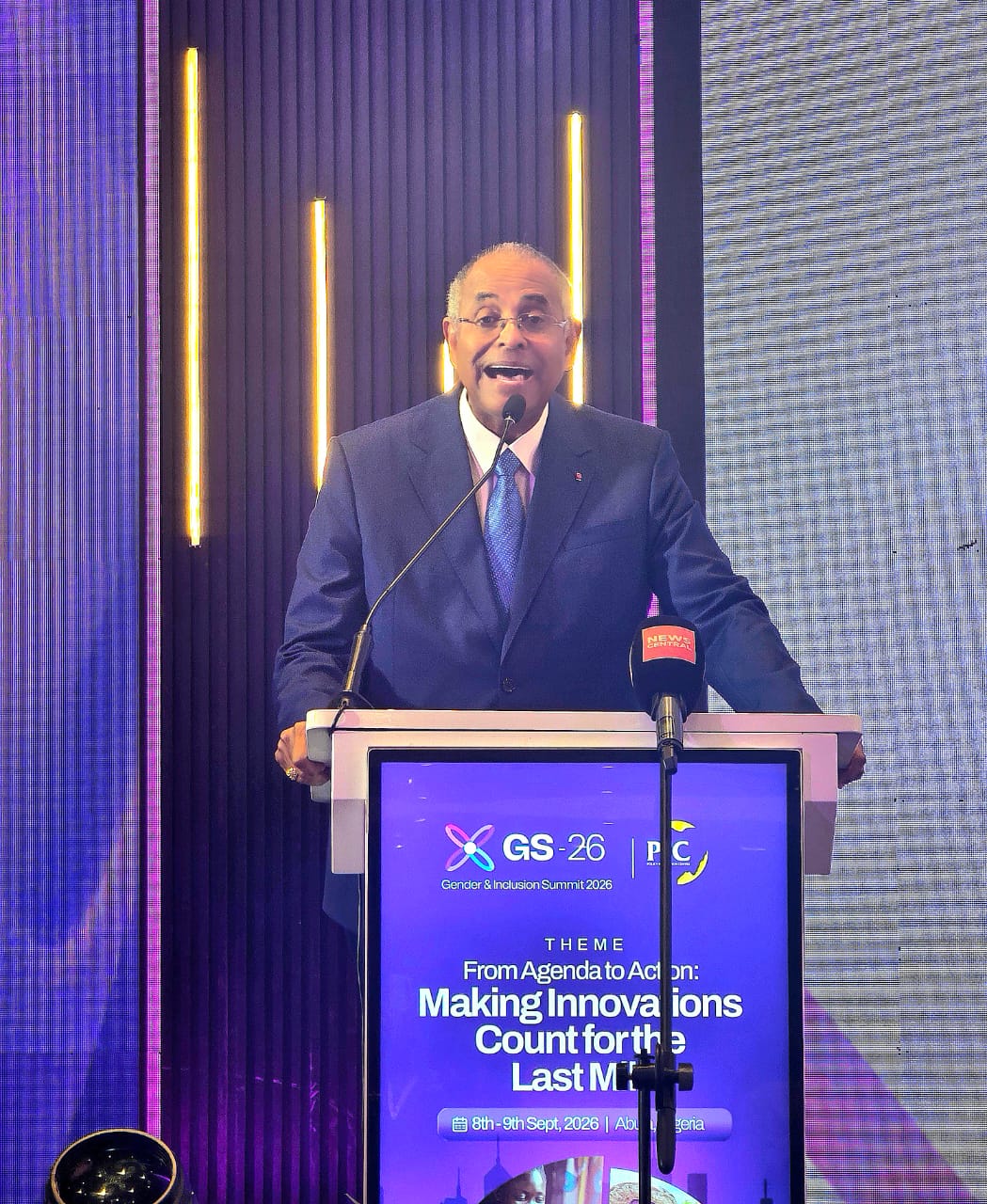
President of the National Assembly of Côte d’Ivoire and former Prime Minister Patrick Achi has urged African governments to make inclusion a core pillar of economic transformation, stressing that development will remain incomplete unless women, young people and underserved communities are connected to productive opportunities.
Achi made the call while delivering the keynote address at the 2026 Gender and Inclusion Summit, GS26, in Abuja, themed: “From Agenda to Action: Making Innovations Count for the Last Mile”.
He said Africa must move beyond treating inclusion as a social intervention and recognise it as critical economic infrastructure for achieving sustainable growth and shared prosperity.
“Inclusion is not a social supplement to development. Inclusion is development,” Achi declared.
The former Ivorian Prime Minister explained that infrastructure only delivers its economic value when it connects people to markets, education, healthcare, jobs and enterprise, warning that physical infrastructure without corresponding opportunities could leave communities excluded from economic growth.
“A bridge that carries no opportunity is only concrete and steel,” he said.
Achi said the continent’s most sustainable pathway out of poverty remained productive employment, enterprise development and rising incomes, while acknowledging the importance of social protection in protecting vulnerable populations and helping them absorb economic shocks.
“We must therefore be careful not to build a system that becomes better at managing poverty than at ending it,” he warned.
According to him, governments must create the conditions for private-sector investment, enterprise development, and job creation at scale while ensuring that the benefits of economic growth reach a broader section of society.
“Social protection must protect people from falling. Productive employment must give them the ladder to climb,” Achi said.
He identified women and young people as critical assets to Africa’s economic transformation, stressing that excluding them from education, finance, technology, and employment represented a significant loss of productive capacity.
“Africa’s largest untapped reserves are not all beneath our soil. They are also in the talent of the woman who has not yet reached capital; in the ambition of the young person who has not yet reached opportunity; and in the productivity of the farmer who has not yet reached a modern value chain.” Achi said.
Drawing from Côte d’Ivoire’s development experience, Achi said the country had progressed from rebuilding after crisis to expanding access to infrastructure and social services and was now focused on converting access into capability, productivity and income.
He said the next phase of African development must focus on agricultural modernisation, industrialisation, human capital development, competitive enterprises, and employment.
Achi outlined four priorities for moving inclusion from agenda to action: designing inclusion as a system; investing where future value will be created; making inclusion a budget and accountability issue; and scaling innovations that demonstrate measurable results.
He said the success of GS26 would ultimately be determined not by the quality of discussions in Abuja, but by the changes produced after the summit and the number of people reached.
“The last mile is not where development ends. It is where development becomes real,” Achi said.
Chairman of the Nigerian Economic Summit Group, Niyi Yusuf, said the summit was designed to close the gap between policy commitments and outcomes for underserved communities.
“An innovation only counts when it arrives,” Yusuf said.
He urged participants to be “bold in their thinking, generous in their partnerships, and relentless in their commitment to those at the last mile”.
The Policy Innovation Centre, organisers of GS26, said the summit was focused on translating policy commitments and innovations into measurable outcomes for women, young people, persons with disabilities and underserved communities across Africa.