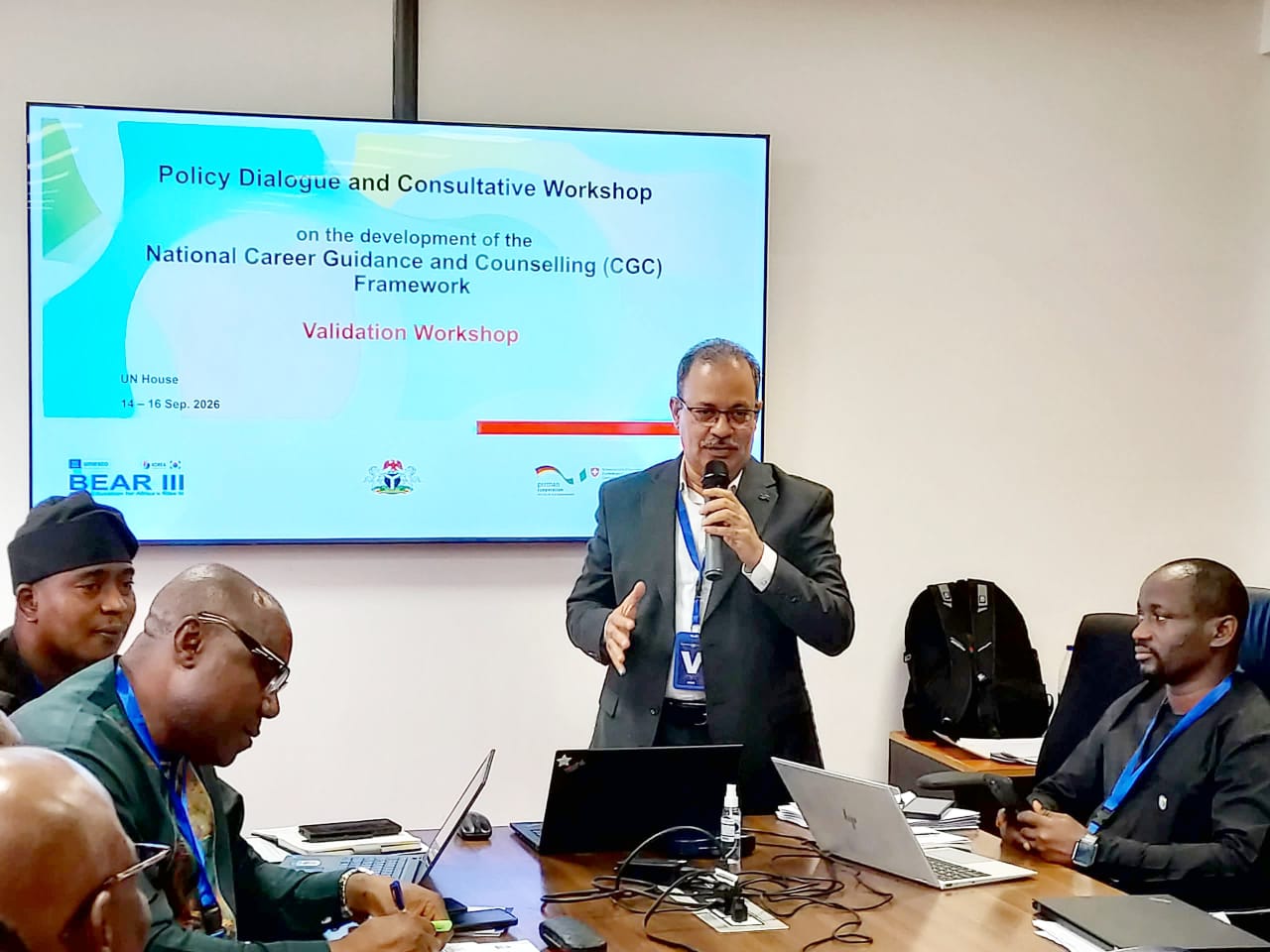
The United Nations Educational, Scientific and Cultural Organisation (UNESCO) and the German Development Cooperation (GIZ) have reiterated their commitment to supporting Nigeria’s efforts to establish a coordinated national system for career guidance and counselling aimed at strengthening education, skills development, employment and youth development.
This was disclosed at a national validation workshop on the proposed National Framework for Career Guidance and Counselling in Abuja, Nigeria.
The workshop, organised by UNESCO in partnership with GIZ, brought together representatives of government institutions, development partners, employers, professional bodies, education and training institutions, among other stakeholders.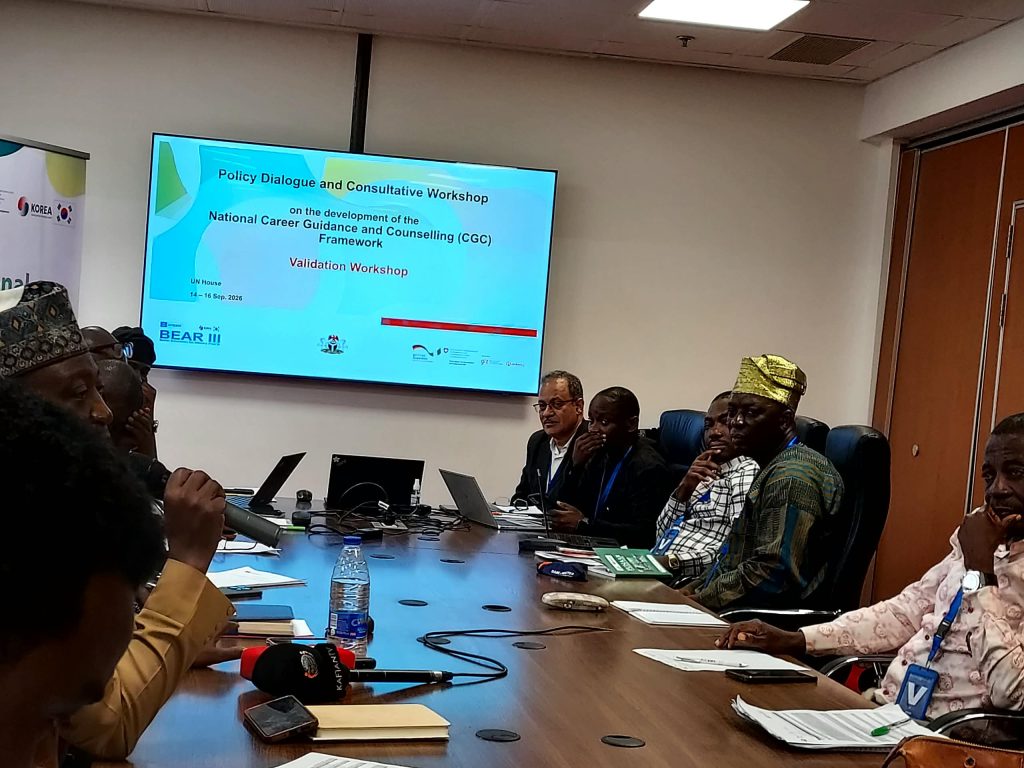
Speaking, the UNESCO Representative to Nigeria and Abuja Head of Office, Dr Isaias Barreto da Rosa, said the development of the framework reflected a shared commitment to making career guidance and counselling an important component of Nigeria’s education, skills and employment systems.
Dr Barreto da Rosa, who was represented by the UNESCO Head of Education Sector, Oladeji Adeyemi, noted that effective career guidance would enable Nigerians to make informed decisions about education, training, skills development and employment.
“For young people, it can help them understand their interests, abilities and options and navigate pathways from education and training to further learning, employment or entrepreneurship,” he said.
Reskilling and Adaptation
He stressed that career guidance should not be restricted to young people or a particular level of education, noting that adults could also benefit from guidance during career transitions, reskilling and adaptation to changing labour-market demands.
“It is therefore not simply a service for one stage of education. It is part of lifelong learning and career development,” he said.
According to him, the need for a coherent national approach had become increasingly important as Nigeria’s large youth population entered an economy being reshaped by digitalisation, technological change, emerging occupations and changing skills requirements.
He emphasised that Nigerians need access not only to education and training, but also to reliable career and labour-market information to enable them to understand available opportunities and make informed choices.
“UNESCO’s support for the framework formed part of its broader engagement in lifelong learning, technical and vocational education and training (TVET), skills development and transitions to the world of work”, he said.
The UNESCO representative said the framework had undergone extensive development involving consultations, a roundtable, a national desk review, stakeholder engagements and successive workshops, noting that the broad participation was necessary because career guidance and counselling cut across education, labour, employment and youth development.
People-Centred
The UNESCO Head of Office also highlighted the contribution of UNESCO’s Better Education for Africa’s Rise (BEAR III) project, implemented with the support of the Republic of Korea, particularly its efforts to improve the relevance, quality and attractiveness of TVET and strengthen its links with employment and entrepreneurship.
According to him, people-centredness and partnership were central to the proposed framework.
“At the heart of the Framework must be the learner, young person, adult, jobseeker or worker seeking to make informed decisions about learning and work,” he said.
He explained that no single institution could establish an effective national career guidance and counselling system alone.
“Strong coordination among education, labour, employment and youth development institutions, together with employers, professional bodies, practitioners and other stakeholders, will be essential,” he said.
Representing the Acting Permanent Secretary, Nigeria’s Ministry of Education, Mrs Folake Olatunji-David, the Director, Education Support Services, Gabriel Amudipe Oluwole, said career guidance and counselling should be regarded as an integral part of quality education and human capital development.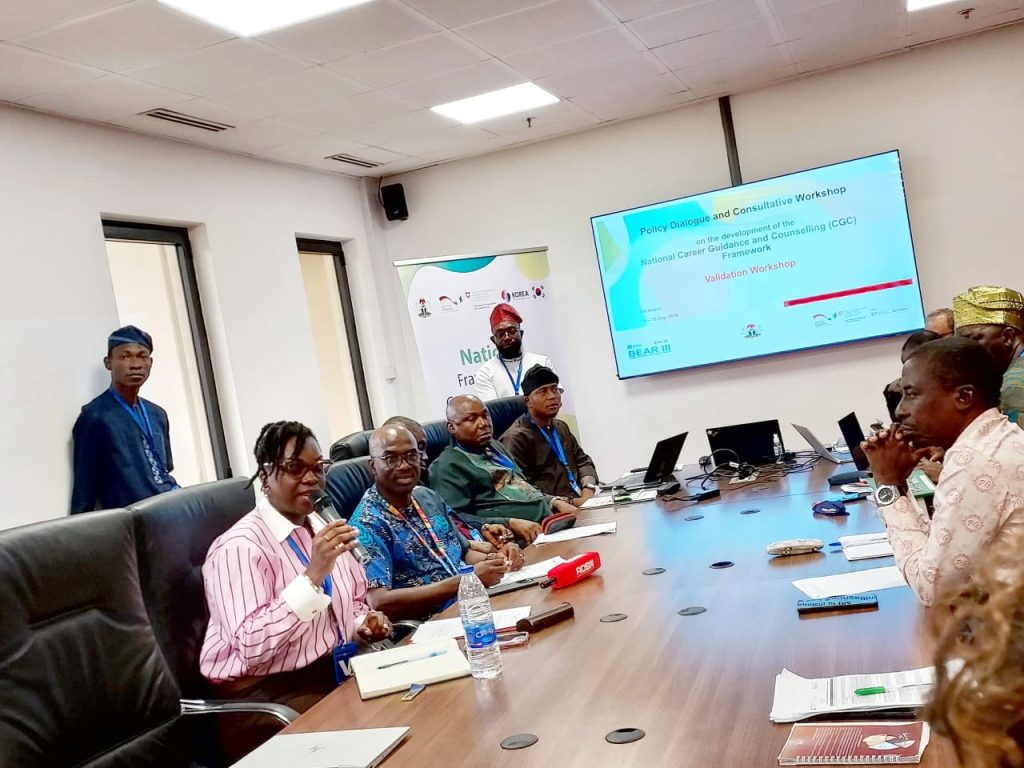
“Education is not only about knowledge and passing examinations. It is fundamentally about equipping individuals with the knowledge, skills, values and competences required to make meaningful choices and contribute productively to society,” he said.
The Permanent Secretary said technological advancement, artificial intelligence, entrepreneurship, emerging occupations and new skills were transforming the world of work, making effective career guidance increasingly necessary.
A Coherent National Approach
She noted that the proposed framework was expected to establish a coherent national approach to career guidance and counselling while promoting consistency in standards, professional practice, roles, responsibilities and quality assurance.
According to her, the framework would strengthen links between education and the labour market and encourage collaboration among schools, tertiary institutions, employers, professional bodies, government agencies and development partners.
She described the validation exercise as an opportunity for stakeholders to collectively shape the future of career guidance and counselling in Nigeria.
Also speaking, the Permanent Secretary, Ministry of Labour and Employment, Dr Kamil Shoretire, who was represented by the Deputy Director, International Labour Migration Division, Sunday Onazi, said the proposed framework could help bridge the gap between education, skills acquisition and employment.
“The initiative is timely, given the changing nature of the global workforce. The need for structured, inclusive, and forward-looking career guidance systems has never been more urgent than now,” she said.
READ ALSO: UNESCO Calls for Digital Transformation of Nigeria’s TVET
He described career guidance as a critical pillar for developing a productive, skilled and adaptable workforce capable of responding to changing national and global economic demands.
“From an institutional standpoint, career guidance is not merely an educational support service but a strategic labour market intervention,” he said.
Dr Shoretire stressed that the Ministry was committed to strengthening labour-market information systems, supporting public employment services and fostering collaboration across sectors to institutionalise career guidance within national development frameworks.
For her part, the Head of Component, Policy, Strategy and Dialogue, Skills Development for Youth Employment (SKYE), GIZ Nigeria, Kikelomo Collins-Chibeze, said every young Nigerian should have an opportunity to make informed decisions about the future and navigate pathways towards decent and sustainable work.
“We need career guidance and counselling services that are relevant, forward-looking and responsive to the realities of today’s labour market, supported by skilled and committed professionals who can guide young people along their journey,” she said.
She described the proposed framework as a strategic enabler of informed career choices, lifelong learning, employability and productive participation in the economy, highlighting the Nigerian ownership and co-creation approach adopted in developing the framework.
According to her, the approach was designed to ensure that the framework responded to institutional realities, respected existing mandates, recognised diverse contexts and could be implemented within available capacities and resources.
“To me, ‘implementation first’ is more than an approach, it is a commitment. Most importantly, it means ensuring that this Framework does not simply become another document on a shelf but becomes a living instrument that drives action and improves the lives of Nigerians,” she said.
She urged stakeholders to ensure that the framework is translated into practical improvements rather than becoming another policy document, while urging participants to move beyond validating the document and focus on implementation.
“Today we validate it. Together we own it. And, most importantly, collectively we make it work,” she added.
The validation workshop is expected to enable stakeholders to address outstanding issues, build consensus on final recommendations and agree on a pathway towards the finalisation, institutionalisation and implementation of the National Framework for Career Guidance and Counselling in Nigeria.