
Britain’s inflation rate eased by more than expected in June after a temporary reduction in tensions during the Iran conflict led to lower fuel prices.
However, economists believe the slowdown may be short-lived, posing a continued challenge for Prime Minister Andy Burnham as he works to reduce the cost of living.
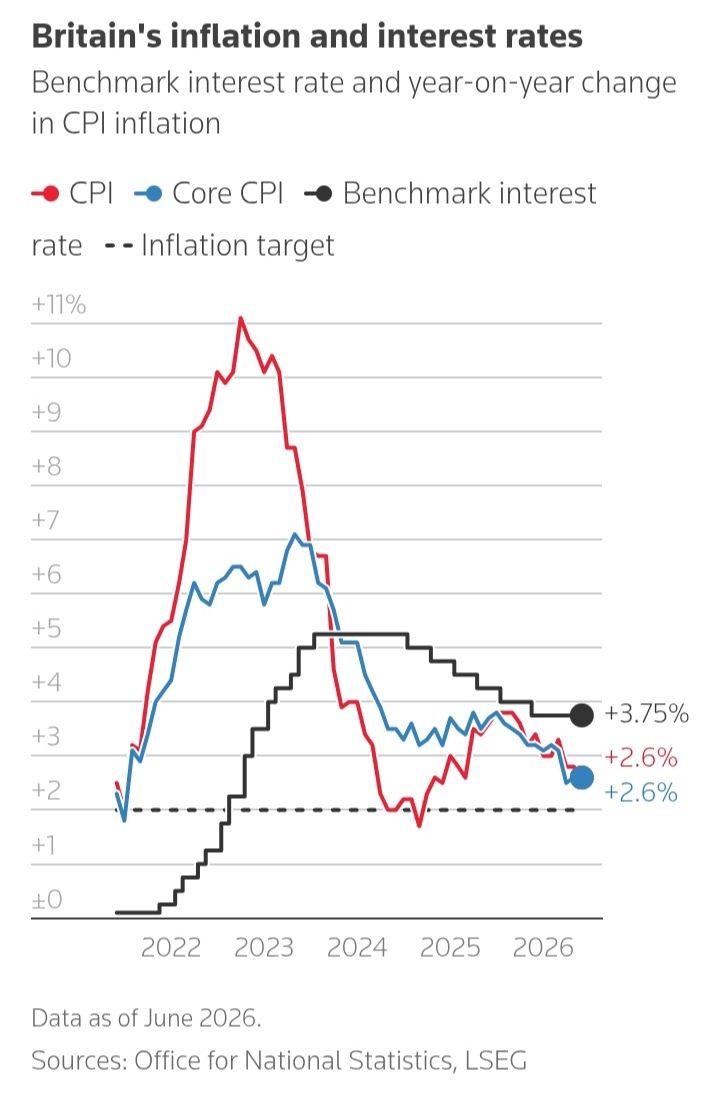
Consumer prices increased by 2.6% year-on-year in June, the slowest pace since March 2025, compared with 2.8% in May. Economists surveyed by Reuters had forecast inflation to ease only to 2.7%.
The decline was largely driven by falling fuel costs, with motor fuel prices recording their first monthly drop since the conflict began in late February. The Office for National Statistics also reported that manufacturers’ input costs fell by 2.0% from May.
Despite the improvement, analysts warned that renewed fighting in the Gulf has already pushed energy prices higher this month, making June’s reading likely to be the lowest inflation figure of the year.
Britain’s headline inflation was lower than that of the United States and the euro zone in June, where inflation stood at 3.5% and 2.8%, respectively.
Government focuses on living costs
The Bank of England (BoE), which targets 2% inflation, has projected that inflation will rise to around 3% in the third quarter.
Food prices, considered a key indicator of public inflation expectations, rose by 1.6% in June from a year earlier, slowing from 2.1% in May.
Since assuming office on Monday, Burnham’s administration has announced a reduction in taxes on household energy bills and lowered the cap on bus fares in a bid to ease financial pressure on households.
Matt Swannell, chief economic adviser at the ITEM Club, said rising wholesale energy prices would outweigh the benefits of the energy tax cut, adding that inflation could approach 3.5% by the end of 2026.
Finance Minister John Healey welcomed the latest inflation figures but acknowledged that more action was needed to support families.
READ ALSO: Keir Starmer Resigns as UK Prime Minister
Suren Thiru, chief economist at ICAEW, warned that a likely rise in inflation over the coming months could reduce Healey’s fiscal flexibility, increase government borrowing costs and add to financial market volatility.
Underlying inflation remains stubborn
Services inflation, a key measure closely monitored by the BoE for underlying price pressures, slowed slightly to 3.6% in June from 3.7% in May but remained above economists’ expectations of 3.5%.
Core inflation, which excludes food, energy, alcohol and tobacco, remained unchanged at 2.6%.
Investors expect the BoE to leave its benchmark interest rate unchanged at 3.75% next week while it assesses the economic impact of the renewed Middle East conflict.
“Today’s data strengthens the case for the Bank of England’s cautious approach, with underlying inflationary pressures remaining relatively muted in an environment of weak domestic demand,” said Yael Selfin, chief economist at KPMG.
Some BoE policymakers who supported higher interest rates in June remain concerned that inflation could continue to stay above the central bank’s 2% target.
Financial markets continue to expect one or possibly two quarter-point interest rate increases before the end of 2026, broadly unchanged from expectations on Tuesday.