
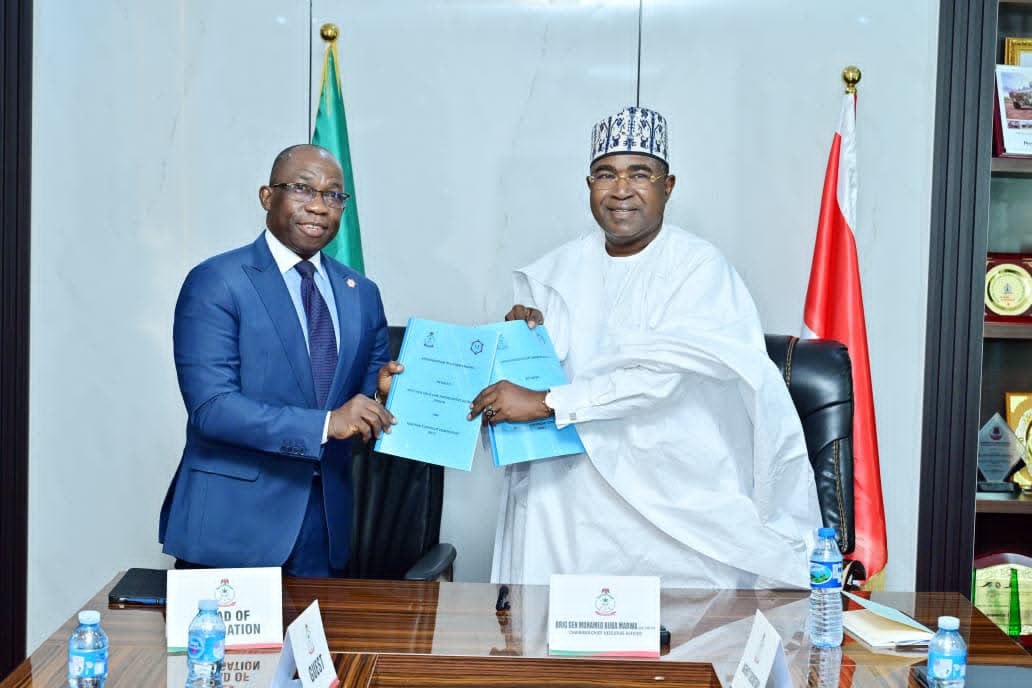
The National Drug Law Enforcement Agency (NDLEA) and the Nigerian Copyright Commission (NCC) have signed a Memorandum of Understanding (MoU) to strengthen collaboration against organised criminal networks involved in drug trafficking and intellectual property piracy.
The agreement, signed on Friday at the NDLEA headquarters in Abuja, provides a framework for intelligence sharing, joint operations, coordinated investigations and capacity building between the two agencies.
Speaking at the signing ceremony, Chairman and Chief Executive Officer of the NDLEA, Brigadier General Mohamed Buba Marwa (Rtd), said; “criminal organisations often engage in multiple illicit activities rather than operating in a single area of crime.”

“Our experience at the frontlines of drug law enforcement has shown us time and again that criminal networks rarely confine themselves to a single illicit enterprise,” Marwa said.
He noted that the same syndicates involved in narcotics trafficking are frequently linked to copyright piracy, with proceeds from one criminal activity often financing the other.
“The same syndicates that traffic in narcotics are often found dabbling in other forms of economic crime, including the piracy of intellectual works that rightfully belong to Nigeria’s creatives. Proceeds from one illegal trade frequently find their way into financing the other. This is the criminal value chain we must disrupt together,” he explained.
Marwa further said that the MoU formalises cooperation through intelligence exchange, coordinated enforcement operations and technical support, with a Joint Working Committee established to oversee implementation and monitor progress.
He said “the partnership goes beyond law enforcement, stressing that it would help protect public health while safeguarding Nigeria’s creative industry, one of Africa’s largest entertainment and content-producing sectors.”
The Director General of the Nigerian Copyright Commission, Dr. John Asein, described large-scale copyright piracy as a serious organised crime that undermines economic growth by depriving creators and investors of legitimate income.
“International experience has demonstrated that organised copyright piracy is rarely an isolated criminal activity,” Asein said.
He noted that criminal syndicates often use the same logistics channels, transportation routes, storage facilities, financial networks and distribution systems to move both illicit drugs and pirated books, films, music and software.
According to him, “the new partnership will enable the NCC to leverage the NDLEA’s expertise in intelligence-led investigations, forensic analysis, surveillance and international cooperation to identify criminal networks, trace illicit financial flows and dismantle organised crime operations.”
Officials from both agencies said the collaboration is expected to strengthen Nigeria’s response to transnational organised crime by disrupting interconnected criminal enterprises that threaten public safety, economic development and the nation’s creative economy.

 and the Nigerian Copyright Commission (NCC) have signed a Memorandum of Understanding..)