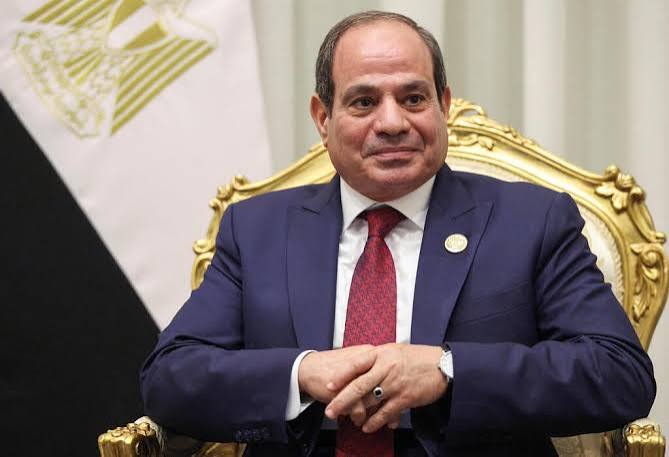
Egyptian President Abdel Fattah al-Sisi says his country’s proposed military support for Saudi Arabia would be strictly defensive and would not involve attacks on Yemen.
Sisi stated this at a government event, Egypt Forum 2026, stressing that Cairo’s proposed support would focus on protecting Saudi territory and borders.
“We are talking about defending the land and borders of the kingdom,” he said, adding that the region could not afford further instability.
He said Egypt wanted to help restore stability in countries affected by conflict.
READ ALSO: Egyptian President Rules Out Tenure Extension Beyond 2030
On Saturday, Sisi asked parliament to authorise possible military support for Saudi Arabia, if requested, amid escalating attacks by Yemen’s Houthi rebels.
The Egyptian parliament has since held two rare closed-door sessions on the proposal but postponed further deliberations until next week.
Following Sisi’s remarks on Wednesday, a high-level Egyptian delegation visited Riyadh, according to the Saudi Press Agency.
Egyptian Foreign Minister Badr Abdelatty and intelligence chief Hassan Rashad delivered a letter from Sisi to Saudi Crown Prince Mohammed bin Salman, the kingdom’s de facto ruler. The contents of the letter were not disclosed.
In recent weeks, Houthi attacks on Saudi Arabia have intensified, disrupting operations at the kingdom’s main airport and forcing the postponement of a major investment conference.
A Houthi maritime blockade has also threatened Saudi oil exports, raising concerns over the impact on the world’s largest crude oil exporter.
Saudi Arabia has since sought support from its allies. French President Emmanuel Macron, during a surprise solidarity visit to the kingdom on Wednesday, said French troops would help protect the strategic oil terminal at Yanbu on the Red Sea.
The British government also announced on Tuesday plans to deploy fighter jets to help Saudi Arabia defend itself against increasing attacks.
Concerns over military involvement
In Egypt, some lawmakers have called for clear objectives and detailed information about any possible military deployment, including an assessment of the risks to Egyptian soldiers.
Direct military involvement remains unpopular among many Egyptians, partly because of the country’s costly intervention in Yemen during the 1960s under former President Gamal Abdel Nasser.
Thousands of Egyptian soldiers were killed during the North Yemen civil war, with the campaign later compared to the United States’ war in Vietnam.
Despite these concerns, Saudi Arabia remains one of Egypt’s closest allies and a major financial supporter of Sisi’s administration since he ousted former President Mohamed Morsi in 2013.
Sisi said on Saturday that Egypt could not stand aside while Saudi Arabia’s security and stability were threatened, citing the kingdom’s support for Cairo during the early years of his administration.
Egypt joined the Saudi-led coalition in Yemen in 2015, contributing naval and air forces and deploying warships to the Red Sea and the Bab al-Mandeb Strait.
However, over the past decade, Cairo has pursued a more cautious foreign policy, placing greater emphasis on its national security and maintaining diplomatic channels with opposing sides in regional conflicts, including Hamas, Israel and Iran.
On Wednesday, Abdelatty reiterated that Egypt’s foreign policy was guided by “wisdom and strategic balance.”
The foreign minister has been in contact with his Iranian counterpart, Abbas Araghchi, who warned that Egypt’s potential involvement in the conflict could make the situation more difficult.
In an interview with Iraqi state broadcaster Al-Iraqiya on Tuesday, Araghchi said Egypt had sufficient experience to avoid becoming entangled in a complex conflict.
Throughout the year, Cairo has repeatedly urged caution as its Gulf allies have faced attacks amid the conflict involving Iran and the United States.
Egypt did not issue a military response after its port of Damietta was struck by an unidentified drone in July.
The country also stayed out of a defence pact signed by Saudi Arabia, Turkey and Pakistan in August, with analysts suggesting that Cairo wanted to preserve its strategic independence.
Beyond its close relationship with Riyadh, Egypt must also consider its economic challenges.
The country has been affected by disruptions around the Bab al-Mandeb Strait, a key maritime passage leading to the Suez Canal, whose revenues have yet to recover fully from the impact of Houthi attacks that began in 2023.