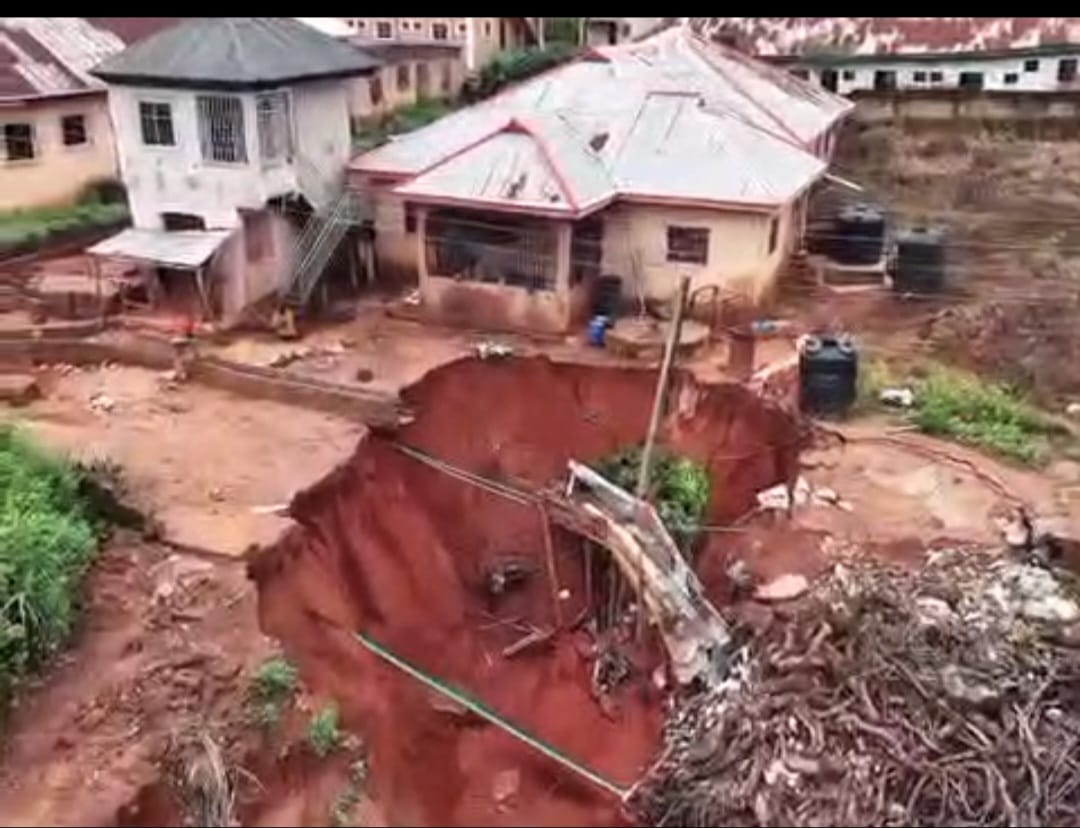
Residents of Auchi in Etsako West Local Government Area of Edo State are appealing for urgent government intervention as relentless erosion continues to threaten homes, roads, businesses and livelihoods in parts of the community.
For Mrs Adiza Shuaib, the danger is painfully close to home.
The elderly woman watches with growing anxiety as a widening gully steadily eats into the land around her house, raising fears that the building could eventually collapse.
Her home, she says, is her only major source of security. With limited means to rebuild, particularly following the death of the son she had hoped would support her, losing the building would leave her in a precarious situation.
Mrs Shuaib has therefore appealed to the Edo State Government, relevant agencies, philanthropists and other well-meaning Nigerians to come to her aid.
Her emotional appeal, which was shared on social media, has drawn attention to the growing erosion challenge in Auchi and surrounding communities.
But for residents, her predicament is not an isolated case.
Across parts of Etsako West, expanding gullies, inadequate drainage, and intense rainfall have turned what was once largely a seasonal environmental concern into a persistent threat to homes, roads, businesses and livelihoods.
A Familiar Threat
Almost every rainy season, residents prepare for the same challenge.
Water rushes through streets and drainage channels, roads become vulnerable, while stormwater cuts through exposed soil and gradually widens existing gullies.
Some residents have been forced to seek temporary refuge in other people’s homes as erosion threatens their properties.
In several villages and neighbouring communities, families are also living in areas considered vulnerable to gully erosion.
For people in Auchi, the threat is no longer something happening somewhere else.
It is happening at their doorsteps
The terrain of the area further compounds the problem. Auchi has steep slopes, low-lying areas and high-relief terrain that can accelerate surface runoff during heavy rainfall.
As rainwater moves rapidly downhill, inadequate drainage infrastructure leaves it with few controlled channels through which to flow.
Existing gutters, canals and underground drainage systems are, in some areas, undersized, damaged or inadequate to cope with the volume of runoff.
The situation is further worsened by indiscriminate dumping of refuse and plastic waste into drainage channels, which obstructs the movement of stormwater and can force water onto roads and residential properties.
The Drainage Can No Longer Contain the Water
The growing danger has also raised concern among community leaders.
The Serikin Samali of Auchi, Chief Inu Mukhtar, has appealed to the local government and other relevant authorities to urgently intervene in the erosion threatening Engineer Momoh Street, off Aviele Road, Auchi.
According to Mukhtar, the affected channel is one of the branches of the main drainage system carrying water from Usoguie Market through the Auchi-Aviele Road.
He said the situation had become more serious since the beginning of the rainy season, as rapid development in the area had increased the amount of water flowing from surrounding houses.
The drainage infrastructure, he explained, was constructed years ago and designed for a smaller volume of runoff.
With the area’s rapid development, he said, the existing system could no longer adequately contain the water.
As the volume of runoff increases, water escapes from the drainage channel, eroding the surrounding soil and gradually expanding the gully.
Residents and landlords have attempted to manage the situation themselves.
Mukhtar said they had constructed three dams to reduce the speed and volume of the water.
They had also created temporary troughs within the main drain using truckloads of wood and debris in an effort to manage the flow until the dry season.
But such measures, residents acknowledge, are temporary responses to a problem requiring permanent infrastructure.
Mukhtar is therefore calling on the local government to intervene before the erosion causes further destruction.
He urged the new administration to make the erosion challenge one of its priority projects, arguing that a lasting solution would provide much-needed relief to residents and property owners.
Government Steps Up Intervention
The concerns in Auchi come against the backdrop of increasing efforts by governments at both the federal and state levels to strengthen flood prevention, erosion control and disaster preparedness across Nigeria.
At the national level, the Federal Government has been pursuing a more proactive approach to disaster management, with greater emphasis on preventing and mitigating the effects of flooding and other climate-related emergencies.
On June 18, 2026, the National Economic Council approved N83.2 billion for interventions aimed at mitigating the anticipated impact of flooding and other climate-related emergencies across the country.
The council said the intervention reflected a commitment to proactive disaster management rather than waiting until disasters occur before responding.
The move is part of wider efforts to strengthen preparedness and early intervention as communities across the country face increasingly severe flooding and other climate-related hazards.
At the state level, the Edo State Government has also been addressing flooding and other environmental challenges through infrastructure maintenance, community engagement and emergency preparedness.
The Edo State Flood, Erosion and Watershed Management Agency, EdoFEWMA, is among the agencies involved in efforts to address the state’s environmental challenges.
Beyond Auchi
The erosion crisis in Auchi is unfolding against a wider backdrop of increasingly destructive flooding and extreme rainfall across Nigeria.
Over the past five years, flood disasters in the country have killed more than 1,500 people, displaced over 1.4 million others and destroyed homes, farmlands and critical infrastructure across several states.
Edo State has also experienced significant flooding in recent years.
Torrential rainfall and the overflowing River Niger have caused extensive destruction in parts of the state, affecting urban and riverine communities and damaging infrastructure, residential properties and farmlands.
In the Illushi community in Esan South-East Local Government Area, for instance, flooding from the River Niger has reportedly submerged a large part of the community, forcing families from their homes.
Several other communities in the same local government area, including Ifeku and Udaba, have also reportedly been severely affected by floodwaters.
Large areas of farmland have been lost, threatening crops including yam, cassava, groundnuts, rice and maize.
The consequences go beyond the destruction of physical structures.
When farms are washed away, livelihoods disappear. When roads are damaged, movement becomes difficult. When homes are threatened, families are forced to spend scarce resources on repairs, relocation or temporary protection.
A Community Under Pressure
In Auchi, residents say they are increasingly bearing the cost of an environmental problem that is beyond what individual households can solve.
The construction of makeshift barriers and temporary drainage channels may slow the water, but they cannot replace properly designed drainage infrastructure capable of handling the volume of runoff generated by the growing population and expanding built-up areas.
For vulnerable residents such as Mrs Shuaib, the stakes are even higher.
Her appeal has resonated because her situation captures the fear confronting many homeowners in erosion-prone parts of the community: the fear of watching years of investment disappear as the ground beneath and around their homes is gradually carried away.
Residents say action is needed to control the gully, protect vulnerable buildings and rehabilitate damaged infrastructure.
They are calling not only for emergency intervention but also for sustainable erosion-control measures, improved drainage systems, regular maintenance and better management of waste.
The Way Forward
For Auchi residents, the challenge is to ensure that intervention goes beyond temporary measures and addresses the underlying causes of the erosion.
The ongoing government efforts at the federal and state levels provide an opportunity to strengthen preventive measures, improve infrastructure and support communities facing environmental threats.
But for Mrs Shuaib, the need is immediate.
Her home remains standing, but the erosion around it continues to advance.
And every downpour reminds her that the ground beneath her feet is no longer something she can take for granted.