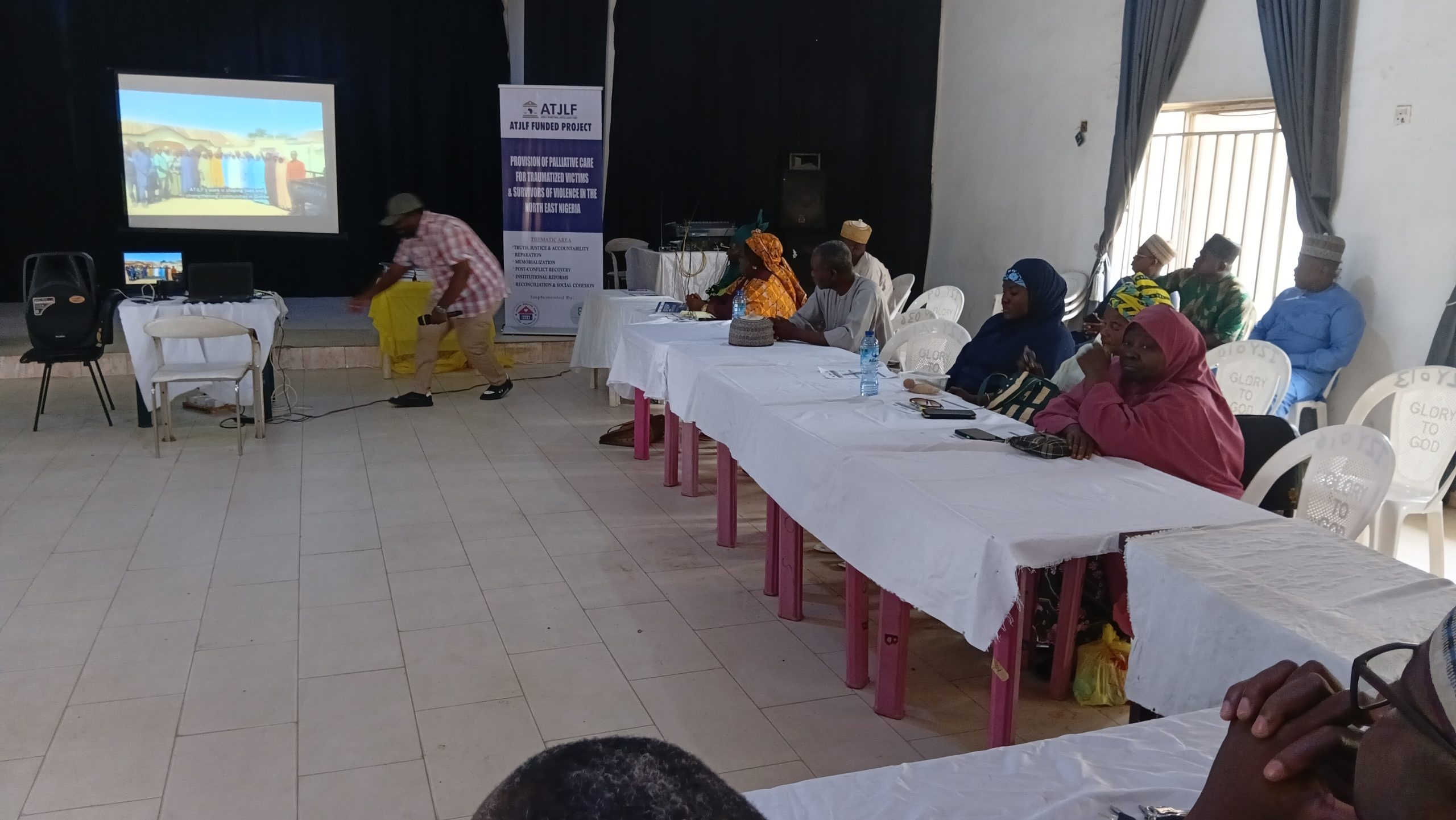
Kishimi Shelter and Care Foundation, in collaboration with the African Transitional Justice Legacy Fund (ATJLF), has put in place sustainable structures to ensure the continuity of mental health support for internally displaced persons (IDPs) in Gombe State, even after a two-year project officially comes to an end.
This was revealed during the closing ceremony of the project, which was organised and funded by the African Transitional Justice Legacy Fund (ATJLF) from Ghana.
The stakeholders’ engagement on transitional justice was held to wrap up the foundation’s activities and to determine what lasting mechanisms could be left on the ground.
The Executive Director of the Kishimi Shelter and Care Foundation, Grace Tony Samuel, explained that the primary aim of the closing event was to ensure the kind of sustainability structures would be placed on the ground so that there will be continuity.
“That is what this programme today was aimed at. We brought in stakeholders for them to know what we have done and for them to know what we can do together after the whole thing is over,” Samuel said.
Reflecting on the project’s achievements over the past two years, Samuel noted that the intervention had reached a significant number of displaced people.
“We have enrolled internally displaced persons across six local governments. We have enrolled more than a thousand on the whole,” she said.
She stated that the foundation had trained roughly 200 lay counsellors, who had been provided treatment for more than 200 traumatised survivors who visited hospital doctors.
“We signed a memorandum of understanding with Aliyu Pharmacy where they pick up their drugs every month,” she said. “The foundation also established safe spaces in several locations, including Kaltungo, Billiri, Gombe, Akko and Funakaye.”
Describing the impact on local communities, Mrs Samuel recalled the testimony of one survivor who had since become an advocate.
“Seeing some of them that testify today, you can see that something really has happened. If you saw her before, she was a shadow of herself, but you can see how radiant she is. Now she has taken it upon herself to become an advocate,” she said.
She explained that the survivor now moves from house to house, encouraging fellow IDPs to bring out their children.
“Every Thursday she brings them to see the medical doctor. You don’t necessarily have to become a professional before you can counsel,” she said.
She also noted that local clergy and community leaders have learned how to offer basic counselling, pointing to a newly produced manual that provides step-by-step guidance on offering support and making referrals.
Corroborating Mrs Samuel’s testimony, Mrs Saratu Joshua, an internally displaced person (IDP) from the Damaturu Local Government Area of Yobe State, described the psycho-social support provided by Kishimi Shelter and Care Foundation as life-changing.
A survivor of a Boko Haram attack that killed nine people in her community and left her injured in a bomb blast, Joshua said she struggled with trauma, insomnia and emotional distress before receiving help.
She also commended the foundation for providing free medications and psycho-social support, which eased the financial burden of treatment and enabled her to continue receiving care consistently.
Joshua said the intervention significantly improved her well-being and restored her hope.
She expressed gratitude to the foundation, noting that its efforts have transformed lives and fostered a strong network of survivors supporting one another’s recovery.
For Haruna Adam of the Atmayo Community Development Initiative, the programme had helped his group become self-sufficient.
“Through their mentorship, we were able to stand on our own. They mentored us to register ourselves with the Corporate Affairs Commission,” Adam said.
He stated that the foundation had helped establish four safe spaces in the Billiri area and that, through these efforts, his group created a village savings and loan scheme.
“We said a person will invest by putting 5,000 naira as a share. The limit is four shares, that is, 20,000 naira. At the end, we give it out as a loan to empower our members so they can get the kind of capital they will start with,” he said.
He described the overall impact as greatly appreciated.
“As an individual, you have grown to a certain level. About 30 people in my group have benefited economically.”
The foundation confirmed that the newly developed manual also addresses gender-based violence (GBV) cases, with a clear referral pathway to ensure all GBV reports are properly handled.