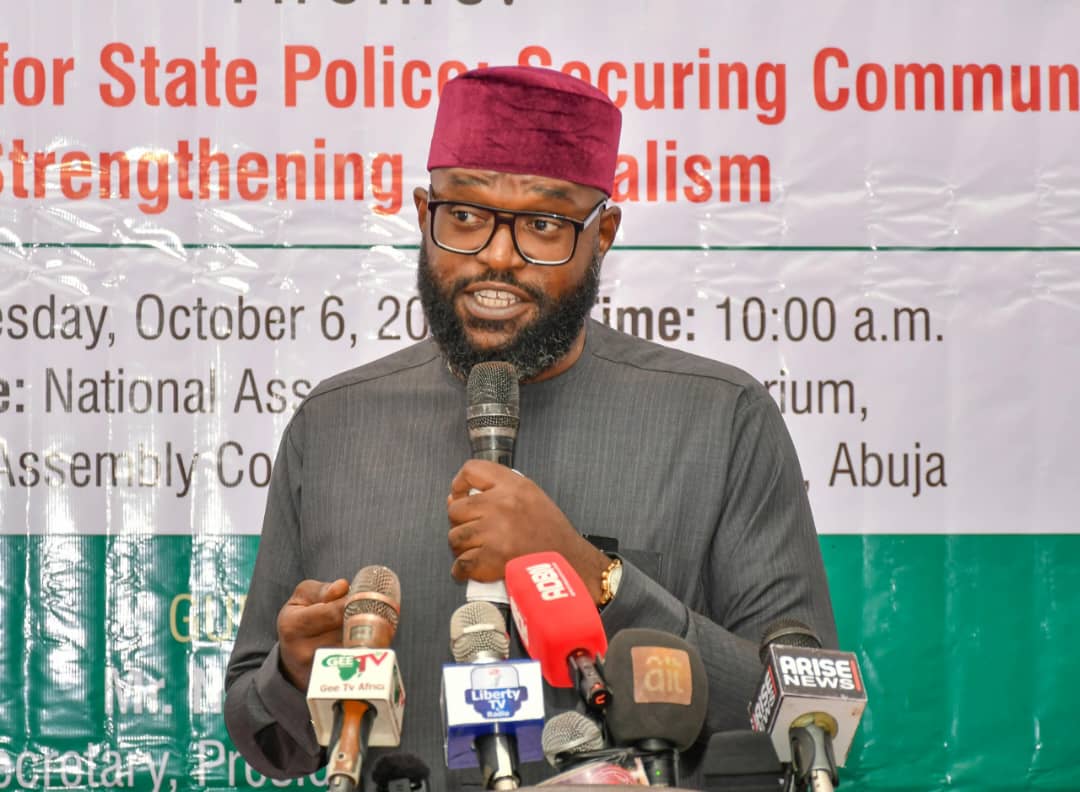
The Presidential Working Group on the National Policing Bill says State police will strengthen security and make federalism work better for Nigerians.
The Senior Special Assistant to President Bola Tinubu on Planning and Research, Mr. Nnadubem Moghalu stated this at the 2nd Annual Distinguished Parliamentarian Lecture and Award Series organised by the House of Representatives Press Corps in Abuja.
Moghalu who is also the Secretary of the Presidential Working Group on the National Policing Bill warned that state police must not become an instrument for political persecution.
He said that while decentralised policing could improve response to local security threats, adequate safeguards must be built into the system to prevent governors or local majorities from abusing the police.
Moghalu also said that “the proposed system must be capable of protecting Nigerians regardless of their political affiliation, social status or connections.”
“Our institutions must be designed to work even when people we distrust hold power. Personal assurances from today’s office holders cannot carry that responsibility. Therefore, the law must define authority clearly and make its misuse answerable.” he said.
Moghalu stated that there is a risk that a governor could pressure state police officers to target political opponents, while local majorities could also attempt to use the police against minorities.
He said the proposed reform was therefore not simply about creating more police formations but building institutions capable of operating professionally under different political administrations.
According to him, the constitutional amendment Bill required to establish the basis for a dual policing structure had been transmitted to the State Houses of Assembly.
He disclosed that Edo, Rivers, Osun and Oyo states had approved the Bill at the time of the lecture, adding that 24 states were required for the constitutional amendment process to succeed.
Moghalu noted that the proposed National Policing Bill would provide the operational framework for implementing state police once the constitutional foundation was established.
He explained that the Presidential Working Group, chaired by the President’s Chief of Staff, Femi Gbajabiamila, had begun drafting the Bill ahead of the completion of the constitutional process to avoid delays in recruitment, training, infrastructure and administrative preparations.
He said the group had also consulted academics, lawyers, civil society organisations, community groups, political organisations and security agencies as part of the process.
Moghalu however warned against a reform that would merely “federalise the status quo” by replicating existing policing deficiencies at the state level.
He said; “The Nigerian who needs the police at three in the morning should be able to get help without influence, without payment demanded as the price of protection, and without first becoming a national news story.”
He added that funding, equipment, training, welfare and accountability would be critical to the success of the proposed system, stressing that legislation alone could not transform policing.