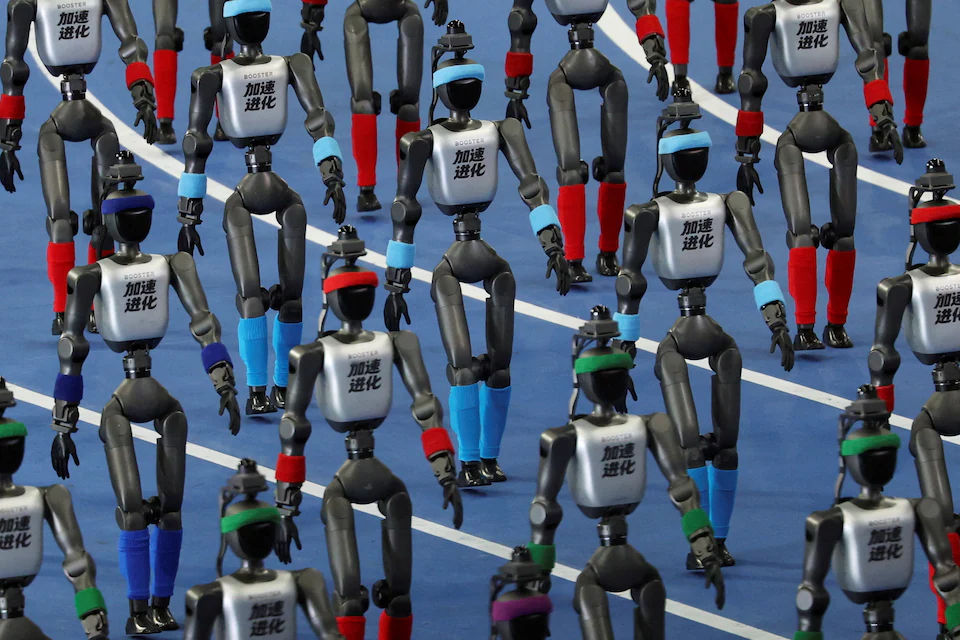
Humanoid robots are being tested beyond athletic competition at the ongoing second World Humanoid Robot Games in Beijing, with contests designed to assess their ability to perform practical workplace tasks.
At a makeshift restaurant ahead of the games’ official opening on Saturday, a humanoid robot used tongs to pick up a snack, placed it in a microwave, adjusted the timer and moved on to another order under the supervision of judges.
The event, which runs through Wednesday, has attracted 666 teams and 2,056 robots from 16 countries and regions across six continents. Team participation has quadrupled from last year’s inaugural edition, while the number of competition events has risen from 26 to 51 and matches from 487 to 1,301.
Twenty-one of this year’s events are scenario-based, simulating workplaces such as factories, hotels, homes and logistics facilities. Tasks include industrial assembly, housekeeping, emergency rescue and library book sorting, focusing on activities that may be repetitive, physically demanding, dirty or dangerous.
In a hotel-service contest, more than 10 teams were given 30 minutes to move luggage of different sizes, replenish guest-room supplies and make beds.
“Judges look at how many tasks the robot completes, whether there are collisions and how smoothly it performs,” an organiser said.
The restaurant contest also tested precision, requiring robots to set a microwave timer to five minutes, with deviations of more than one minute resulting in deductions. Robots could also lose points for spilling excessive amounts of liquid while delivering prepared drinks.
A new dexterous-hand competition features eight high-precision tasks, including assembling power tools, picking beans with tweezers, weighing powder, opening bottle caps and connecting flexible cables.
Liu Weiliang, deputy head of the Beijing Municipal Bureau of Economy and Information Technology, said organisers surveyed stakeholders in commercial services, landscaping inspection and emergency rescue before designing the contests.
He said some tasks were modelled on supermarket work, including restocking shelves at night, packing delivery orders and returning misplaced goods.
“Every task completed is effectively a trial run in a real-world scenario,” said Liu. “There is no need to rebuild the same testing environment after the competition. Performance on the field itself provides evidence of commercial viability.”
The games have also raised requirements for autonomous operation. Apart from the 100-metre and 400-metre hurdles, all track and other competitive events require full autonomy. In scenario-based events, fully autonomous robots receive a scoring coefficient of one, compared with 0.5 for remotely controlled machines.
Jiang Guangzhi, head of the Beijing Municipal Bureau of Economy and Information Technology, said many of the competition rules were expected to evolve into practical technical standards, helping translate technological advances into industrial applications.
“Once robots master these ‘last-meter’ skills, they can turn medals into orders and move directly from the competition arena to real-world workplaces,” Jiang said.
At the 2026 World Robot Conference in Beijing, Xu Xiaolan, chairwoman of the Chinese Institute of Electronics, said China’s humanoid robot industry had entered a critical stage of large-scale commercialisation and deployment, with embodied-intelligence products moving from small-scale trials towards wider adoption.
However, significant technical challenges remain.
READ ALSO: World Cup of Robotics, AI Kick Off In Brazil
Wang Xingxing, founder of Unitree Robotics, identified limited generalisation capability as a major bottleneck for the global humanoid robot industry. He said robots could achieve task success rates close to 100 percent in controlled environments when AI models were trained on sufficient data, but performance could decline sharply when objects or surroundings changed.
Wang said “a ChatGPT moment in embodied intelligence” would come when a robot could operate in an unfamiliar environment and complete about 80 percent of everyday tasks using simple voice or text instructions.
He said such a breakthrough could occur within two to three years, or within five to 10 years at the latest.
Liang Hongjun, an official with the Beijing Municipal Bureau of Economy and Information Technology, said the World Humanoid Robot Games also served as a testing ground for assessing technological progress and giving companies, investors and the public a clearer picture of the industry’s development.
“The industry is moving from telling technology stories to delivering real-world applications, and from pure technology development toward products and services,” Liang said.
He added that the transition would require companies to continue technological innovation, while governments and industry organisations open up application scenarios, develop standards and establish safety boundaries.
Xinhua