

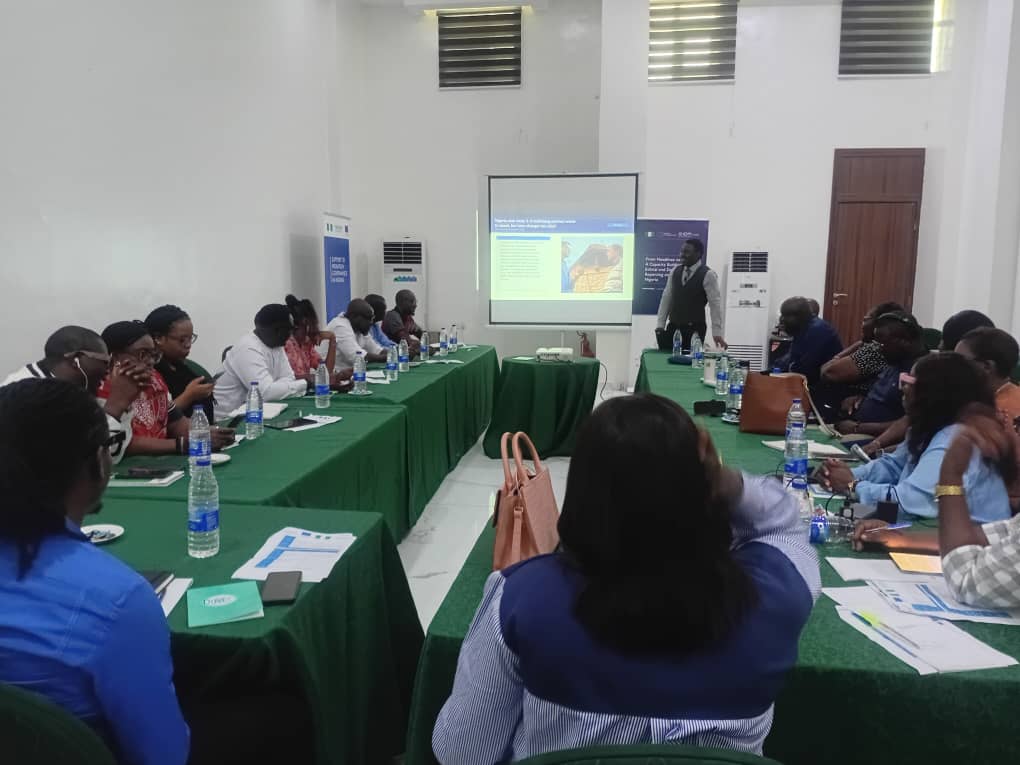
The International Organisation for Migration (IOM) is training Nigerian journalists on ethical and data-driven reporting of migration and displacement issues at a three-day workshop in Lagos.
The training, titled “From Headlines to Impact: Capacity Building on Ethical and Data-Driven Reporting on Migration in Nigeria,” is organised in collaboration with Nigerian government agencies and United Nations partners.
The workshop brings together journalists from across the country to strengthen responsible reporting on migration and displacement while promoting accurate and fact-based storytelling.
Participants are being equipped with skills to analyse and interpret migration data, combat misinformation, and apply conflict-sensitive approaches when covering migration-related issues.
According to the organisers, the training is designed to enhance the capacity of media professionals to report migration trends and displacement challenges in a manner that upholds ethical standards and supports informed public discourse.
The workshop also provides a platform for engagement between journalists, migration experts, government representatives, and development partners on emerging migration issues in Nigeria.
Organisers expressed optimism that the training would contribute to improved media coverage of migration by encouraging evidence-based reporting and balanced narratives that reflect the realities of migrants and displaced persons.
The three-day programme is expected to strengthen collaboration between the media and stakeholders working in the migration sector, while fostering greater public understanding of migration dynamics in Nigeria.
It also introduced journalists to innovative data-driven journalism techniques and human-interest storytelling methods aimed at amplifying the voices and experiences of migrants and vulnerable populations.
Speaking at the opening session, IOM Head of Sub – Office, Lagos Ali Ibrahim, emphasised the critical role of the media in shaping public understanding of migration.
He said; “Journalists are key partners in ensuring that migration narratives are accurate, balanced, and grounded in facts. Through ethical reporting, the media can help dispel misconceptions and foster informed public discourse.”
According to Ibrahim, journalists have a responsibility to tell stories that accurately reflect the realities migrants face and to help the public better understand the complex factors driving migration.
Ibrahim stressed that migration should first be understood as a human issue rather than merely a policy or security concern.
“Migration is many things to many people, but in the real sense, the reality is about people. People, real people with real stories. We want to talk about how we are going to tell their stories in a way that humanises them, dignifies them, and allows us to share their experiences together,” he stated.
As part of efforts to deepen that understanding, Ibrahim said that journalists participating in the workshop would witness the arrival of a charter flight evacuating stranded Nigerians from Libya and interact with returnees at a transit centre.
He said that the engagement would provide firsthand insight into the challenges encountered by migrants and the difficult circumstances that compel many to undertake risky journeys.
Also speaking, the Project Assistant with the IOM Awareness Raising Team, Fatima Adeyemi highlighted ongoing efforts to address displacement and migration challenges across Nigeria.
Adeyemi noted that the agency’s interventions in northern Nigeria focus on supporting populations displaced by conflict through shelter, sanitation, protection services and access to energy.
She explained that the organisation’s southern operations are primarily aimed at promoting safe and orderly migration while strengthening migration governance systems.
Adeyemi said that the IOM is working with the Economic Community of West African States (ECOWAS) to improve regional migration management through stronger border systems and enhanced data infrastructure.
Earlier, Senior Communications Assistant, Elijah Elaigwu said the workshop was organised to strengthen journalists’ capacity to report migration issues accurately and responsibly.
“The goal is to empower journalists to better communicate migration issues to the public, promote humane and orderly migration, and ensure that those who choose to migrate do so through the right and safe channels,” he said.
On his part, IOM Nigeria Head of Migration Data Analytics and Research, Wani Denis Andrew spoke on the importance of utilising verified data and evidence in migration reporting to counter stereotypes and misinformation.
“Data-driven journalism allows reporters to move beyond assumptions and present migration issues in a way that is factual, nuanced, and impactful,” Andrew stressed.
Throughout the workshop, participants engaged in expert-led sessions, practical exercises, case studies, and group discussions designed to deepen their understanding of migration dynamics in Nigeria and beyond.
They also expressed confidence in applying their newly acquired skills to produce more accurate, balanced, and compelling reports on migration and displacement.
The training forms part of broader efforts by IOM and its partners to strengthen media engagement and promote informed public dialogue on migration issues in Nigeria.

 is training Nigerian journalists on ethical and data-driven reporting of migration...)