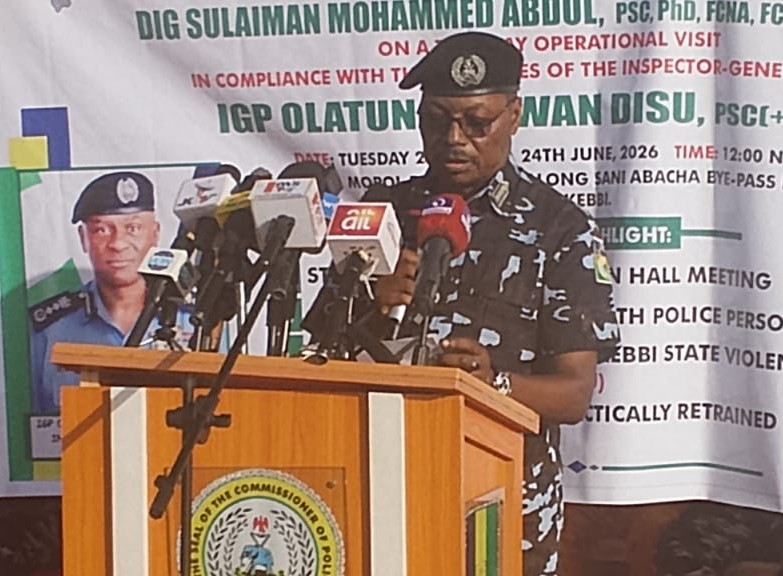
The Deputy Inspector General of Police in charge of the Northwest Geopolitical Zone, DIG Sulaiman M. Abdul, has called on officers of the Kebbi State Police Command to strengthen efforts in securing waterways, protecting farming communities, and combating transnational smuggling.
The charge came during a strategic assessment visit to Kebbi State, where the DIG also attended the passing-out parade of retrained police constables and the official launch of the Violent Crime Response Unit, known as the VCRU.
Welcoming the delegation, the Commissioner of Police, Kebbi State Command, CP Umar M. Hadejia, said the visit reflects the commitment of the Inspector-General of Police, IGP Olatunji Rilwan Disu, to strengthening the security architecture of the Nigeria Police Force, improving service delivery, enhancing personnel welfare, and boosting officers’ morale.
READ ALSO: Police Seek Stronger Community Partnership to Combat Crimes
The Commissioner disclosed that the Command currently has more than 800 police constables, with 436 officers successfully completing a retraining programme.
He said many of the officers have also been certified to carry firearms, a development expected to improve operational effectiveness across the state.
CP Hadejia noted that Kebbi remains a frontline state due to its extensive international borders with the Republics of Niger and Benin, as well as its boundaries with Sokoto, Zamfara and Niger states.
According to him, criminal elements, including bandits and other armed groups, frequently exploit the border corridors to launch attacks and evade arrest.
He said the Command has continued to implement intelligence-led policing, community policing initiatives and close collaboration with other security agencies. “Within the last month, 14 suspects linked to violent crimes, including banditry, kidnapping, armed robbery and homicide, were arrested, while a kidnapped victim was rescued unharmed.
The Commissioner, however, identified manpower shortages, inadequate logistics, insufficient operational vehicles and funding constraints as major challenges affecting security operations in the state.
He appealed for the provision of surveillance equipment, including drones, tracking devices and other operational assets to enhance policing and intelligence gathering.
CP Hadejia also commended the Inspector-General of Police for approving an additional Police Mobile Force Squadron currently under construction in Zuru.
He further requested approval for the establishment of a Special Intervention Squad, saying the unit would significantly improve the Command’s response to emerging security threats.
In his lecture to officers and men of the Command, DIG Abdul emphasised the importance of intelligence-led and technology-driven policing, strict accountability, community engagement, inter-agency collaboration, operational professionalism and personnel welfare.
He conveyed a message from the Inspector-General of Police, commending officers for recent operational successes against criminal elements and encouraging them to sustain proactive policing strategies.
The DIG urged officers to strengthen riverine patrols and improve cooperation with local communities, transport unions and traditional institutions to tackle criminal activities along waterways and border communities.
He also called for enhanced intelligence sharing with neighbouring commands through joint security operations and the expansion of “Handshake Patrols” to prevent criminals from exploiting jurisdictional boundaries.
DIG Abdul further stressed the need for proper documentation of criminal incidents through the Nigeria Police Force Crime and Incident Database to improve intelligence analysis and support predictive policing.
He warned against corruption, extortion and other forms of misconduct, especially at border checkpoints and highway corridors, saying such practices undermine public trust and weaken security efforts.
The Deputy Inspector-General reaffirmed the commitment of the Nigeria Police Force to protecting lives and property, while urging officers to maintain professionalism, uphold human rights and strengthen partnerships with communities across Kebbi State.