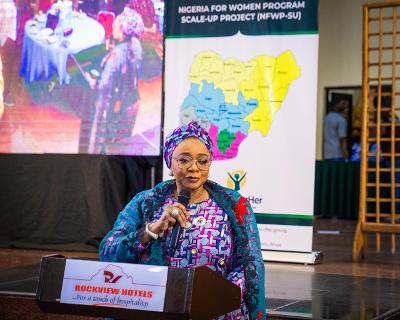
The Minister of Women Affairs and Social Development, Hajiya Imaan Sulaiman-Ibrahim, has charged stakeholders to accelerate the Nigeria for Women Programme Scale-Up (NFWP-SU) towards reaching 20 million women.
She declared that the next phase must be about building systems capable of delivering women’s economic power at scale.
Sulaiman-Ibrahim gave the charge during the Implementation Support Mission of the NFWP-SU, organised by the World Bank Group in Abuja.
She said the programme had already demonstrated that community-based structures could create a viable pathway to women’s economic empowerment and prosperity.
According to the Minister, the programme had established more than 44,000 Women Affinity Groups (WAGs), with over one million women collectively saving more than ₦7 billion in less than one year of active field-level implementation.
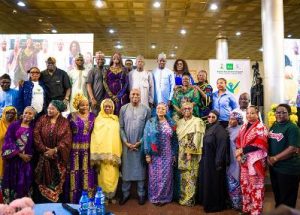
“The goal is for us to be able to do so well, to fast track so that we’re able to expand because the target within the available financing to reach a minimum of 4.5 million women. We must expand to 20 Million,” she declared.
READ ALSO: Women Minister Reaffirms Commitment to Grassroots Women’s Economic Empowerment
The Minister said the expansion would require joint ownership by the Federal and State project units, the World Bank and other stakeholders.
She stressed that the scale of the ambition could not be achieved through fragmented implementation.
“This lies on all of us not just the states and their project units, not just the National project unit, not just the world bank, we have to work together to be able to achieve that,” she said.
The Minister said that collaboration with the World Bank and sub-national governments had enabled the development of an integrated system designed to support women across multiple dimensions.
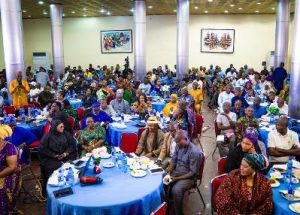
“In collaboration With the World Bank and sub-nationals we were able to find a working system, that actually helps women develop in 360 degrees,” she said.
Sulaiman-Ibrahim said the programme was deliberately creating community-level structures that would enable women to determine their own pathways to prosperity, while strengthening the systems required to sustain that progress.
She described the intervention as a major continental investment in women, noting that its unprecedented scale made effective coordination, accountability and rapid implementation critical.
“Its not easy to do a programme at this scale because its not been done in Africa so this is the biggest investment in the women space on the continent,” she said.
The Minister also announced plans to strengthen strategic communications, saying beneficiaries must be empowered to document and amplify the impact of the programme in their communities.
“The programme is the best kept secret in Nigeria so its very important that we tell stories as they are,” she said.
She disclosed that the Coordinating Office would establish a strategic communications team to train women to tell their stories, beginning with 12 pilot states before expanding nationwide.
Sulaiman-Ibrahim urged the project coordinating units to use the mission to close implementation gaps, strengthen accountability and sustain momentum.
The Minister added that the ultimate measure of success was not the number of groups created but the lasting economic opportunities generated for Nigerian women.