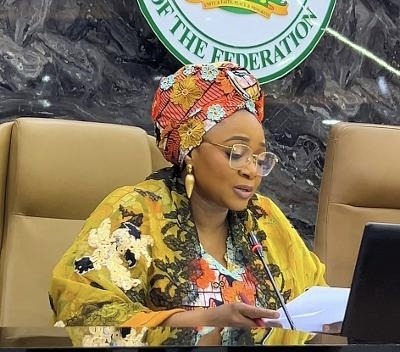
Nigeria’s Minister of Women Affairs and Social Development, Hajiya Imaan Sulaiman-Ibrahim, has charged Permanent Secretaries and public finance managers to embed women’s economic empowerment in government plans and budgets.
Sulaiman-Ibrahim spoke in Abuja at a workshop organised by the Head of the Civil Service of the Federation, in collaboration with the Federal Ministry of Women Affairs and Social Development, on gender-responsive leadership and women’s economic empowerment.
She expressed that Nigeria could not achieve sustainable growth while nearly half of its productive capacity remained constrained.
READ ALSO: Women Minister Reaffirms Commitment to Grassroots Women’s Economic Empowerment
The Minister said the workshop was significant because Permanent Secretaries, the Accountant-General of the Federation and the Auditor-General for the Federation represented the implementation chain from plans to funded programmes and outcomes.
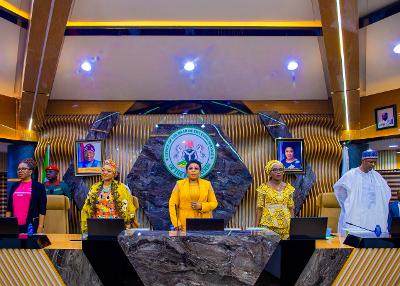
“What is missing is not will. It is transmission. It is the machinery that carries a policy from the page into the ledger, and from the ledger into a citizen’s hands,” the minister emphasised.
Sulaiman-Ibrahim stated that gender-responsive leadership was not goodwill, but decisions on sector strategies, budget ceilings, releases, procurement, monitoring, postings and promotions.
She described the Women’s Economic Empowerment Policy, launched in 2023, as a whole-of-government framework built around five pillars: agriculture, entrepreneurship, labour market, emerging industries, and education and skills, supported by cross-cutting enablers, including gender-responsive and data-driven government processes.
“My Ministry cannot write another Ministry’s sector strategy. It cannot sign another Ministry’s budget submission. It cannot open an account code or determine the scope of an audit. Only the officers seated here can do those things,” she said.
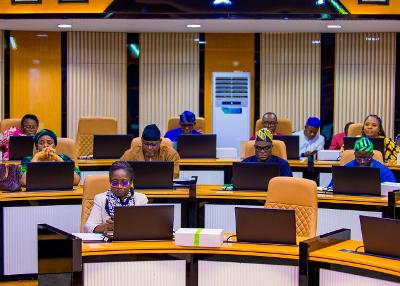
Sulaiman-Ibrahim said the policy had been domesticated in Kaduna, Kano and Lagos States, while the Presidential High-Level Advisory Council on Support for Women and Girls was mobilising multisectoral and private-sector support.
She urged Permanent Secretaries, as Accounting Officers, to take ownership of the budgetary process.
The Minister said Nigeria’s gender gaps imposed an economic cost, citing joint analysis by the World Bank and UN Women, which estimated that the country forfeited about N3.5 trillion annually from gender gaps in agriculture alone, rising to N12.2 trillion with spillover effects.
Accordibg to her, women constituted over 40 per cent of micro, small and medium enterprises but received less than 15 per cent of formal financing, describing the disparities as “systemic economic inefficiencies.”
She highlighted the expansion of the Nigeria for Women Programme to target 25 million beneficiaries and the integration of the Women’s Economic Empowerment Policy into Renewed Hope Social Impact Interventions across the 774 Local Government Areas.
“Women’s economic empowerment is not optional. It is central to Nigeria’s growth, our productivity and our long-term stability, and it is a pathway not only for Nigerian women but for all of Nigeria to reach its potential as the Giant of Africa,” the Minister said.
She said the agenda would be measured by tangible improvements in Nigerian women’s lives and economic opportunities.