The Minister of Women Affairs and Social Development, Hajiya Imaan Sulaiman-Ibrahim, has called on financial institutions, state governments and development partners to reform their approach to supporting women’s economic participation.
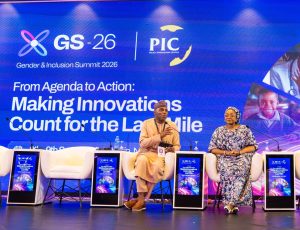
Sulaiman-Ibrahim made the call during a Ministerial Fireside Chat at the 2026 Gender and Inclusion Summit (GS26) in Abuja.
The session, moderated by Senior Social Development Specialist at the World Bank, Mr Michael Ilesanmi, was titled, “Lessons from the Nigeria for Women Project: Expanding Pathways to Women’s Economic Participation and Empowerment.”
READ ALSO:Women Affairs Minister Drives Economic Inclusion For Growth
The minister identified access to finance, stronger sub-national ownership and improved coordination as critical to expanding women’s economic participation.
She urged financial institutions to design products around women’s realities rather than credit models that exclude viable businesses.
“One of the asks is for the financial institutions and the simple ask is for them to design for women who actually exist, not the borrowers your credit models was built for,” she said.
Sulaiman-Ibrahim said lenders should recognise women’s collective strength and business records as credible indicators of their capacity.
“They should lend against the group because the group is her security. Now women move in collectives and that should be security enough for them,” she said.
The minister also called on state governments to co-finance and localise the Nigeria for Women Programme, stressing that sub-national ownership would determine its sustainability and effectiveness.
“For the states, the state government is to co-finance and localise,” she said.
In her third call, Sulaiman-Ibrahim urged development partners to align their interventions with national systems instead of operating parallel programmes.
“And the last ask is for the development partners in the room to please align rather than run parallel instruments,” she said.
She said greater coordination was particularly important as development financing declines.
“When global development financing is shrinking, coordination is how we protect coverage,” she said.
Sulaiman-Ibrahim said the pilot phase of the programme was supported with 100 million dollars, while the second phase started with 540 million dollars and attracted an additional 90 million dollars through government support.
She identified women’s growing savings culture as one of the programme’s key achievements.
“Presently, between this pilot and the scale-up programme, we’ve seen almost about a million women save 10 billion naira of their money,” she said.
Beyond savings and income, the minister said the programme was helping women address interconnected social challenges, including education, nutrition, gender-based violence and civic participation.
“The lessons remain that when women are given structures and systems, their productivity can go to a different level beyond our expectations,” she said.
Sulaiman-Ibrahim said sustainability would depend on policy, community ownership and institutionalisation, noting that the government was reviewing and developing frameworks to support the programme’s expansion.
She added that the ministry would open its programme pipelines to institutions willing to test women-focused financial products at scale.
The minister also urged partners to work through shared monitoring frameworks to strengthen coordination and impact.
The GS26 Summit, convened by the Policy Innovation Centre, was themed, “From Agenda to Actions: Making Innovations Count for the Last Mile.”