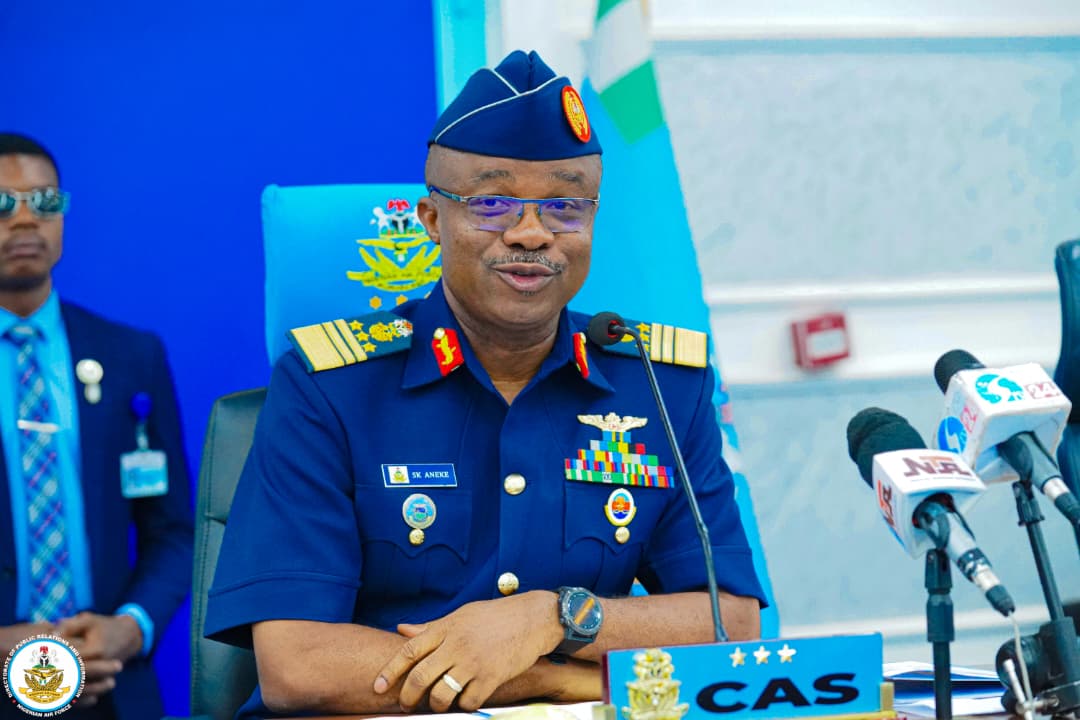
The Chief of the Air Staff (CAS), Air Marshal Sunday Aneke, has charged Nigerian Air Force (NAF) public relations and information personnel to strengthen their strategic communication capabilities, describing effective media engagement and crisis communication as critical to modern military operations.
The CAS gave the charge while declaring open the 2026 Directorate of Public Relations and Information (DOPRI) Annual Media Workshop and Meeting with Information Officers at the Headquarters of the Nigerian Air Force, Abuja.
The workshop, themed “Enhancing Strategic Media Operations of Nigerian Air Force Public Relations and Information Personnel Through Capacity Building in Crisis Management Skills,” brought together NAF information officers, senior military officers, media practitioners and communication experts to examine emerging challenges in the information environment.
Represented by the Chief of Policy and Plans, Air Vice Marshal Abubakar Abdullahi, the CAS said the contemporary information space had become increasingly complex and contested, with misinformation, disinformation and hostile narratives capable of undermining military operations and eroding public confidence.
According to Aneke, strategic communication has evolved beyond a support function to become an operational necessity that directly contributes to mission success.
“As Information Officers, you represent the voice and image of the Nigerian Air Force. Your responsibilities extend beyond issuing press releases and organising media engagements. You are strategic communicators entrusted with shaping public understanding of our operations, projecting professionalism, preserving institutional credibility and strengthening public trust in the Service,” he said.
READ ALSO: NAF Neutralises Nine ISWAP Fighters in Borno
Aneke stressed that every communication, engagement and crisis response must reflect accuracy, professionalism, integrity and timeliness.
Effective Strategic Communication
The CAS linked effective strategic communication to his command philosophy of enhancing and sustaining a highly motivated, professional and mission-ready force capable of delivering decisive airpower in synergy with surface forces to achieve national security objectives.
Aneke urged participants to take full advantage of the workshop, which he said was designed to expose them to contemporary trends in strategic communication, crisis communication, media relations, digital engagement and information management.
He also commended the Director of Public Relations and Information and members of the organising committee for sustaining the annual capacity-building initiative, describing it as a vital platform for professional development, innovation and institutional learning.
Earlier, the Director of Public Relations and Information, Air Commodore Ehimen Ejodame, highlighted the growing importance of information operations in modern warfare, noting that military campaigns are now contested not only on the battlefield but also within the information environment.
He said public relations and information personnel must recognise their role as strategic communicators whose work directly supports operational and strategic objectives.
“Whether we are photographers, videographers, reporters, graphic designers, social media managers or public relations officers, we are primarily strategic communicators. Our role is to synchronise and maximise communication activities in support of operational and strategic objectives,” Ejodame stated.
He emphasised that credibility remained the most valuable asset of any information officer, warning that while it takes years to build trust, it can be lost in moments through careless communication.
The workshop featured a keynote lecture by the Director-General of Voice of Nigeria (VON), Mallam Jibrin Baba Ndace, titled “Maintaining Strategic Media Relationship: Best Practices for NAF Public Relations and Information Officers.”
Ndace described the media as a strategic partner in contemporary security operations and urged military information officers to cultivate professional relationships with journalists before crises emerge.
According to him, military operations now unfold simultaneously in both physical and information domains, making effective communication indispensable to operational success.
Need for Transparency
Drawing lessons from previous NAF operational experiences, including crisis management responses to airstrike investigations and aviation incidents, Ndace stressed the need for transparency, stakeholder engagement and timely communication.
He outlined 10 key principles for effective media relations, including building relationships before crises, prioritising credibility over publicity, balancing speed with accuracy, understanding media requirements, ensuring spokesperson accessibility, strengthening internal communication, monitoring narratives, avoiding unnecessary confrontation with the media, and balancing transparency with operational security.
Practical Communication Framework
The VON Director-General also introduced a practical communication framework built around the “5Cs” of crisis communication — Clarity, Credibility, Consistency, Compassion and Continuity.
He warned that emerging technologies, particularly artificial intelligence, had increased the risks posed by misinformation and fabricated content, making credible and timely official communication more important than ever.
The workshop also featured panel discussions by retired senior officers and former NAF spokespersons, who shared practical experiences and lessons from managing military-media relations during various operational and crisis situations.
Participants are expected to develop strategies for improving public engagement, countering misinformation and enhancing the effectiveness of NAF communication efforts in support of national security objectives.
The annual workshop forms part of the Nigerian Air Force’s broader efforts to strengthen institutional communication capacity and reinforce public confidence in its operations across the country.