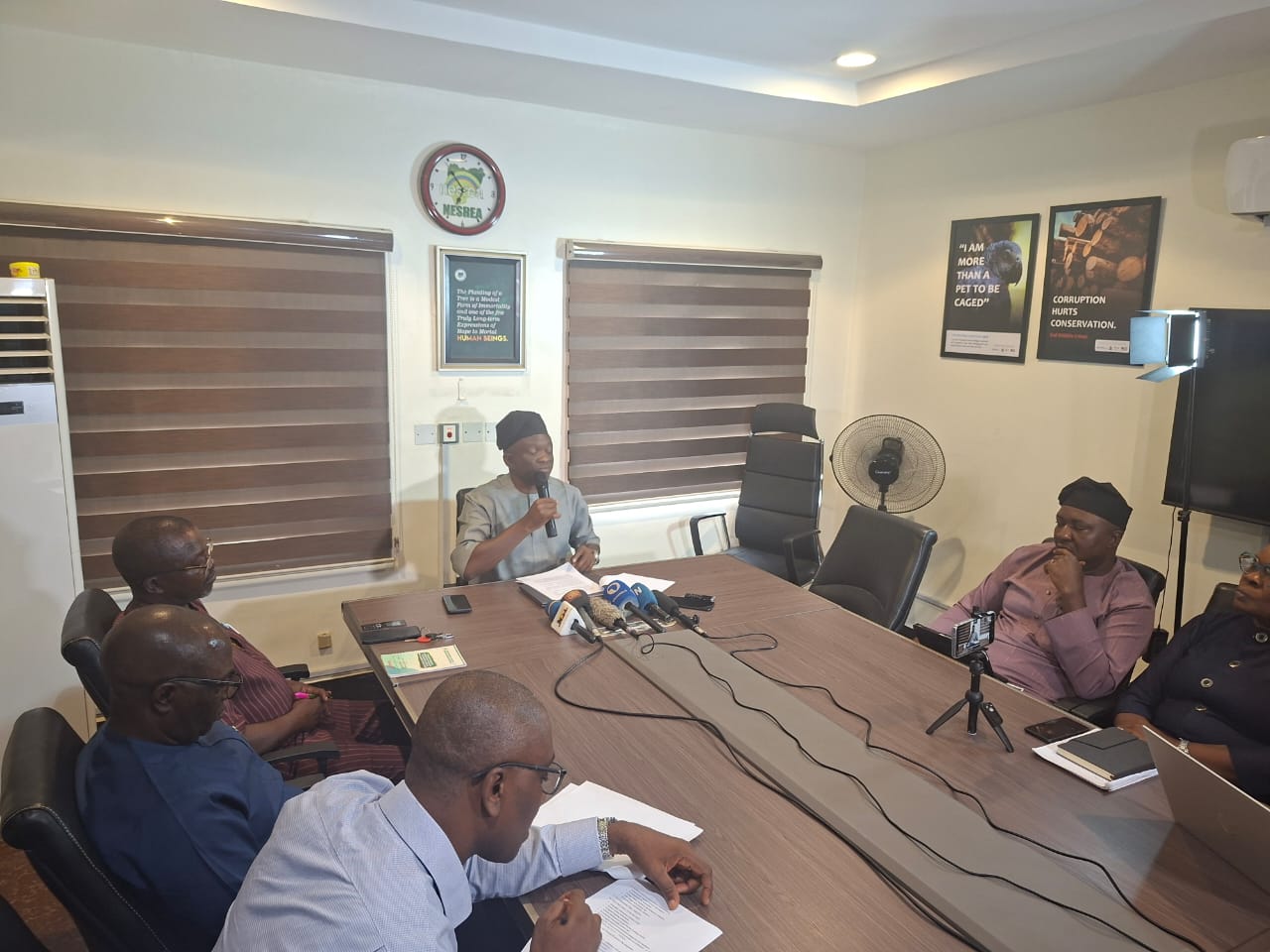
The National Environmental Standards and Regulations Enforcement Agency, NESREA, says the National Environmental, Plastic Waste Control, Regulations, 2026, are not intended to halt manufacturing activities or impose a total ban on plastic products, contrary to claims circulating in some quarters.
The Agency said the regulations are aimed at addressing plastic waste pollution through responsible production, use and disposal practices while supporting sustainable industrial growth.
Briefing journalists in Abuja, the Director-General of NESREA, Professor Innocent Barikor, said concerns raised by the Manufacturers Association of Nigeria (MAN) stemmed from a misunderstanding of the scope, objectives and implementation framework of the regulations.
Represented by the Director of Inspection and Enforcement, Dr Christopher Beka, Professor Barikor said “the regulations are aimed at tackling Nigeria’s growing plastic pollution challenge while promoting a circular economy that encourages recycling, innovation, resource efficiency and sustainable industrial development.”
He said; “The regulations are not designed to shut down industries, undermine investments or impose abrupt burdens on manufacturers.
“Rather, they are intended to reduce plastic pollution, strengthen producer accountability, stimulate recycling markets and create new economic opportunities.”
No Blanket Ban
Addressing concerns over an alleged ban on plastics below 80 microns, NESREA clarified that the provision applies only to specific categories of plastic carrier bags made from plastic film and does not constitute a blanket prohibition on all single-use plastics or plastic packaging.
According to the Agency, the regulations distinguish between different categories of plastic products, including packaging materials, PET containers and recyclable products, with separate compliance pathways for various sectors.
Professor Barikor noted that the policy targets low-value plastic materials that are difficult to recover and frequently contribute to environmental pollution.
He described the regulations as pro-environment, pro-resource efficiency, pro-recycling, pro-innovation and pro-sustainable industrial development.
Phased implementation
The Agency further explained that the regulations contain transition periods to allow manufacturers and other stakeholders sufficient time to adapt.
“For example, the mandatory recycled PET content requirement will begin at 25 per cent from January 1, 2028, before increasing to 50 per cent by January 1, 2030,” Professor Barikor said.
He noted that the phased timeline provides opportunities for businesses to invest in recycling infrastructure, strengthen supply chains and build local capacity for recycled materials.
“The intention is not to halt production but to support a managed transition from a linear ‘produce-use-dispose’ model to a circular model where materials are recovered and reused more efficiently,” he said.

Job Creation
Responding to fears that the policy could threaten jobs and investments, NESREA said a well-implemented circular economy framework could create employment opportunities in recycling, waste collection, sorting, packaging innovation, logistics and compliance services.
The agency maintained that the long-term risks posed by unmanaged plastic pollution, including environmental degradation, flooding, marine litter and public health challenges, are far greater than the temporary costs associated with compliance.
Professor Barikor also stressed that the regulations provide regulatory certainty that could attract investment into Nigeria’s recycling and waste management sectors.
“Nigeria must move away from a system where plastic products are introduced into the market without adequate responsibility for their recovery and disposal,”q he said, adding that consultation and partnership would remain central to implementation.
Local Recycling Industry
Barikor also rejected suggestions that the regulations would increase dependence on imported materials, highlighting provisions that encourage the use of locally sourced recycled PET from certified food-grade recycling facilities.
The agency said “the approach is designed to strengthen Nigeria’s domestic recycling industry, create demand for locally recovered plastic waste and reduce pressure on foreign exchange.”
While acknowledging the concerns raised by industry stakeholders, Professor Barikor insisted that suspending the regulations would be counterproductive.
He argued that suspension would create uncertainty, delay investment decisions and weaken efforts to improve producer responsibility and plastic waste recovery.
The DG also proposed continued engagement with manufacturers, producer responsibility organisations, recyclers, packaging companies, state governments and other stakeholders to ensure smooth implementation.
He announced plans to develop implementation guidelines, establish a national plastics data platform, strengthen producer responsibility systems and support local recycling capacity.
“The appropriate way forward is not withdrawal, but collaborative implementation,” he added.