


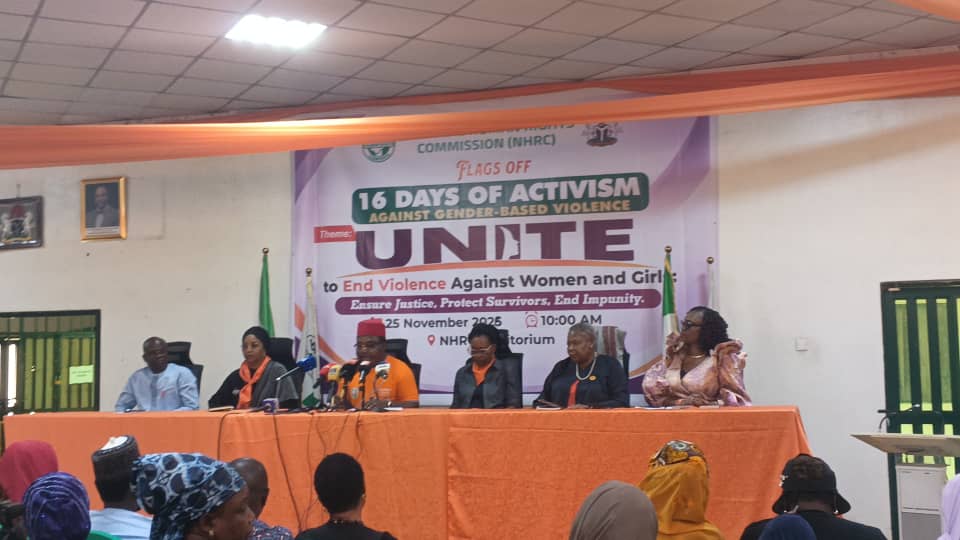
The National Human Rights Commission (NHRC) has called for stronger justice systems, survivor-centred protection and institutional accountability to address gender-based violence and end impunity against women and girls in Nigeria.
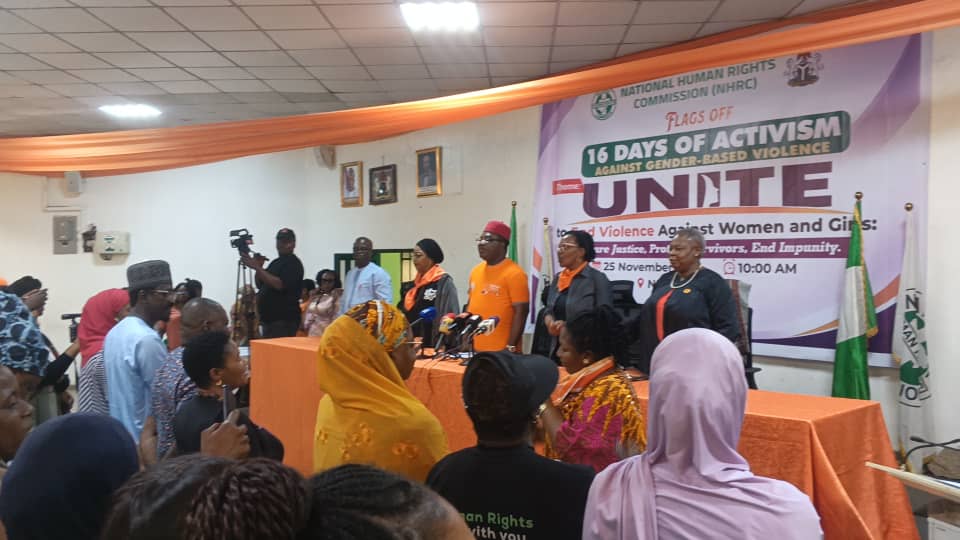
The Executive Secretary of the National Human Rights Commission (NHRC), Dr Tony Ojukwu, made the call in Abuja during the flag-off of the 2026 16 Days of Activism Against Gender-Based Violence, themed “UNITE to End Violence Against Women and Girls: Ensure Justice, Protect Survivors, End Impunity.”
Ojukwu said ending gender-based violence required more than public awareness campaigns, stressing the need for effective access to justice, responsive institutions and accountability for perpetrators.
READ ALSO: NGO’s Team Up To Deepen Push Against Gender-Based Violence – Voice of Nigeria
“This calls for more than public declarations. It demands effective access to justice, survivor-centred protection, responsive institutions and accountability for perpetrators,” he said.
The NHRC chief described violence against women and girls as a fundamental human rights violation rather than merely a social problem, noting that it undermines their dignity, equality and freedom from discrimination and abuse.
He said addressing the challenge required confronting harmful social norms, discriminatory practices and institutional failures that continue to sustain gender-based violence.
According to the Commission’s Monthly Human Rights Situation Dashboard, more than 2.5 million human rights complaints were recorded across its 36 state offices and the Federal Capital Territory between January and October 2026.
The October statistics included 1,873 complaints of domestic violence, 376 cases of forced marriage and 339 cases of trafficking involving women.
The Commission also recorded 2,141 cases of child sexual abuse, 2,093 cases of child forced marriage, 2,581 cases of denial of children’s access to education and 1,681 cases of child trafficking.
Ojukwu said the figures reinforced the urgency of strengthening prevention, protection, access to justice and accountability for violations against women and children.
Highlighting the Commission’s response, he disclosed that the NHRC had documented 180 cases of sexual and gender-based violence among displaced persons between May and June 2026, drawing attention to protection challenges affecting vulnerable populations.
He also identified several direct interventions, including securing the release of 12 detained youths in Benue State, preventing the forced marriage of a 14-year-old girl in Adamawa State and rescuing children from hawking and child labour in Cross River and Adamawa states.
Other interventions included providing temporary shelter for domestic violence survivors, reuniting separated families and facilitating the prosecution of individuals accused of sexually abusing children in Jos and Kaduna.
Ojukwu said the Commission had also reached more than 56,000 people through human rights education and gender-based violence prevention campaigns.
On institutional reforms, he said the NHRC had reviewed its Standing Orders and Rules of Procedure in partnership with International IDEA under a European Union-supported programme to improve complaint handling and strengthen access to remedies for survivors.
He added that the Commission had developed and adopted child safeguarding and workplace sexual harassment policies in collaboration with relevant stakeholders.
The NHRC had also inaugurated a Child and Youth Ombuds Desk, with support from the European Union and in collaboration with SOS Children’s Villages Nigeria, to provide children with a child-friendly platform to report violations and seek redress.
As part of efforts to strengthen international cooperation, Ojukwu disclosed that the Commission had signed a Memorandum of Understanding with India’s National Human Rights Commission to promote training, research, capacity building and the exchange of expertise in handling human rights violations.
The 2026 campaign will involve nationwide engagements with traditional rulers, religious leaders, judicial officers, legislators, schools, health facilities, civil society organisations and the media across the 36 states and the FCT.
The engagements will focus on challenging harmful cultural practices, strengthening investigation and prosecution of gender-based violence cases and improving access to medical care and other essential support services for survivors.
Looking ahead to 2027, the Commission plans to intensify data collection and monitoring, expand state-level interventions, strengthen survivor-centred services, protect displaced populations and promote accountability.
Ojukwu called on families, government institutions, traditional and religious leaders, schools, law enforcement agencies, the judiciary and civil society to work collectively towards ending violence against women and girls.
“We must challenge harmful practices, reject victim-blaming, educate our boys, empower our girls and create an environment where survivors can report violations without fear, stigma or discrimination,” he said.
He formally flagged off the 2026 nationwide activities of the 16 Days of Activism Against Gender-Based Violence, reaffirming the Commission’s commitment to ensuring justice, protecting survivors and ending impunity.
Speaking at the event, the Executive Director of BAOBAB for Women’s Human Rights, Mrs Yeye Dipo Salami addressed the need to strengthen efforts towards protecting women’s rights and ending gender-based violence.
“At all levels we must remember that this 16-day activity is not a one day, one month activity but a continuous process. We have many protective measures, but they are not enough. We have to hold our government to account,” she said.

