


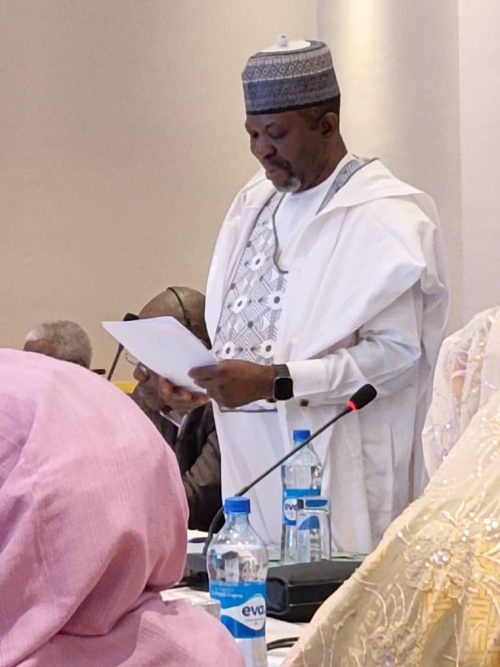
The National Boundary Commission (NBC) has reaffirmed Nigeria’s commitment to the peaceful resolution of outstanding boundary issues with the Republic of Benin.
The Commission emphasised the need to combine boundary demarcation with effective cross-border cooperation to enhance security and promote development in border communities.
The Director-General of the Commission, Surveyor Adamu Adaji, stated this while delivering his welcome address at the opening ceremony of the meeting of the Joint Standing Committee on the Nigeria–Benin International Boundary, held in Lagos from October 28 to 30, 2026.
In a statement issued by the Commission’s Head of Information, Press and Public Relations, Chinwe Udouwem, Adaji described the meeting as “an important step towards strengthening friendship, cooperation and peaceful coexistence between the two countries.”
He noted that Nigeria and Benin share approximately 770 kilometres of land boundary, traversing six Nigerian states, with communities on both sides maintaining longstanding social, cultural and economic relationships.
“The management and resolution of boundary issues must be guided by applicable legal instruments, available evidence and technical procedures, while also taking into account the legitimate interests of border communities,” Adaji stressed.
He called for adequate sensitisation and engagement of affected communities as the demarcation process progresses.
The Director-General recalled that the current meeting builds on deliberations at previous meetings held in Abuja in 2022 and Cotonou in 2024.
He also highlighted recommendations from the meeting of the Joint Technical Team held in Kétou, Republic of Benin, from June 2 to 8, 2026, following field completion exercises conducted by both countries along the Illo–Borgu axis.
While acknowledging the importance of completing boundary demarcation, Adaji emphasised that effective border governance requires sustained cooperation among institutions and communities living along the boundary.
He particularly called for the effective implementation of the Memorandum of Understanding (MoU) on Local Cross-Border Cooperation, following undertakings signed by chairmen of border local government areas in Nigeria and their counterparts in communes of the Republic of Benin.
According to him, “translating the agreement into practical action through regular consultations, joint action plans and community-based initiatives would strengthen border security, promote cultural integration, facilitate legitimate cross-border trade and enhance socio-economic development.”
The Director-General also expressed appreciation to the Government of the Republic of Benin for its continued commitment to bilateral boundary mechanisms.
He acknowledged the support of the German Government, through the German Agency for International Cooperation (GIZ), in promoting peaceful boundary management and cross-border cooperation.
He reaffirmed the National Boundary Commission’s commitment to working closely with its Beninese counterpart to resolve outstanding issues and advance the demarcation process.
Adaji urged both delegations to engage constructively and agree on practical, time-bound measures that would benefit the two countries and their border communities.
In his remarks, the Director-General of Benin’s Agency for Integrated Management of Border Spaces and head of the Beninese delegation, Adam Youssoufou, expressed appreciation to the Government and people of Nigeria for their hospitality.
He also commended the German Agency for International Cooperation (GIZ) for its support towards resolving boundary issues and facilitating cross-border cooperation between the two countries.
Youssoufou noted that “the lack of clear boundary demarcation had posed challenges to security, economic development and cooperation along international boundaries.”
He urged both delegations to work together to ensure the completion of the demarcation process, expressing confidence that participants would achieve positive outcomes and emerge with a clear understanding, renewed commitment and a shared sense of purpose.
Also speaking, the Minister of State for Foreign Affairs, Ambassador Sola Enikanolaiye, represented by the Acting Director of the West Africa Division, Ministry of Foreign Affairs, Mrs Temidayo Balogun, said “the objective was not merely to delineate a geographical line but to consolidate a peaceful, predictable and mutually beneficial relationship between the two neighbouring countries.”
“Our success should not be measured only by progress in the technical definition of the boundary but also by the confidence it inspires, the cooperation it facilitates and the benefits it delivers to our respective people,” she said.
The meeting of the Joint Standing Committee provides a platform for both countries to review outstanding boundary matters, consider technical recommendations and strengthen bilateral cooperation towards the peaceful and effective management of their shared international boundary.

 has reaffirmed Nigeria’s commitment to the peacefull..................................................)